
Quick Answer
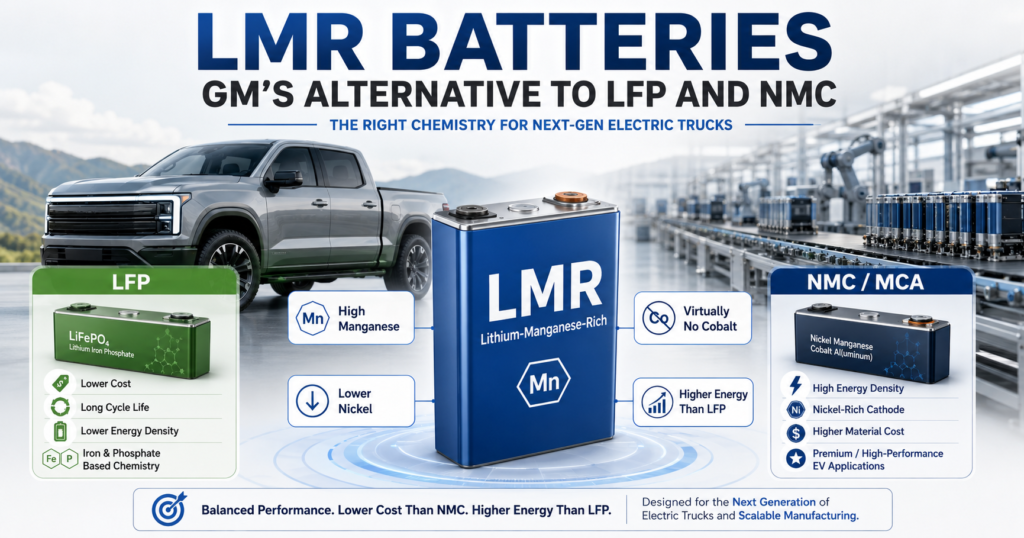
LMR batteries, short for lithium-manganese-rich batteries, are emerging as a possible middle ground between low-cost LFP and high-energy NMC batteries. LMR batteries are a developing type of lithium-ion battery that uses far more manganese and much less nickel and cobalt than the high-nickel batteries commonly found in long-range electric vehicles. The goal is ambitious: combine much of the energy density associated with nickel-based batteries with a material cost closer to lithium iron phosphate, or LFP.
General Motors and LG Energy Solution plan to commercialize large prismatic LMR cells for future electric trucks and full-size SUVs. Pre-production is expected to begin at an LG Energy Solution facility by late 2027, followed by commercial production in the United States through Ultium Cells in 2028.
GM says its LMR cells are being engineered to deliver approximately 33% higher energy density than leading LFP cells at a comparable cost. The company also believes the chemistry could support electric trucks with more than 400 miles of range while reducing pack costs compared with today’s high-nickel batteries.
That does not mean LMR is ready to replace LFP or NMC everywhere. LMR cathodes have historically suffered from voltage decay, energy-efficiency losses, difficult first-cycle behavior, and limited cycle life. GM and LG Energy Solution say they have made substantial progress, but large-scale manufacturing and years of real-world vehicle data will ultimately determine whether LMR fulfills its promise.
Why LMR Batteries Are Suddenly Important
For much of the past decade, the EV battery market has appeared to be moving toward two main chemistry families. LFP batteries have become the practical choice for affordable EVs, standard-range models, commercial vehicles, and energy-storage systems. They avoid nickel and cobalt, offer strong thermal stability, and can deliver excellent cycle life. Their main drawback is lower energy density, which can make long-range battery packs larger and heavier.
Nickel-based batteries such as NMC and GM’s NMCA chemistry sit at the other end of the market. They provide more energy in a smaller and lighter package, making them useful for premium EVs, performance models, large SUVs, and long-range electric trucks. Their disadvantages include higher material costs and greater dependence on nickel and cobalt.
LMR is interesting because it does not fit neatly into either category. It is not simply a cheaper version of NMC, nor is it a higher-energy version of LFP. It represents a different attempt to balance range, cost, material availability, and pack design. The renewed attention began when GM and LG Energy Solution announced plans to commercialize LMR prismatic cells for future GM electric trucks and full-size SUVs. GM has since described LMR as a central part of its multi-chemistry battery strategy rather than a laboratory experiment.
For buyers, the potential benefit is straightforward. A manganese-rich battery could make a long-range electric truck less expensive without requiring the enormous, heavy LFP pack that would otherwise be needed to deliver the same range.
What Are LMR Batteries?
LMR usually stands for lithium-manganese-rich, although technical papers may use terms such as lithium-rich manganese-based oxide, manganese-rich layered oxide, or LMR-NMC. Like LFP and NMC, LMR is still a lithium-ion battery. The main difference lies in the cathode, the positive electrode that stores and releases lithium during charging and driving.
A conventional NMC cathode contains nickel, manganese, and cobalt in varying proportions. Modern high-nickel versions increase the nickel content to improve energy density while reducing cobalt. GM’s existing long-range electric trucks and SUVs use NMCA, which adds aluminum to a nickel-manganese-cobalt formulation.
An LMR cathode shifts the composition much more heavily toward manganese. GM has described the approximate active-material composition of its developing LMR cathode as roughly:
- 65% manganese
- 35% nickel
- Virtually no cobalt
By comparison, GM describes a typical high-nickel cathode as roughly 85% nickel, 10% manganese, and 5% cobalt. These percentages should be understood as GM’s simplified comparison of its intended chemistry rather than a universal formula for every LMR material.
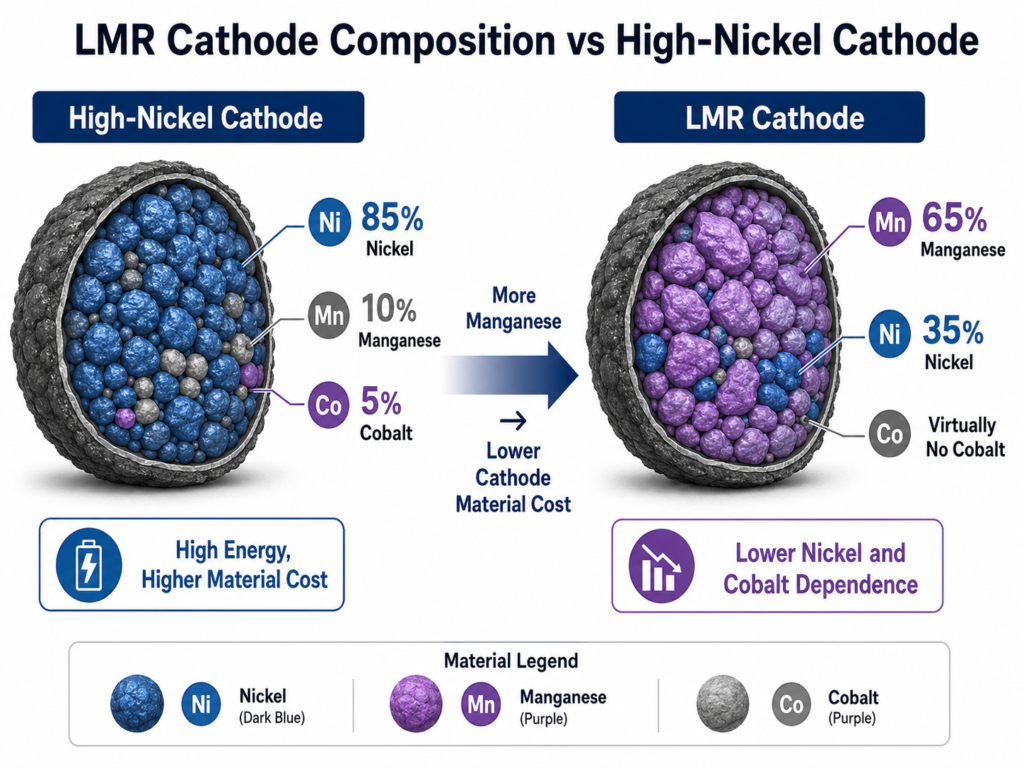
The high manganese content is important because manganese is generally more abundant and less expensive than battery-grade nickel or cobalt. Reducing cobalt can also lessen exposure to one of the battery industry’s most expensive and supply-sensitive cathode materials.
However, the word “manganese-rich” does not fully explain why LMR can store so much energy. Its high theoretical capacity comes partly from the unusual electrochemical behavior of lithium-rich layered oxide materials.
Why LMR Can Store More Energy
In a conventional layered cathode, most charge storage comes from changes in the oxidation state of transition metals such as nickel and cobalt. As lithium ions leave and return to the cathode, those metals participate in reactions that balance the electrical charge. LMR materials can use those familiar transition-metal reactions, but they can also obtain additional capacity through oxygen-related, or anionic, redox activity within the cathode structure.
That extra reaction pathway is one reason lithium-rich manganese-based cathodes can deliver very high specific capacity. Recent technical reviews describe them as promising high-energy cathodes but also emphasize that their complex redox behavior is closely tied to their most persistent weaknesses, including oxygen loss, voltage decay, hysteresis, slow kinetics, and structural instability.
A useful way to think about it is that LMR tries to extract more usable energy from the cathode material than a conventional formulation. The benefit is higher capacity. The cost is a more difficult material to stabilize. This is why LMR has spent decades in research laboratories without appearing in a mass-market EV. The chemistry’s potential was never the main question. The challenge was making that performance last for thousands of vehicle cycles under changing temperatures, charging rates, and states of charge.
Why the High Manganese Content Matters
Battery discussions often focus on energy density, but cathode chemistry also shapes cost, sourcing, and manufacturing risk. Nickel is valuable because it helps raise energy density. Yet high-purity battery-grade nickel is expensive to produce, and nickel-rich cathodes can be demanding to manufacture and manage. Cobalt improves structural stability and performance in many layered cathodes, but it is costly and associated with concentrated supply chains.
Manganese offers a different economic profile. It is widely used in steelmaking, has a broader resource base, and generally costs less than nickel or cobalt. That does not mean battery-grade manganese is unlimited or immune to supply constraints. Purification, regional processing capacity, and demand growth still matter. Even so, replacing a large share of nickel and nearly all cobalt with manganese can reduce cathode material cost. This is the basic economic idea behind LMR.
GM is not trying to make the cheapest possible cell at any cost. It is trying to reduce material expense without giving up the energy density needed by a large truck or SUV. That distinction is important. In a small urban EV, LFP’s lower energy density may be acceptable because the vehicle does not need an extremely large battery. In a full-size pickup expected to tow, carry cargo, and travel hundreds of highway miles, every additional kilogram and liter of battery volume becomes more consequential.
LMR vs. LFP vs. NMC
No battery chemistry is best in every category. The right choice depends on the vehicle, expected range, climate, performance target, charging behavior, warranty requirement, and price point.
| Characteristic | LMR | LFP | High-Nickel NMC/NMCA |
|---|---|---|---|
| Primary cathode emphasis | High manganese, some nickel, little or no cobalt | Iron and phosphate | High nickel with manganese and cobalt |
| Energy density | Potentially higher than LFP and competitive with nickel-based cells | Generally lower | Generally high |
| Material cost | Targeted near LFP levels | Usually low | Usually higher |
| Cycle life | Historically challenging; commercial performance not yet proven | Usually excellent | Good when carefully managed |
| Thermal stability | Expected to benefit from lower nickel, but not equivalent to LFP by default | Strong | Requires careful thermal management |
| Cold-weather potential | Not yet established in production EVs | Often weaker in cold conditions | Generally stronger |
| Commercial maturity | Pre-production and validation stage | Widely commercialized | Widely commercialized |
| Best potential use | Long-range vehicles needing lower cost | Affordable and standard-range EVs | Premium, performance, and long-range EVs |
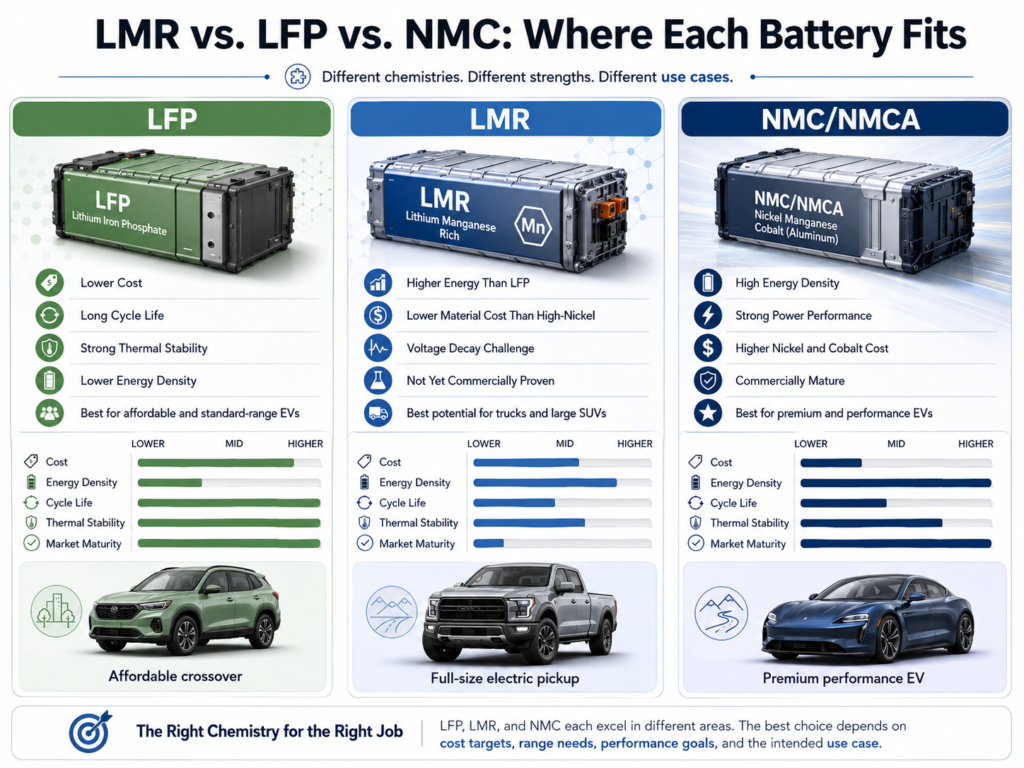
The comparison contains an important asymmetry: LFP and NMC are mature commercial technologies with years of field data. GM’s LMR cell is still being prepared for production. GM estimates that its new LMR cells can provide 33% higher energy density than the best-performing LFP cells at a comparable cost. That could be a major advantage, but it is a manufacturer projection, not yet an independently verified fleet result. Readers looking for a more detailed comparison of today’s established chemistries can also see our guide to LFP vs. NMC batteries.
Why LMR Is Not Simply “Better LFP”
It is tempting to describe LMR as an LFP replacement because both chemistries aim to reduce battery cost. That comparison is incomplete. LFP’s appeal comes from more than inexpensive raw materials. Its olivine phosphate structure is exceptionally stable, which contributes to good thermal behavior and long cycle life. LFP cells can tolerate repeated cycling well, making them attractive for vehicles that accumulate substantial mileage.
LMR may offer much higher energy density, but it does not automatically inherit LFP’s durability or thermal characteristics. An LMR battery still contains nickel. It operates through a different layered-oxide structure and may rely on relatively high upper voltages to access its full capacity. Its degradation mechanisms are therefore different from those of LFP.
For a standard-range crossover, LFP may remain the more sensible choice. A manufacturer can accept the additional pack weight in exchange for proven durability, simpler material sourcing, and mature production. For a 400-mile electric pickup, the calculation changes. Achieving that range with LFP could require a very large pack. The extra cells add mass, cost, cooling hardware, structural material, and manufacturing complexity. In that vehicle class, LMR’s higher energy density may outweigh LFP’s cycle-life advantage.
Why LMR Is Not Simply Low-Nickel NMC
LMR also should not be viewed as a conventional NMC battery with a little more manganese. Lithium-rich manganese-based layered oxides can involve different structural domains and additional oxygen redox activity. That helps create high capacity, but it also changes how the cathode evolves during cycling.
In a high-nickel NMC or NMCA cathode, engineers already understand many of the dominant degradation mechanisms, even though controlling them remains difficult. These include particle cracking, electrolyte oxidation, transition-metal dissolution, surface reconstruction, gas generation, and loss of active lithium.
LMR introduces additional concerns around oxygen activity, irreversible structural changes, voltage hysteresis, and a gradual decline in average operating voltage. This makes LMR a distinct chemistry platform requiring its own materials, electrolyte, formation, BMS, and manufacturing strategy.
The Biggest LMR Problem: Voltage Decay
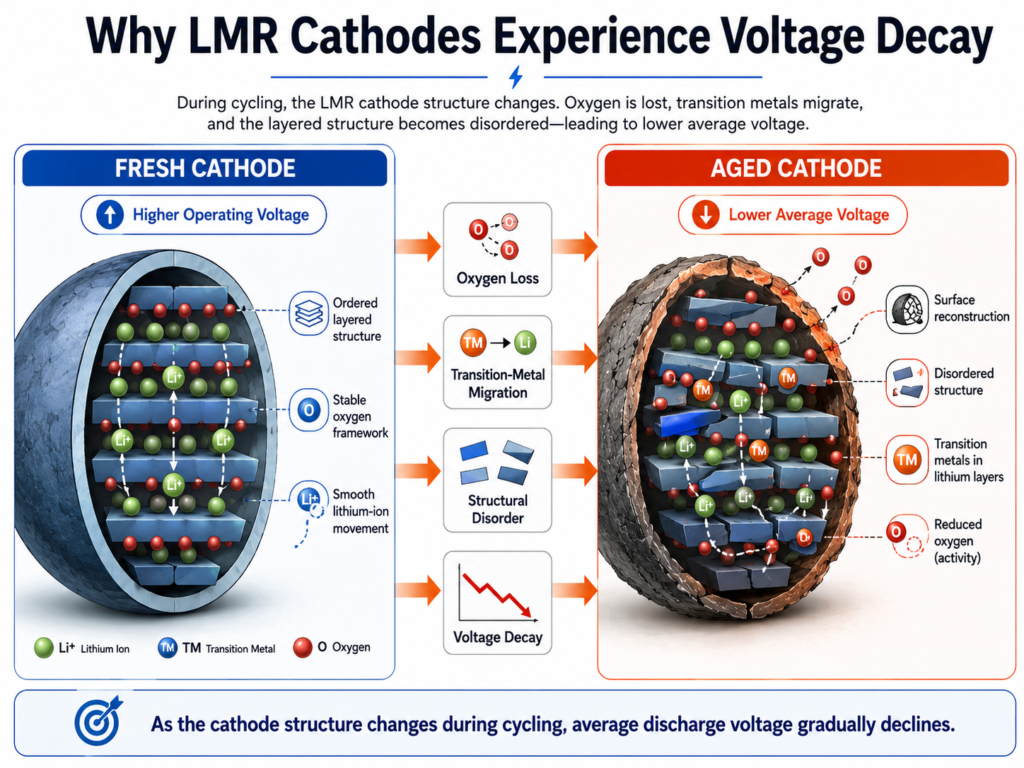
A battery can retain much of its amp-hour capacity while still delivering less energy than it did when new. That is what makes voltage decay especially troublesome. Battery energy depends on both capacity and voltage. In simplified form:
Energy = Capacity × Average Voltage
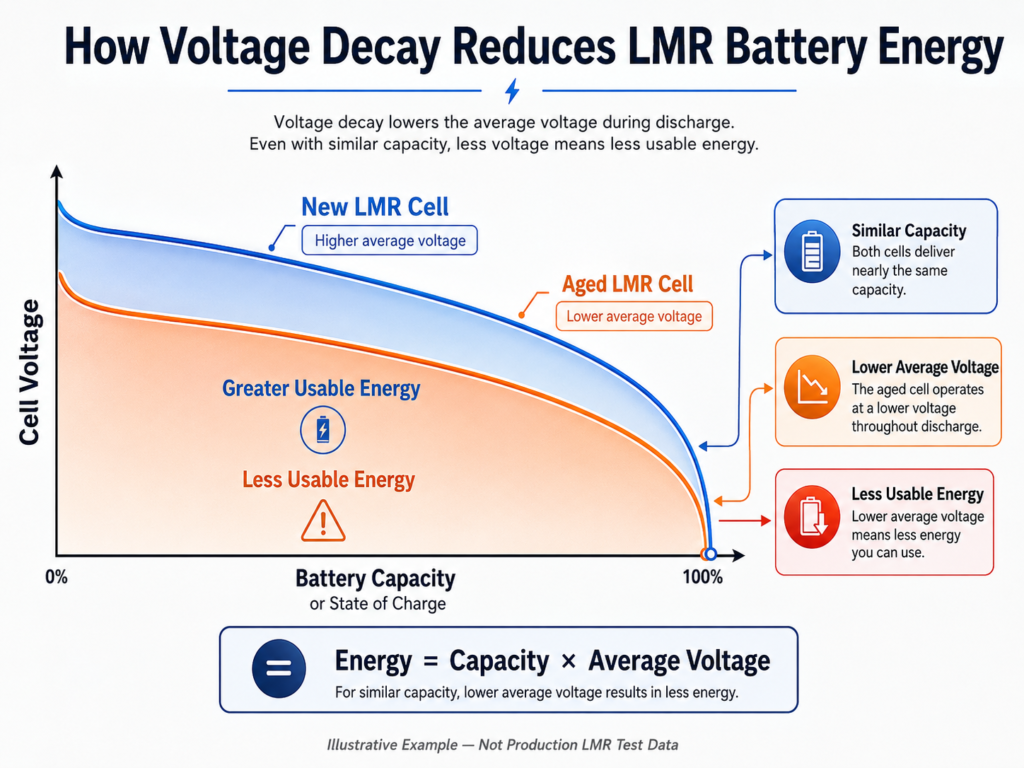
Suppose a cell can still move nearly the same quantity of lithium after hundreds of cycles. If its average discharge voltage has declined, each cycle delivers less energy. The vehicle may lose usable range or power even when a conventional capacity test does not initially look disastrous.
In lithium-rich manganese cathodes, repeated cycling can cause transition metals to move within the crystal structure. Layered regions may gradually develop more spinel-like or disordered characteristics. Surface reactions, oxygen loss, and local structural rearrangement can change the voltage at which lithium is stored and released.
The result is a discharge curve that gradually shifts downward. Voltage decay can create several vehicle-level problems. The pack may deliver less energy, voltage estimation becomes more difficult, heat generation may increase, and the BMS must account for a changing relationship between state of charge and cell voltage.
This issue has been studied for years. A recent review in Materials Chemistry Frontiers identifies voltage decay, hysteresis, oxygen release, reaction kinetics, and cycle stability as major barriers to commercial adoption. Research available through the U.S. Department of Energy’s OSTI database also shows how fluorination, coatings, and interface engineering are being investigated to suppress LMR degradation.
Voltage Hysteresis and Energy Efficiency
Voltage decay is not the only voltage-related concern. LMR materials can also exhibit pronounced voltage hysteresis. This means the voltage path during charging differs significantly from the voltage path during discharging.
Some hysteresis is normal in batteries, but a large gap represents lost energy. The charger may need to push lithium into the cathode at a relatively high voltage, while the battery returns that energy at a lower voltage during discharge. The difference is released as heat or lost through irreversible processes.
For an EV, poor round-trip efficiency matters because it can reduce real-world range, increase cooling demand, and raise the amount of electricity required to refill the battery. It may also become more noticeable under high-power operation. A successful commercial LMR cell therefore needs more than high laboratory capacity. It must retain a useful voltage profile and deliver acceptable efficiency across the vehicle’s operating life.
Cycle Life and First-Cycle Loss
Lithium-rich cathodes often require an initial activation process at high voltage. During early charging, part of the cathode structure undergoes irreversible changes. Oxygen may be released or rearranged, and some lithium inventory can be permanently lost. This can create low first-cycle efficiency. In practical terms, more lithium leaves the cathode during the initial charge than returns during the first discharge.
Automakers and cell manufacturers can compensate for some of this loss through electrode balancing, material treatment, electrolyte design, and formation procedures. However, those solutions add complexity and must work consistently at industrial scale.
Long-term cycle life is equally important. An electric truck may experience fewer full equivalent cycles per mile than a short-range EV because its battery is so large. Even so, it must survive years of calendar aging, fast charging, towing, high temperatures, winter operation, and sustained highway loads.
GM says its current LMR design can match the life of its present high-nickel cells. The company attributes this progress to proprietary dopants, surface coatings, particle engineering, material optimization, and process improvements. That is encouraging, but detailed independent cycling data for GM’s final production cell are not yet public. Until production vehicles accumulate meaningful mileage, cycle-life claims should be treated as development targets rather than settled facts.
How GM and LG Energy Solution Say They Addressed the Problems
GM began researching manganese-rich lithium-ion cells in 2015 and accelerated the program in 2020. According to GM’s LMR technology overview, the company had coated approximately one ton of LMR cathode material by the end of 2024.
GM also reported testing hundreds of large-format prismatic cells across 18 prototype versions and three cell dimensions. Collectively, the testing was described as equivalent to about 1.4 million miles of EV driving. Those numbers show that the program has moved well beyond coin cells and small laboratory samples. Large-format cells introduce problems that may not appear at a smaller scale, including temperature gradients, current-density variation, mechanical pressure, electrode uniformity, electrolyte wetting, and gas management.
LG Energy Solution contributes manufacturing experience and a substantial intellectual-property portfolio. The company reported holding more than 200 LMR-related patent applications across major global patent offices as of the end of 2024. The companies say their approach includes:
- Cathode dopants that help stabilize the material structure
- Protective surface coatings
- Particle-level engineering
- Electrolyte and additive optimization
- Improved cell assembly and production processes
- Large-format prismatic cell design
No single technique is likely to solve every LMR weakness. Commercial success will depend on how well these measures work together over thousands of cells produced at high speed.
Why GM Is Using Prismatic Cells
Chemistry receives most of the attention, but cell format is another major part of GM’s strategy. GM’s first Ultium-generation battery packs largely used large pouch cells. Its future LMR cells will use a rectangular prismatic format.
Prismatic cells are enclosed in rigid metal housings and can be arranged efficiently inside a battery pack. Large cells can reduce the number of electrical connections, monitoring channels, cooling interfaces, fasteners, and structural components required for a given pack capacity.
GM says its prismatic architecture can reduce battery module components by 75% and total pack components by 50% compared with its existing design. These reductions are not solely benefits of LMR chemistry. They come from the combined chemistry, cell size, and pack architecture. Still, LMR may be well suited to large cells, and the resulting simplification could lower manufacturing cost beyond the savings from cathode materials alone.
Large cells also create engineering tradeoffs. Temperature, pressure, and current must remain sufficiently uniform across a bigger electrode area. A defect in one large cell can affect more pack capacity than a defect in a small cell. Manufacturing consistency will therefore be critical. Our article on EV battery formation cycling explains why cell chemistry alone does not determine quality. Formation time, electrolyte wetting, screening, pressure control, and manufacturing consistency can strongly influence durability.
GM and LG Energy Solution’s Commercialization Timeline
The current public plan is divided into several stages.
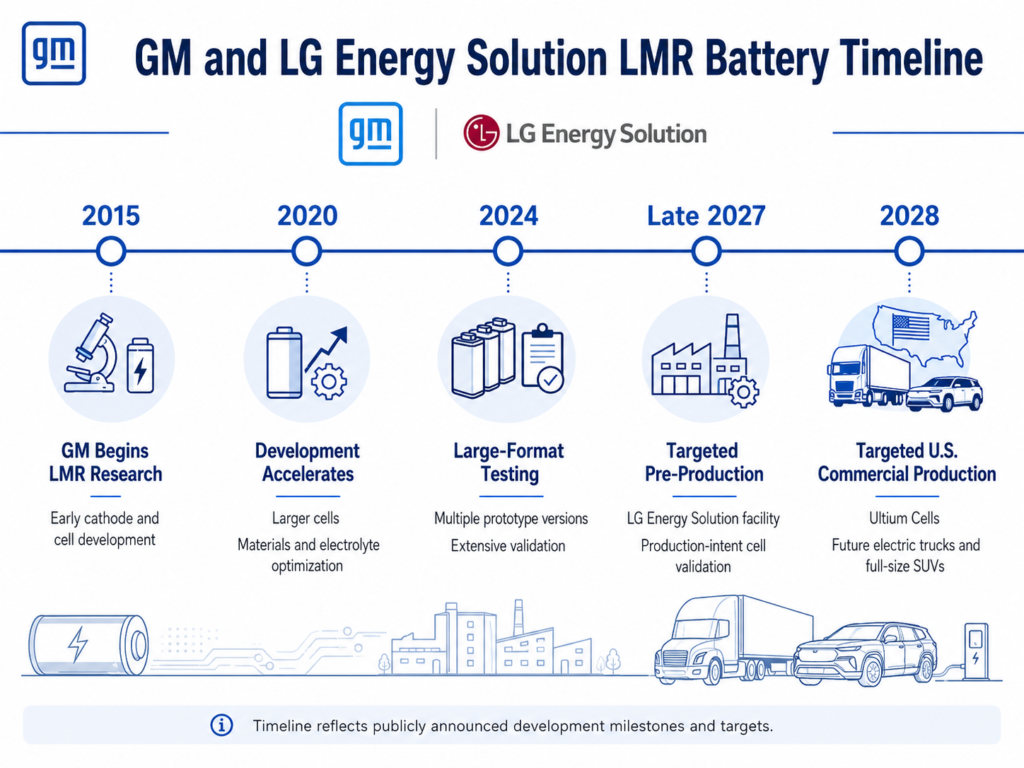
LG Energy Solution expects to begin pre-production of LMR cells at one of its facilities by late 2027. GM’s Battery Cell Development Center in Warren, Michigan, is expected to help validate the final production design. Ultium Cells, the GM–LG Energy Solution joint venture, then plans to begin commercial production of LMR prismatic cells in the United States in 2028.
GM aims to become the first automaker to deploy large-format prismatic LMR batteries in production EVs. The initial targets are future electric trucks and full-size SUVs, where the combination of high energy density and reduced material cost has the clearest value.
This timeline is still forward-looking. Battery programs can change because of validation results, factory readiness, market conditions, material sourcing, or vehicle-development schedules. As of June 2026, GM has not announced a customer-delivered LMR vehicle or released final production specifications for a particular model.
Why GM May Value LMR More Than LFP for Some Vehicles
GM is not abandoning LFP. In fact, the company is adding LFP to its portfolio for vehicles and applications where cost matters more than maximum energy density. The more accurate interpretation is that GM sees LFP and LMR as complementary. LFP may be the best fit for entry-level EVs, lower-range trims, commercial fleets, and stationary storage. LMR may be better suited to vehicles that need both long range and a lower battery cost than today’s high-nickel packs can provide.
This distinction becomes especially important in electric pickups. Large trucks have poor aerodynamic efficiency compared with sedans. They are heavy, have large frontal areas, and may be used for towing. Range can fall significantly when pulling a trailer, so manufacturers often install very large battery packs to preserve useful travel distance.
Replacing a high-nickel truck battery with LFP may reduce cathode cost, but the vehicle could need substantially more cell mass and volume to recover the lost energy density. That can create a loop in which a heavier battery requires more structure, more cooling, and more energy to move.
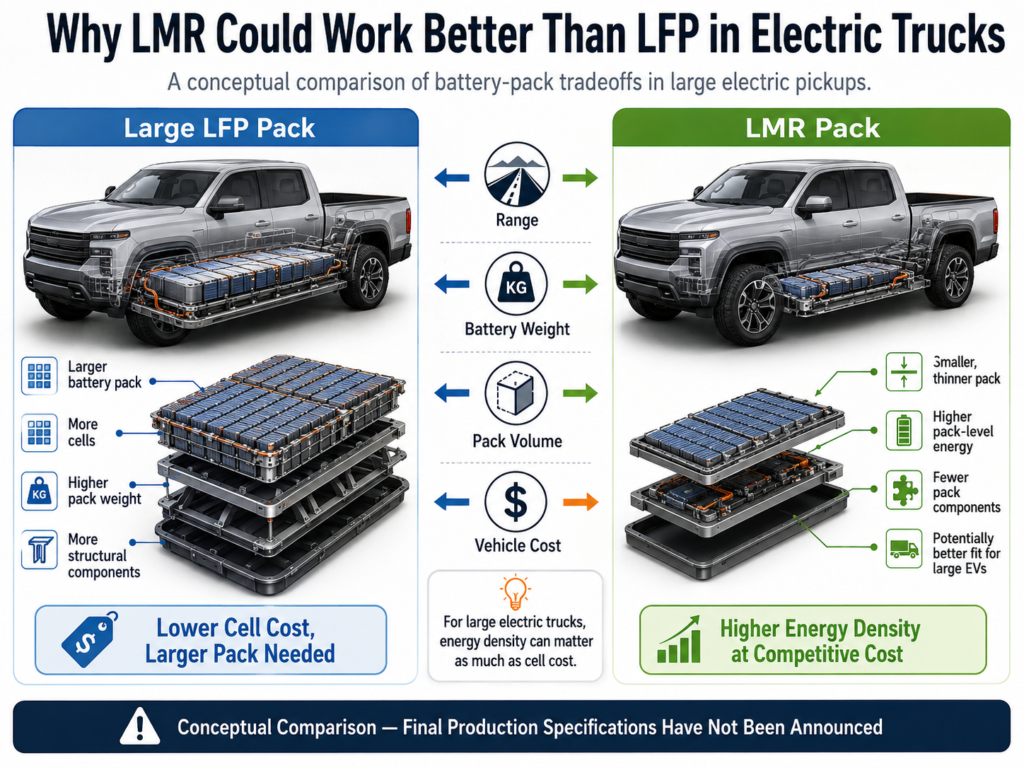
LMR offers GM a possible middle path. The company says LMR could enable more than 400 miles of range in an electric truck while providing significant pack-cost savings compared with its current high-nickel design. That makes LMR strategically important in trucks and large SUVs even if LFP remains preferable elsewhere.
Could LMR Batteries Replace LFP?
Not completely. LFP is already produced at enormous scale and continues to improve. Cell-to-pack designs, better electrode loading, advanced pack integration, and improved low-temperature controls are reducing many of its traditional disadvantages.
LFP’s thermal stability and cycle life will remain valuable in vehicles where extreme range is unnecessary. It is also particularly attractive for stationary storage, where weight and volume are less important than cost, durability, and safety.
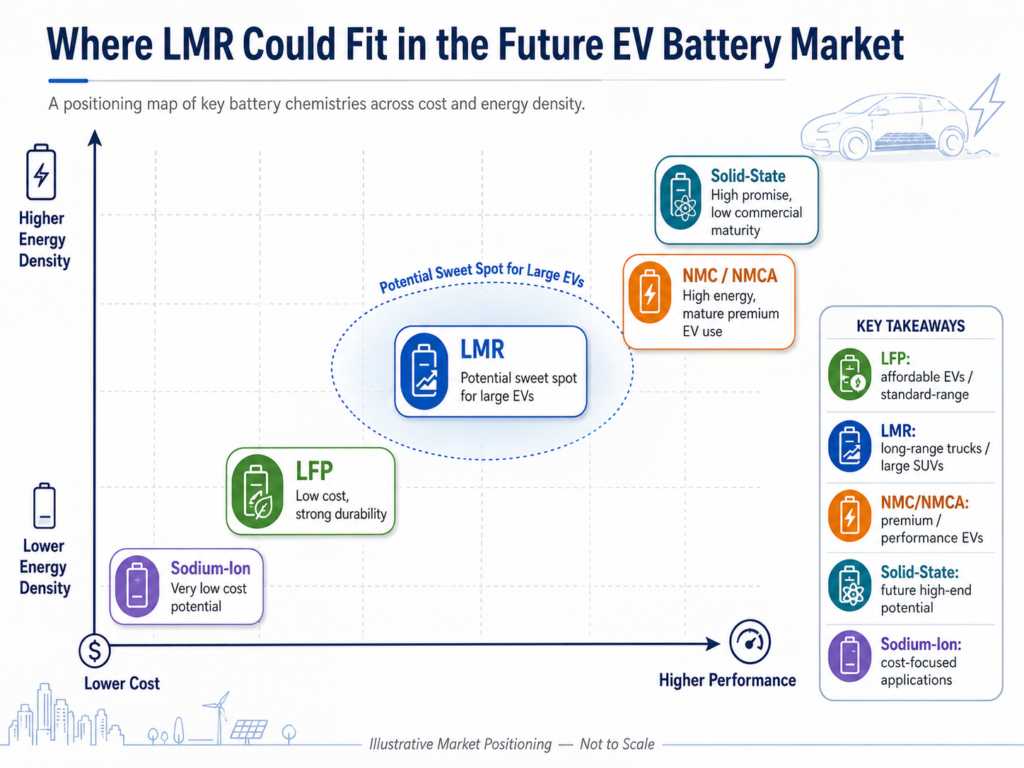
LMR could take some applications that might otherwise have required a very large LFP pack. However, it is unlikely to eliminate LFP from affordable EVs or energy storage. The market is more likely to divide by use case than converge on one universal chemistry.
Could LMR Replace NMC or NMCA?
LMR may pose a more direct challenge to high-nickel chemistries in certain long-range vehicles. If GM’s production cells deliver comparable useful energy, durability, charging performance, and power at a lower cost, the economic case for high-nickel NMCA could weaken in trucks and large SUVs. Even then, high-nickel cells may retain advantages in applications where the highest possible specific energy, power capability, cold-weather behavior, or proven performance is worth the added cost.
LMR’s early commercial role may therefore be substitution rather than total replacement. It could reduce GM’s dependence on high-nickel cells in vehicles where slightly different performance characteristics are acceptable in exchange for lower cost.
What We Still Do Not Know
The public announcements answer the broad strategic questions, but many engineering details remain unavailable. GM has not publicly released the final cell-level gravimetric and volumetric energy densities, full charge and discharge curves, cycle-life test conditions, fast-charging limits, cold-temperature performance, round-trip efficiency, or long-term voltage-retention data for the production-intent cell.
We also do not know how aggressively GM will use the cell’s upper voltage range. Restricting the usable voltage window could improve life but reduce accessible energy. The BMS may also reserve larger hidden buffers during early production years until durability is proven.
Thermal behavior needs careful evaluation as well. Lower nickel content may improve some safety characteristics relative to a high-nickel cathode, but LMR should not automatically be assumed to match LFP’s thermal stability. Cell design, electrolyte, separator, cooling, pack structure, and BMS protection will remain essential.
Finally, laboratory-equivalent mileage is not the same as years of customer use. Real vehicles experience irregular charging, long parking periods, vibration, manufacturing variation, extreme weather, towing, fast charging, and occasional operation near the limits of the battery. These are not reasons to dismiss LMR. They are reasons to separate promising engineering progress from completed commercialization.
What LMR Could Mean for EV Buyers
Most buyers will never choose a vehicle because its cathode contains a particular percentage of manganese. They will notice the results instead. A successful LMR battery could help deliver a long-range electric truck at a lower price. It might reduce pack weight compared with an equally capable LFP battery and reduce exposure to nickel and cobalt costs compared with a high-nickel pack.
It could also give automakers more flexibility. Rather than installing the same chemistry in every vehicle, they could choose LFP for affordable models, LMR for high-capacity trucks and SUVs, and high-nickel cells for applications with specialized performance requirements. The real test will be whether those benefits remain after accounting for degradation, charging speed, cold weather, warranties, manufacturing yield, and pack-level safety.
Battery buyers should also remember that chemistry is only one part of durability. Thermal management, cell consistency, charging calibration, pressure management, and the BMS can matter just as much. Our guide to EV battery degradation and range loss explains why a battery’s long-term behavior cannot be predicted from the cathode label alone.
Conclusion: LMR Is a Bridge Between Low Cost and Long Range
LMR is one of the most important near-term battery technologies to watch because it addresses a gap that neither LFP nor high-nickel NMC solves perfectly. LFP offers low cost, strong thermal stability, and long cycle life, but its lower energy density can be difficult to accommodate in large, long-range vehicles. High-nickel batteries provide the required energy density but carry higher material costs and greater dependence on nickel and cobalt.
LMR attempts to occupy the space between them. Its manganese-rich cathode could reduce raw-material cost while preserving enough energy density for electric trucks and full-size SUVs. GM and LG Energy Solution believe their prismatic LMR cells can provide 33% more energy density than leading LFP cells at a comparable cost, with commercial production targeted for 2028.
The chemistry still carries meaningful risk. Voltage decay, hysteresis, first-cycle loss, structural change, and cycle life have prevented earlier LMR materials from becoming practical EV batteries. GM says it has overcome these barriers through coatings, dopants, particle engineering, electrolyte development, and large-cell process improvements, but production and field data will determine how complete those solutions really are.
LMR probably will not replace both LFP and NMC across the entire EV market. A more realistic outcome is that it becomes a third major option: LFP for cost and durability, high-nickel cells for maximum performance, and LMR for vehicles that need premium range without a premium battery price.
For GM, that middle ground could be especially valuable. Electric trucks do not merely need inexpensive batteries. They need inexpensive batteries that can still carry enough energy to make a large, heavy vehicle useful. That is the problem LMR is designed to solve.
FAQs
What does LMR stand for in batteries?
LMR stands for lithium-manganese-rich. It usually refers to lithium-ion cathode materials that contain a high proportion of manganese and additional lithium within a layered oxide structure.
Is LMR the same as LMFP?
No. LMFP stands for lithium manganese iron phosphate. It is related to LFP and uses a phosphate structure. LMR generally refers to lithium-rich, manganese-rich layered oxide cathodes. The two technologies have different structures, voltage characteristics, advantages, and degradation mechanisms.
Does an LMR battery contain cobalt?
The exact formula depends on the manufacturer. GM says its intended LMR cathode uses roughly 65% manganese, 35% nickel, and virtually no cobalt.
Is LMR safer than NMC?
Its lower nickel and cobalt content may offer some advantages, but there is not enough production-vehicle data to declare LMR categorically safer than NMC. Safety depends on the complete cell and pack design, including electrolyte, separator, cooling, mechanical protection, and BMS controls.
Does LMR have better cycle life than LFP?
There is currently no evidence that production LMR cells will exceed LFP’s cycle life. LFP remains known for excellent cycling durability. GM says its LMR design can match the life of its current high-nickel cells, not necessarily the best LFP cells.
When will GM use LMR batteries?
LG Energy Solution expects pre-production by late 2027. Ultium Cells plans to begin U.S. commercial production in 2028. GM intends to use the cells first in future electric trucks and full-size SUVs.
Will LMR replace LFP in GM vehicles?
Probably not. GM is developing a multi-chemistry strategy. LFP is expected to serve cost-sensitive vehicles and other applications, while LMR is intended for larger vehicles that require greater energy density.
Why is voltage decay a problem?
Voltage decay lowers the average discharge voltage as the cathode ages. Even when the cell retains much of its charge capacity, it may deliver less total energy because energy depends on both capacity and voltage.
Is LMR already used in production EVs?
Not in the large-format prismatic form announced by GM and LG Energy Solution. As of June 2026, their production program remains under development, with commercial manufacturing targeted for 2028.