
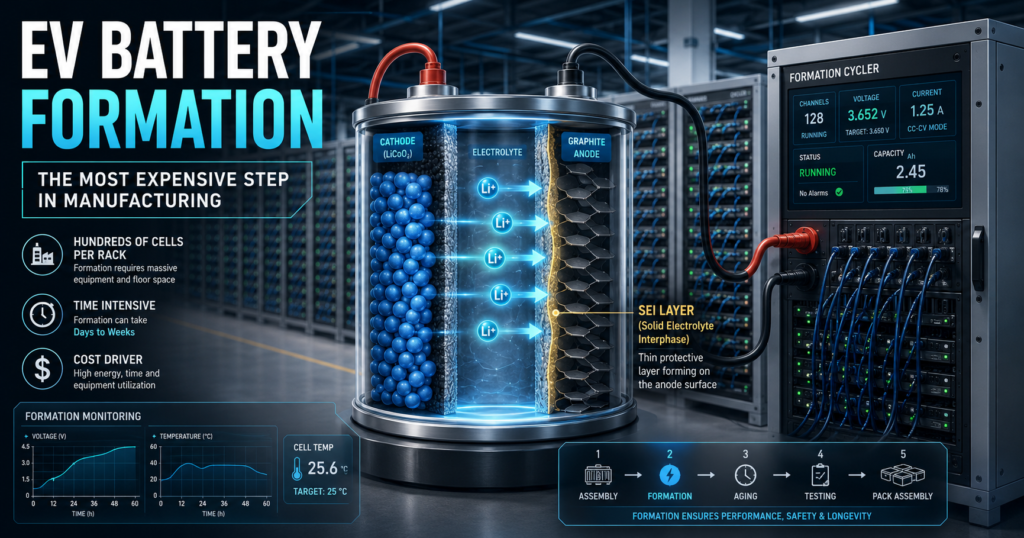
Quick Answer
EV battery formation cycling is the carefully controlled first charging and discharging process performed after a lithium-ion cell has been assembled and filled with electrolyte. During this stage, the electrolyte reacts with the anode and creates a thin protective layer known as the solid electrolyte interphase, or SEI. A well-formed SEI allows lithium ions to move through it while limiting continued electrolyte decomposition. Its quality can influence capacity, internal resistance, fast-charging performance, gas generation, safety, and long-term battery life.
Formation is also one of the slowest and most capital-intensive stages of battery manufacturing. Thousands of newly assembled cells may spend days connected to precision cyclers, resting in temperature-controlled rooms, and undergoing quality checks before they can be installed in an EV battery pack. In other words, an EV battery begins aging before it ever reaches the vehicle—but this carefully managed initial aging is necessary to make the cell stable enough for years of use.
Introduction
When people imagine an EV battery factory, they usually picture coating machines, robotic assembly lines, welding equipment, and rows of finished battery cells moving quickly through a gigafactory. One of the most important production stages, however, does not look particularly dramatic.
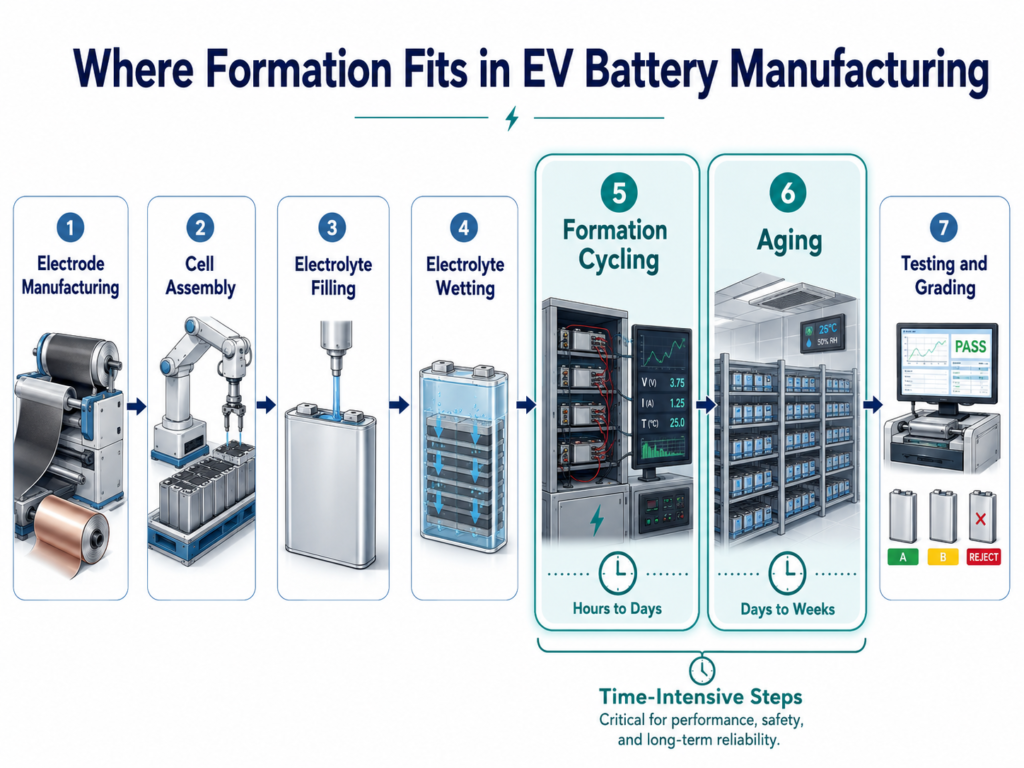
After a lithium-ion cell has been assembled, sealed, and filled with electrolyte, it cannot simply be shipped to an automaker. The cell must first be charged under carefully controlled conditions. It may then be discharged, allowed to rest, measured, charged again, and stored for an additional aging period. This process is known as battery formation. Formation creates the electrochemical interfaces that allow the battery to operate normally. It also exposes cells with abnormal leakage, excessive self-discharge, internal shorts, unusual gas generation, or manufacturing defects.
The challenge is that formation takes time. A coating line can continuously process long rolls of electrode material, and automated equipment can assemble cells at high speed. Formation equipment, by contrast, must hold and monitor large numbers of individual cells for hours or days. That combination of long processing time, precision electrical equipment, energy use, floor space, thermal control, and cell inventory makes formation one of the most expensive bottlenecks in lithium-ion battery manufacturing. Research supported by the U.S. Department of Energy has described conventional formation as a process that can take several days and require a large number of battery-cycling channels (OSTI1, OSTI2).
Understanding formation helps explain an important fact about EV batteries: battery quality depends on much more than the cathode chemistry printed on a specification sheet.
What Is EV Battery Formation Cycling?
A freshly assembled lithium-ion cell contains the main components needed to store energy:
- A cathode
- An anode
- A separator
- Liquid electrolyte
- Current collectors
- Electrical terminals
- A sealed enclosure
Yet the cell is not electrochemically mature. During assembly, electrolyte is injected into the cell and must spread throughout the porous electrodes and separator. This is called electrolyte wetting. Manufacturers may use vacuum filling, pressure changes, controlled temperature, and extended soak periods to help the electrolyte reach areas that would otherwise remain dry.
Once adequate wetting has occurred, the cell is connected to formation equipment and charged for the first time. Lithium ions leave the cathode and travel through the electrolyte toward the anode. In a conventional graphite-anode cell, the ions begin entering the layered graphite structure. At the same time, some electrolyte molecules react at the anode surface.
Those side reactions consume a small amount of lithium and electrolyte, but they also create the protective SEI layer that the cell needs. Formation is therefore not simply a factory test. It is a controlled electrochemical manufacturing process that completes the cell internally.
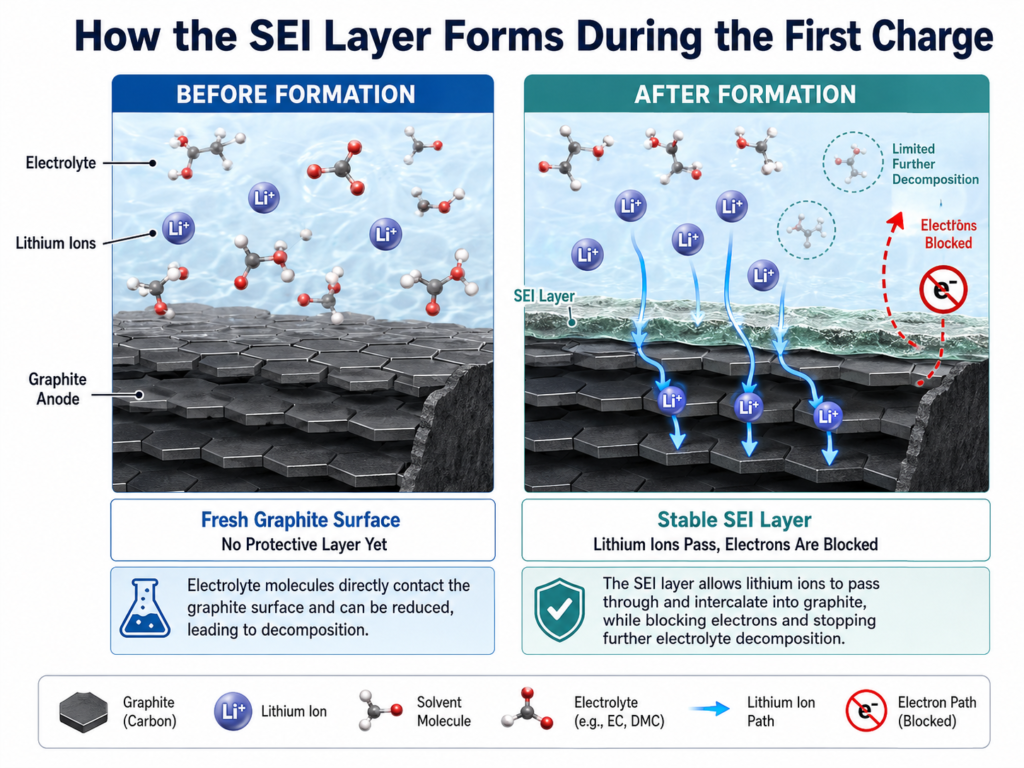
The SEI: A Protective Layer Created by Electrolyte Decomposition
The solid electrolyte interphase is a thin layer of reaction products formed mainly on the anode surface. The name sounds complicated, but its function can be understood as a selective protective coating. The liquid electrolyte must remain stable enough to carry lithium ions between the electrodes. However, conventional carbonate electrolytes are not completely stable at the low voltage of a charged graphite anode. During the first charge, part of the electrolyte decomposes. The resulting compounds accumulate on the graphite particles and form the SEI.
A useful SEI must perform two jobs that initially appear contradictory. It must be electronically insulating so that electrons cannot continuously reach and decompose the electrolyte. At the same time, it must remain sufficiently permeable to lithium ions. When the layer works properly, lithium ions can continue moving in and out of the graphite while most ongoing electrolyte reduction is suppressed.
The SEI is not a perfectly uniform sheet. It can contain a complex mixture of inorganic and organic compounds, including lithium fluoride, lithium carbonate, and electrolyte-derived polymeric species. Its composition depends on the electrolyte, additives, electrode material, temperature, pressure, charge current, and voltage trajectory used during formation.
Researchers continue to investigate exactly how these components nucleate, grow, crack, heal, and change during battery operation. Direct observations and spectroscopy studies show that SEI formation occurs through multiple reactions rather than a single uniform event (Nature1, Nature2).
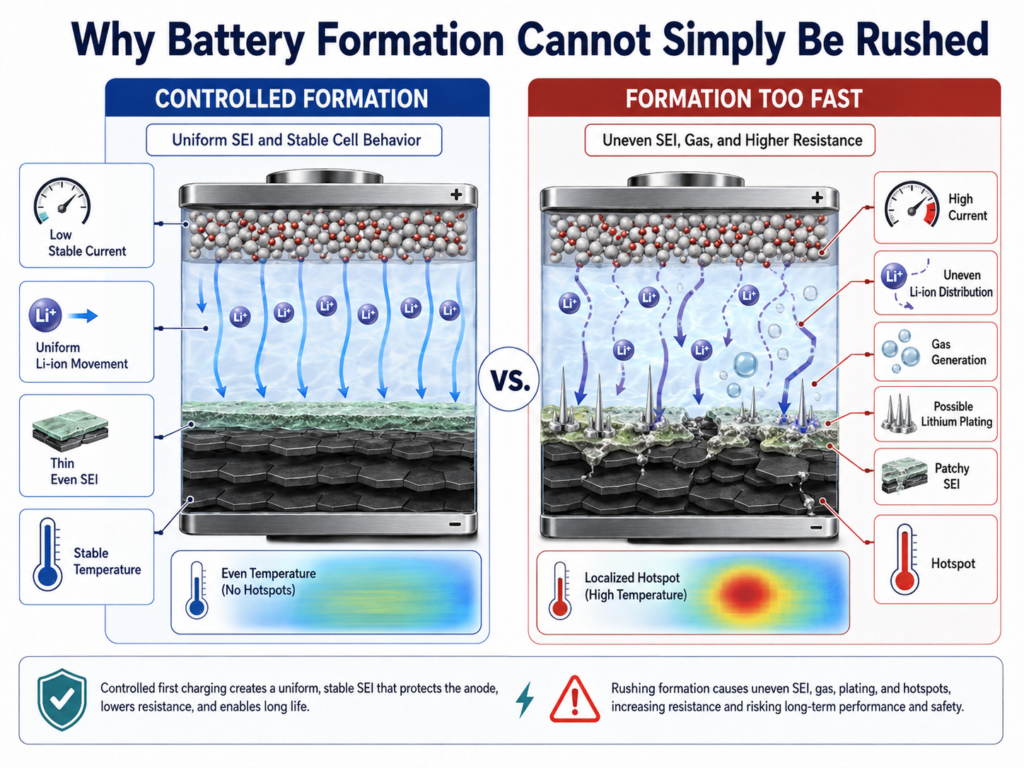
Why the First Charge Must Be Slow and Controlled
It might seem logical to form a cell as quickly as possible. Faster charging would reduce factory time and allow manufacturers to produce more cells with the same equipment. Unfortunately, the SEI formed under aggressive conditions may not provide the desired combination of uniformity, resistance, flexibility, and chemical stability.
A high initial current can create uneven reaction rates across the electrode. Differences in local temperature, porosity, electrolyte concentration, particle contact, and current distribution can cause some regions to form more quickly than others.
A poorly controlled first charge may contribute to:
- Uneven SEI coverage
- Excessive lithium consumption
- Increased gas generation
- Higher internal resistance
- Local lithium plating
- Reduced capacity
- Accelerated future degradation
The first charge is particularly sensitive because the anode initially has little protection from electrolyte decomposition. Once an effective SEI has formed, it limits many of the reactions that were possible on the fresh electrode surface.
The exact protocol is proprietary and varies among manufacturers. A simplified formation sequence may include a low-current initial charge, voltage holds, rest periods, one or more discharge cycles, and additional charges at different currents.
Temperature is tightly controlled because it affects reaction speed, ion transport, wetting, and SEI composition. Mechanical pressure may also be controlled for pouch and prismatic cells because cell expansion and electrode contact change during the first cycles. Formation is not simply about charging to 100 percent. The path taken to reach the target voltage can be just as important as the final state of charge.
Some Lithium Is Permanently Lost During Formation
During the first charge, not every lithium ion leaving the cathode returns during the following discharge. Some lithium becomes trapped in SEI compounds or otherwise becomes unavailable for normal cycling. This is known as irreversible lithium loss.
The difference between charge capacity and discharge capacity during the first cycle is often described through first-cycle coulombic efficiency. A cell with lower first-cycle efficiency has consumed a larger fraction of its lithium inventory in side reactions. This does not mean all SEI formation is harmful. The battery needs the protective layer. The engineering objective is to form an SEI that provides adequate passivation without consuming more active lithium than necessary.
Too little reaction can leave the electrode insufficiently protected. Too much reaction reduces usable capacity and may create a thick, resistive layer. This tradeoff becomes increasingly important for cells containing silicon in the anode. Silicon changes volume substantially as lithium enters and leaves the material. Repeated expansion can damage the interphase, expose fresh surface, and trigger additional electrolyte decomposition.
Our related article, Silicon-Anode Batteries: 2026 EV Range Upgrade?, explains why silicon offers greater energy-storage potential but makes interface stability and mechanical control more difficult.
Formation and Aging Are Closely Connected
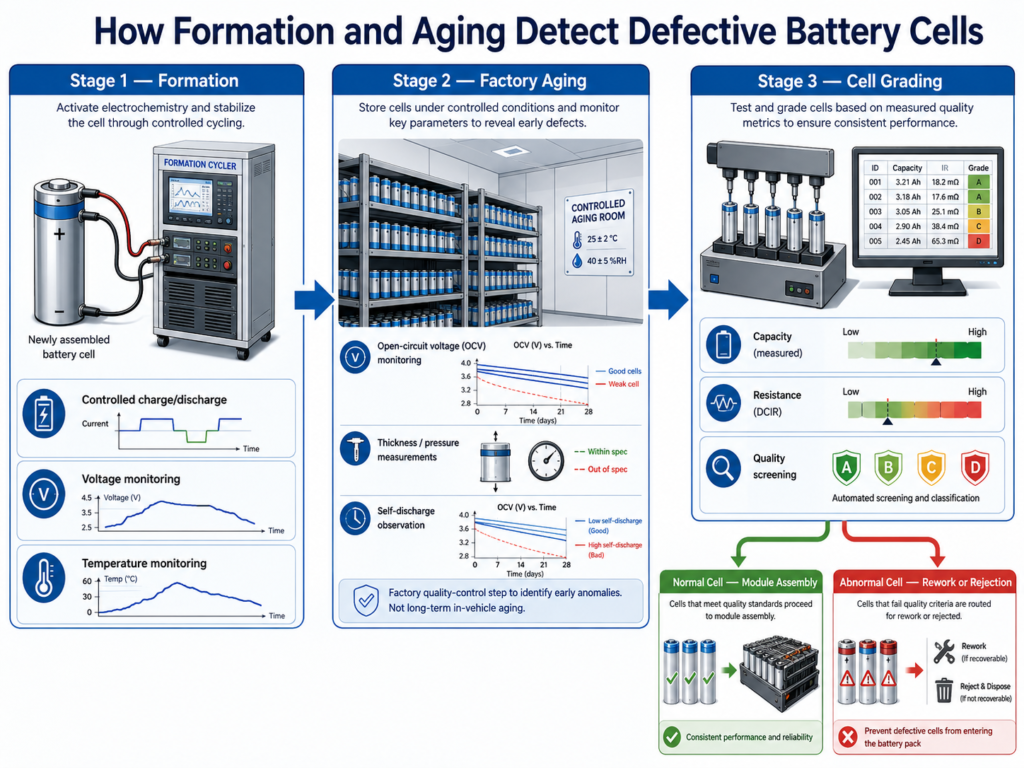
In battery manufacturing, the word aging does not always mean years of normal battery deterioration. After formation, manufacturers often store cells under controlled conditions for a defined period. During this manufacturing-aging stage, the cell voltage, open-circuit behavior, self-discharge rate, thickness, pressure, temperature, or gas generation may be monitored. The purpose is partly stabilization and partly quality control.
A cell with a microscopic internal short may lose voltage more quickly than a healthy cell. Contamination, separator damage, metal particles, poor sealing, electrolyte leakage, or abnormal side reactions may also produce measurable changes during the aging period. Without adequate observation time, a defective cell might appear normal immediately after assembly and fail only after it has been incorporated into a module or pack. Detecting that problem at the cell factory is far less expensive than finding it after vehicle production.
This is one of the reasons formation and aging cannot be eliminated simply because they slow the line. They help manufacturers separate healthy cells from cells that could create capacity imbalance, warranty problems, or safety risks later.
Why EV Battery Formation Cycling Is So Expensive
Formation does not necessarily consume the most raw material, but it creates an unusual manufacturing problem: every cell needs electrical attention for an extended period. A high-volume plant may produce hundreds of thousands of cells per day. Each cell must be connected to a channel capable of accurately controlling current and voltage while measuring its response.
That requires large formation racks, power electronics, wiring, fixtures, temperature management, safety systems, data acquisition, and factory space. The equipment must also handle charging energy and the energy returned when cells are discharged. Some modern systems recover discharge energy and reuse it elsewhere in the facility rather than wasting it as heat. Even with energy recovery, the infrastructure remains substantial.
The larger cost may come from time and inventory. While cells are undergoing wetting, formation, resting, and aging, they occupy space without generating revenue. A factory must maintain enough work-in-process inventory to keep downstream module and pack assembly running. If the formation period is shortened from several days to one day without harming quality, the manufacturer may need fewer cyclers, less floor space, and less inventory. However, an overly aggressive shortcut can reduce yield or battery life, eliminating any apparent savings.
Argonne National Laboratory’s BatPaC battery manufacturing cost model includes process-level manufacturing costs and is widely used to study how cell design, factory scale, yield, and manufacturing assumptions affect battery economics (OSTI).
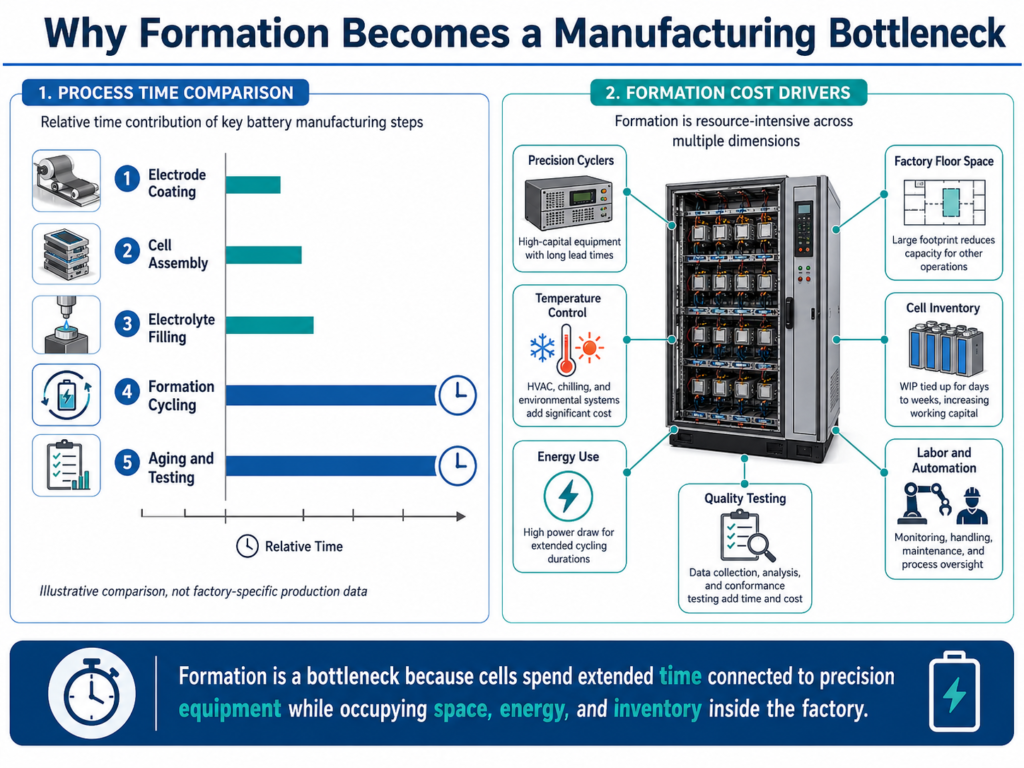
In practice, formation cost is driven by several connected factors:
Equipment utilization: A formation channel cannot process another cell until the existing protocol is complete.
Factory footprint: Cells may occupy formation racks and aging rooms for extended periods.
Energy and cooling: Charging, discharging, thermal control, and power conversion all consume energy.
Labor and automation: Cells must be loaded, connected, tracked, measured, and removed.
Yield loss: A cell rejected after formation already contains nearly all of its expensive materials and manufacturing value.
Capital tied up in inventory: Large numbers of completed but unfinished cells remain inside the factory.
This is why formation optimization is so financially valuable. Saving even a few hours per cell can produce large improvements when multiplied across gigawatt-hours of annual production.
Formation Is Also a Quality-Control Opportunity
The electrical data collected during formation contains information about what happened during every earlier manufacturing step. A coating defect may change local resistance. Poor electrolyte wetting may affect voltage response. Excess moisture can alter side reactions and gas production. Electrode misalignment, particle contamination, welding defects, or separator damage can create abnormal signatures.
Manufacturers can examine measurements such as:
- Charge and discharge capacity
- Coulombic efficiency
- Voltage relaxation
- Internal resistance
- Cell temperature
- Incremental capacity behavior
- Self-discharge
- Physical expansion
These measurements help classify cells and identify outliers.
More recently, researchers have been exploring whether formation data can predict long-term battery life without waiting months or years for conventional aging tests. A 2025 study developed interpretable features from formation data to estimate cycle life, illustrating how manufacturing measurements may eventually support faster process development and quality screening (OSTI, arXiv).
This does not mean one short test can perfectly predict every cell’s future. Battery life depends on temperature, charging behavior, state of charge, mechanical conditions, and many other factors. Still, formation data offers a valuable early view of cell consistency.
For readers interested in how battery condition is evaluated later in vehicle life, see EV Battery SOH Explained: How State of Health Is Actually Measured.
The Difference Between Formation Aging and EV Battery Degradation
Formation intentionally creates a small amount of irreversible change. Normal EV battery degradation continues gradually afterward. During vehicle use, the SEI can continue growing, especially at high temperature and high state of charge. Continued growth consumes active lithium and increases resistance. Cracking of electrode particles can expose new surfaces, leading to further reaction. This is why the same SEI that protects a new cell can also contribute to long-term capacity loss when it becomes excessively thick or repeatedly damaged.
The distinction is important:
Formation builds the initial protective interface.
Calendar aging and cycle aging continue changing that interface over time.
A properly formed cell is not immune to degradation, but it begins life with a more stable electrochemical foundation. A poorly formed cell may have lower initial capacity, greater cell-to-cell variation, higher impedance, or faster aging.
Our guide to EV Battery Degradation in Hot Weather discusses how elevated temperature accelerates SEI growth and other side reactions after the vehicle enters service.
Can Formation Be Made Faster?
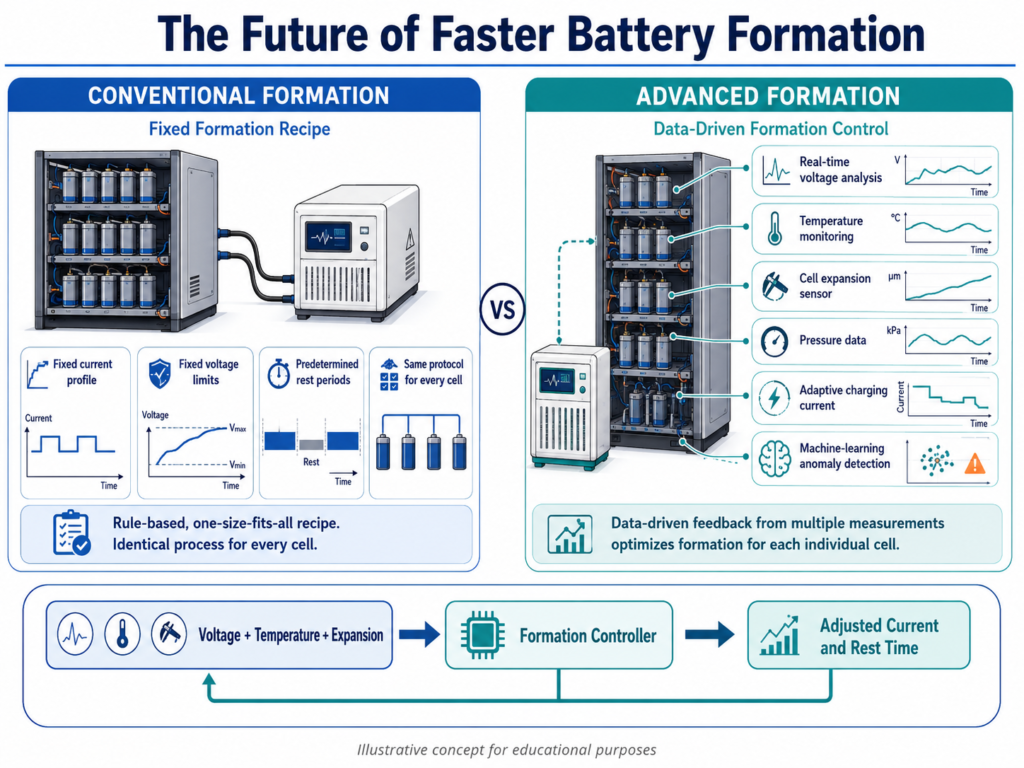
Battery manufacturers and researchers are working aggressively to shorten formation without sacrificing quality. One approach is to optimize current, voltage, temperature, and rest periods using better electrochemical models. Rather than following a conservative fixed recipe, manufacturers may eventually adjust formation based on real-time cell measurements.
Researchers are also studying cell expansion as an indirect signal of electrochemical activity. Graphite changes thickness as lithium enters it, while gas generation and SEI growth can produce additional dimensional changes. When expansion data is combined with voltage and current measurements, it may provide insight into what is occurring inside the sealed cell.
A June 2026 preprint from researchers associated with the University of Michigan described a control-oriented model that estimates SEI growth using terminal voltage and cell-expansion measurements. The proposed direction is significant: formation could eventually move from an empirically timed process toward closed-loop control of interphase growth. Because this work is a recent preprint, it should be treated as emerging research rather than established mass-production practice.
Other development areas include improved electrolyte additives, faster wetting methods, advanced pressure control, more accurate thermal management, machine-learning-based anomaly detection, and rapid self-discharge screening. The goal is not simply to charge faster. It is to determine the minimum processing time required to create the desired interface and reliably detect defective cells.
Why EV Owners Should Care About a Factory Process
Drivers never select a formation protocol from the vehicle’s touchscreen. Most will never know how their cells were formed. Yet the process can influence characteristics they care about every day:
- How much capacity the battery delivers
- How consistent the cells remain
- How much resistance develops
- How well the battery accepts fast charging
- How quickly it loses capacity
- How much gas or swelling develops
- How reliably it operates over time
Formation also helps explain why two batteries using apparently similar materials may perform differently. Chemistry matters, but so do electrode manufacturing, moisture control, electrolyte filling, pressure, formation, screening, thermal design, and BMS calibration. An EV battery is not defined only by whether it uses LFP or NMC. It is the product of thousands of design and manufacturing decisions.
Conclusion
Formation cycling is one of the least visible steps in EV battery production, but it is also one of the most consequential. During the first controlled charge, electrolyte decomposition creates the solid electrolyte interphase on the anode. This layer consumes some lithium, but it also protects the electrolyte from continuous reaction and allows the cell to operate efficiently.
Formation and manufacturing aging then give producers time to stabilize the cell, measure its behavior, identify abnormal self-discharge, and remove defective units before they reach a vehicle. The process is expensive because it requires precision equipment, energy, factory space, and time. Every hour spent in formation increases work-in-process inventory and limits production throughput. Every hour removed carelessly, however, risks lower quality or shorter battery life.
That is why formation remains such an active area of battery research. The next major reduction in battery manufacturing cost may not come from a new cathode material. It may come from learning how to create and verify the right electrochemical interface in less time.
FAQs
Do all lithium-ion EV batteries require formation?
Yes. The exact process differs by chemistry, cell format, electrolyte, and manufacturer, but newly assembled lithium-ion cells require an initial electrochemical conditioning process before normal use.
Is formation the same as breaking in a new EV battery?
No. Formation occurs at the cell factory before the battery is installed in a vehicle. Owners do not need to reproduce it by repeatedly charging and discharging a new EV.
Does formation reduce battery capacity?
Formation consumes a portion of the initial lithium inventory through irreversible side reactions. However, these reactions create the protective interphase needed for stable operation. The objective is to limit unnecessary lithium loss while producing a durable SEI.
How long does battery formation take?
The total process can range from many hours to several days when wetting, cycling, rest periods, aging, and quality checks are included. Exact protocols are usually proprietary and vary considerably among cell designs.
Can poor formation cause early battery failure?
Poor formation can contribute to excessive resistance, gas production, cell inconsistency, capacity loss, and accelerated degradation. It is only one of many factors, however. Material defects, contamination, mechanical damage, thermal conditions, and pack design also affect battery reliability.