
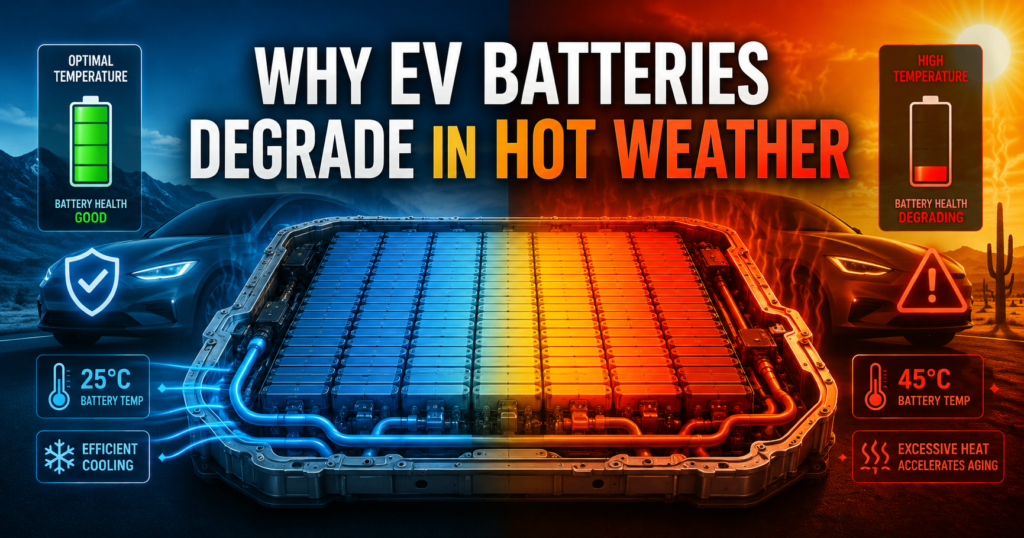
EV battery degradation in hot weather has become one of the biggest concerns for electric vehicle owners, especially in regions with extreme summer temperatures. While many people focus on winter range loss, battery engineers are often more concerned about high temperatures. In reality, prolonged exposure to heat typically causes more permanent battery degradation than cold weather.
Modern lithium-ion batteries are highly sensitive to temperature. When battery cells remain hot for extended periods — especially above 30–35°C (86–95°F) — chemical aging accelerates significantly (Journal of Power Sources, Physical Chemistry Chemical Physics). This is particularly important in regions with extreme summer temperatures such as Arizona, Texas, Nevada, and parts of Southern California.
If you want to better understand how battery chemistry affects durability and thermal stability, check out our comparison of LFP vs NMC batteries.
Table of Contents
- Why EV Battery Degradation in Hot Weather Happens
- What Heat Does Inside an EV Battery
- Fast Charging and Thermal Stress
- Why Some EVs Handle Heat Better Than Others
- New Technologies Designed to Reduce Heat Damage
- How EV Owners Can Reduce Battery Aging
- Final Thoughts
EV Battery Degradation in Hot Weather: Why Heat Is So Damaging
Cold weather mainly reduces short-term performance. Heat, however, directly accelerates irreversible chemical degradation inside the battery.
The Hidden Impact of High Temperatures
Unlike winter-related range reduction, heat damage is often gradual and difficult to notice at first. The vehicle may still operate normally while the battery slowly loses usable capacity over time.
Recent studies suggest that elevated temperatures can significantly increase “calendar aging,” which refers to battery degradation occurring even when the vehicle is parked (Journal of Power Sources). This means an EV sitting fully charged in a hot parking lot may age faster than many drivers realize.
Why Battery Aging Accelerates in Summer
Higher temperatures increase the speed of electrochemical reactions inside lithium-ion cells. Unfortunately, not all of these reactions are beneficial. Many side reactions consume active lithium and increase internal resistance, reducing both battery efficiency and long-term capacity (Physical Chemistry Chemical Physics).
This is one reason why EVs operated in consistently hot climates often experience faster degradation compared to vehicles used in milder regions.
What Happens Inside an EV Battery in Hot Weather
Battery degradation is not caused by a single mechanism. Multiple chemical and thermal processes occur simultaneously inside the cells.
SEI Layer Growth and Lithium Loss
One of the most important mechanisms involves the growth of the Solid Electrolyte Interphase (SEI) layer on the anode surface.
The SEI layer is necessary for battery operation, but excessive heat causes it to grow more rapidly. As the layer thickens, the battery loses usable lithium ions, which directly reduces available capacity (Journal of The Electrochemical Society).
In simple terms, the battery gradually becomes less capable of storing and delivering energy.
Electrolyte Breakdown and Internal Resistance
High temperatures can also accelerate electrolyte decomposition. Over time, this increases internal resistance and generates additional heat during charging and discharging (Physical Chemistry Chemical Physics, Journal of The Electrochemical Society).
This creates a harmful cycle:
- more heat causes more degradation,
- and more degradation generates even more heat.
Nickel-rich chemistries such as NMC batteries are particularly sensitive to this effect because they prioritize high energy density.
Why High State of Charge Makes It Worse
Keeping the battery near 100% charge during hot weather can further accelerate degradation.
At high states of charge, the cathode becomes chemically less stable, especially under elevated temperatures. This is why many automakers recommend limiting daily charging to around 80% unless additional range is needed (Tesla).
Fast Charging and Heat: A Growing Concern
As charging speeds continue to increase, thermal management has become even more critical.
Why DC Fast Charging Generates More Heat
DC fast charging pushes very large currents into the battery pack within a short time. Modern EVs can now charge above 250 kW, which generates substantial thermal stress inside the cells (Journal of Power Sources).
Without proper cooling, rapid charging can create localized hot spots and uneven temperature distribution throughout the battery pack.
Can Frequent Supercharging Damage Batteries?
Modern EVs are much smarter than earlier generations, and occasional fast charging is generally not a major issue. However, repeated fast charging under extreme heat conditions can accelerate long-term degradation (Journal of Power Sources).
Battery management systems now actively monitor:
- cell temperatures,
- coolant flow,
- charging current,
- and thermal gradients across the pack.
Some vehicles even reduce charging power automatically when temperatures become too high in order to protect the battery.
Why Some EVs Handle Heat Better Than Others
Not all EV battery systems are designed equally.
Air Cooling vs Liquid Cooling
Early EVs often relied on passive or air-based cooling systems. While simpler and less expensive, these systems struggled in extremely hot environments.
Liquid-cooled battery systems are far more effective because they can actively regulate cell temperatures under both driving and charging conditions (Advanced Automotive Battery Conference).
Tesla, GM, Hyundai, and Modern Thermal Management
Modern EV platforms from Tesla, General Motors, Hyundai Motor Company, and Kia use sophisticated liquid cooling systems combined with advanced software controls.
Today’s thermal management systems do much more than simply cool the battery. They continuously optimize battery temperature based on:
- charging conditions,
- driving behavior,
- ambient weather,
- and predicted energy demand.
Why Early Nissan Leafs Aged Faster
Early Nissan Leaf models are often discussed as an example of why thermal management matters. Because they did not use the same type of active liquid-cooled battery system found in many newer EVs, battery aging in hot climates became a major concern among owners and industry observers (MOTORWATT)
The industry learned valuable lessons from these early designs, leading to much more advanced thermal management architectures in newer EVs.
New EV Battery Technologies Designed for Hot Climates
Battery technology is evolving rapidly to address thermal challenges.
LFP Batteries and Improved Thermal Stability
LFP (Lithium Iron Phosphate) batteries generally tolerate heat better than many nickel-rich chemistries. Although they have lower energy density, they offer improved thermal stability and longer cycle life (Future Batteries).
This is one reason why many automakers are increasingly adopting LFP batteries for affordable EVs.
Predictive Thermal Management and AI Controls
The industry is now moving beyond simple reactive cooling strategies.
Future EV battery systems are expected to rely more heavily on:
- predictive thermal management,
- model predictive control (MPC),
- AI-based optimization,
- and adaptive charging algorithms (Springer)
Instead of reacting after the battery becomes hot, next-generation systems aim to predict thermal behavior before excessive temperatures occur.
Will Solid-State Batteries Solve the Problem?
Solid-state batteries promise improved thermal stability, reduced fire risk, and potentially lower degradation under extreme temperatures (Reuters)
However, large-scale commercialization remains several years away, and many engineering challenges still need to be solved before mass adoption becomes realistic.
How EV Owners Can Reduce Battery Degradation
While heat exposure cannot always be avoided, drivers can still reduce long-term battery aging by following several practical habits:
- Avoid leaving the battery at 100% charge for extended periods
- Use shaded or indoor parking whenever possible
- Limit unnecessary fast charging during extreme heat
- Enable battery preconditioning when available
- Avoid aggressive driving immediately after repeated fast charging
Small habits can make a surprisingly large difference over many years of ownership.
Final Thoughts
As EV technology continues to evolve, battery longevity will increasingly depend on intelligent thermal management rather than battery size alone.
The next major breakthrough in EVs may not simply come from larger battery packs or faster charging speeds, but from smarter software capable of balancing performance, charging speed, efficiency, and long-term battery health simultaneously.
In many ways, the future of EV batteries is becoming as much a software challenge as a chemistry challenge.
Related:
LFP vs NMC Batteries: Which Chemistry Handles Heat Better?