
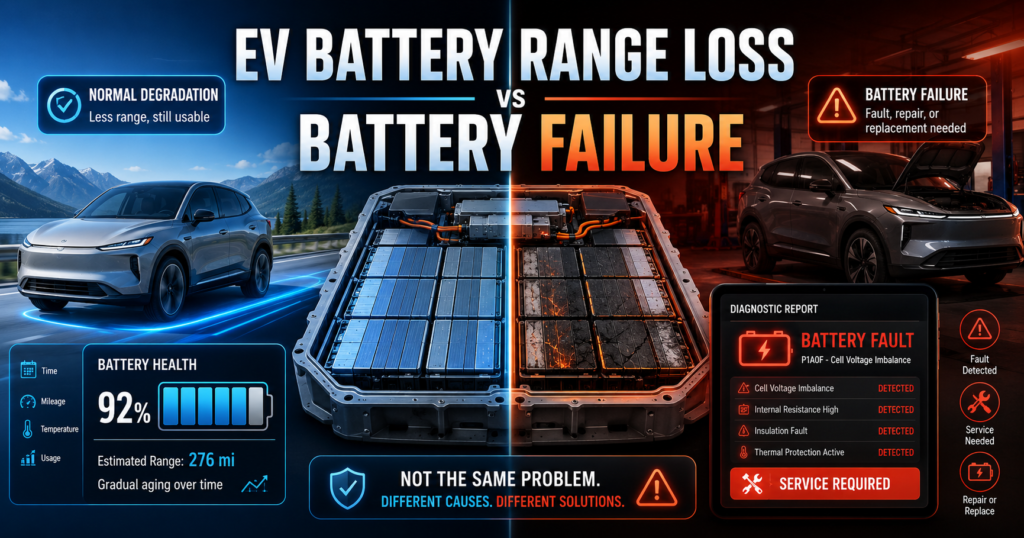
Quick Answer
EV battery degradation is one of the biggest concerns for new electric vehicle buyers, but it is often misunderstood. EV batteries lose range over time because lithium-ion cells gradually store less usable energy and develop higher internal resistance. This process is called battery degradation. It is normal, slow, and usually predictable.
But degradation is not the same thing as battery failure. A degraded battery may still work safely and reliably, just with less driving range than when it was new. True battery failure means the pack can no longer operate normally, has a serious fault, or must be repaired or replaced. In modern EVs, that is much less common than gradual range loss.
Large real-world battery studies continue to show that modern EV batteries are generally durable. Geotab’s 2026 analysis of more than 22,700 EVs found an average degradation rate of 2.3% per year, while also noting that battery aging depends heavily on fast charging habits, climate, vehicle design, chemistry, and usage pattern (Geotab EV Battery Health Study).
Introduction: Range Loss Feels Like Failure, But It Usually Isn’t
EV battery degradation is one of the biggest concerns for new electric vehicle buyers, but it is often misunderstood. Many drivers assume that losing range means the battery is about to die. In reality, gradual range loss and true battery failure are very different problems.
One of the biggest fears new EV buyers have is simple: “What happens when the battery dies?” That question sounds reasonable. Most of us have experienced phone batteries getting worse after a few years. A smartphone that once lasted all day may eventually need charging by lunchtime. So when people hear that an EV also uses lithium-ion batteries, they naturally wonder whether the same thing will happen on a much more expensive scale.
But EV batteries age differently from phone batteries in several important ways. They are larger, actively cooled or heated, protected by sophisticated battery management systems, and usually operated with hidden buffers that prevent the driver from using the most stressful parts of the battery’s full electrochemical range.
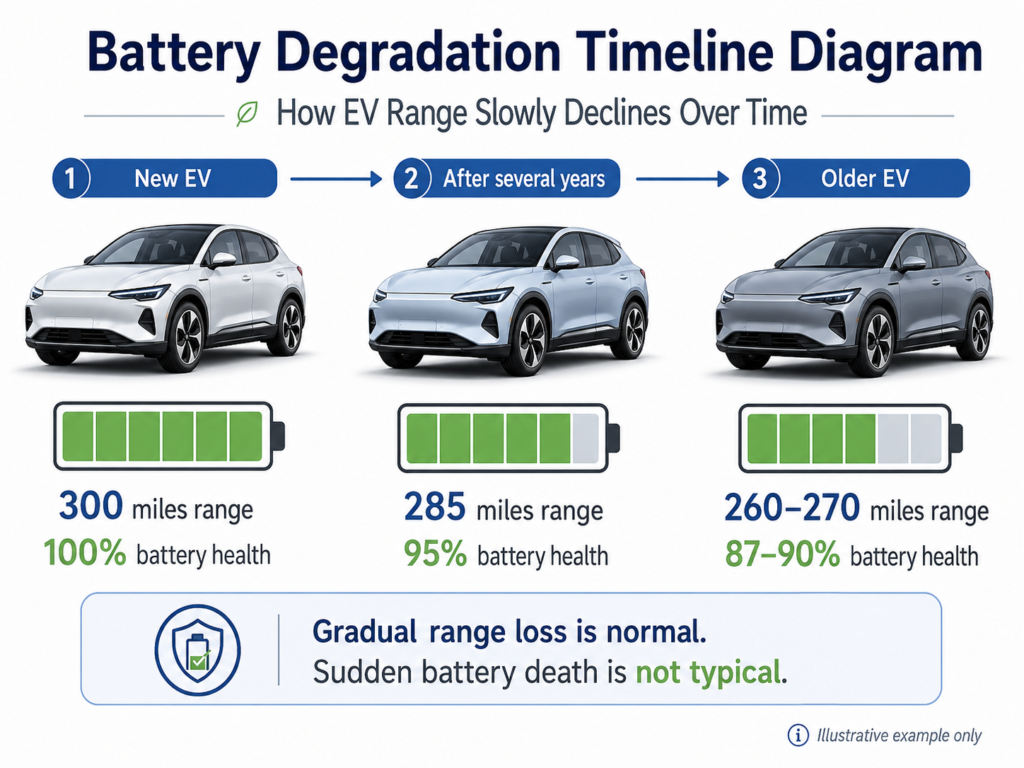
That does not mean EV batteries last forever. They do lose range over time. A car that originally delivered 300 miles of real-world range may eventually feel more like a 270-mile or 250-mile car depending on age, mileage, climate, charging habits, and chemistry.
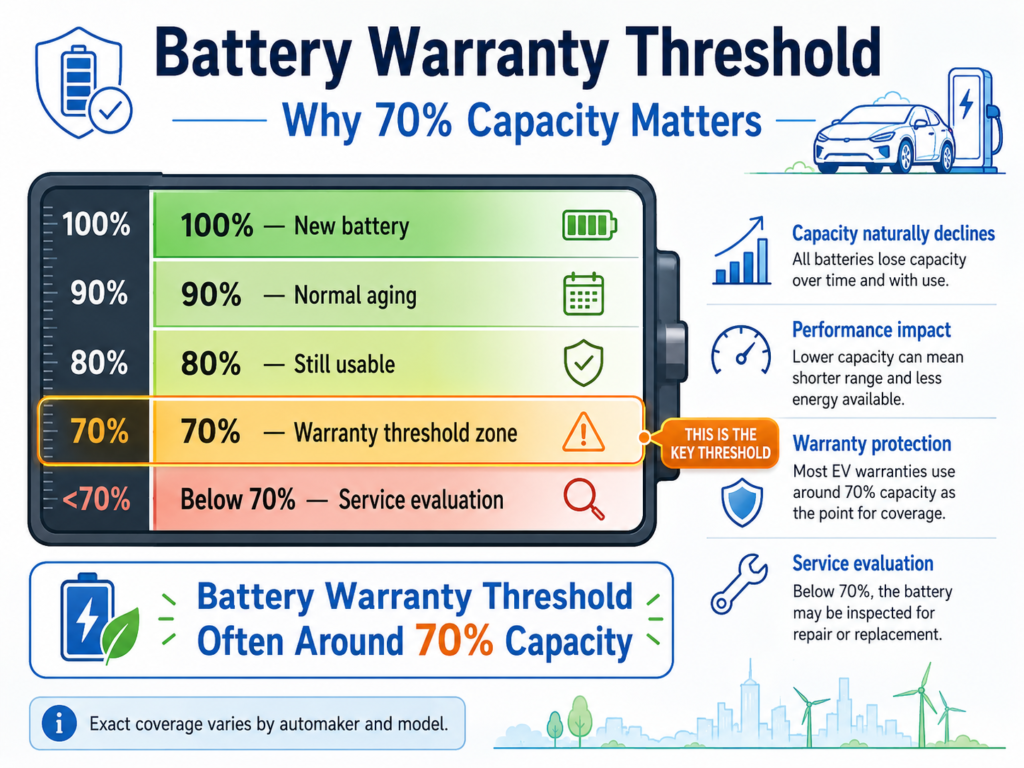
The key point is that this is usually degradation, not sudden death. A battery can lose some capacity and still be perfectly usable. In fact, most modern EV batteries are designed around that reality. Automakers know capacity will fade, which is why battery warranties usually focus on whether the pack falls below a certain capacity threshold rather than whether it retains 100% of its original range forever.
Tesla, for example, lists battery warranty coverage with a minimum 70% capacity retention threshold over the warranty period for its current U.S. models, with mileage limits varying by vehicle (Tesla Vehicle Warranty). Kia’s U.S. warranty page also states that EV battery coverage applies to capacity loss below 70% of original capacity for 10 years or 100,000 miles (Kia Warranty). Ford lists the 2026 Mustang Mach-E battery warranty as 8 years or 100,000 miles with a minimum 70% original-capacity retention over that period (Ford Mustang Mach-E).
That 70% number is important because it shows how the industry thinks about EV battery aging. A battery is not considered “dead” just because it has lost 5%, 10%, or even 20% of its original capacity. It may simply have less usable range than it did when new.
EV Battery Degradation vs Battery Failure
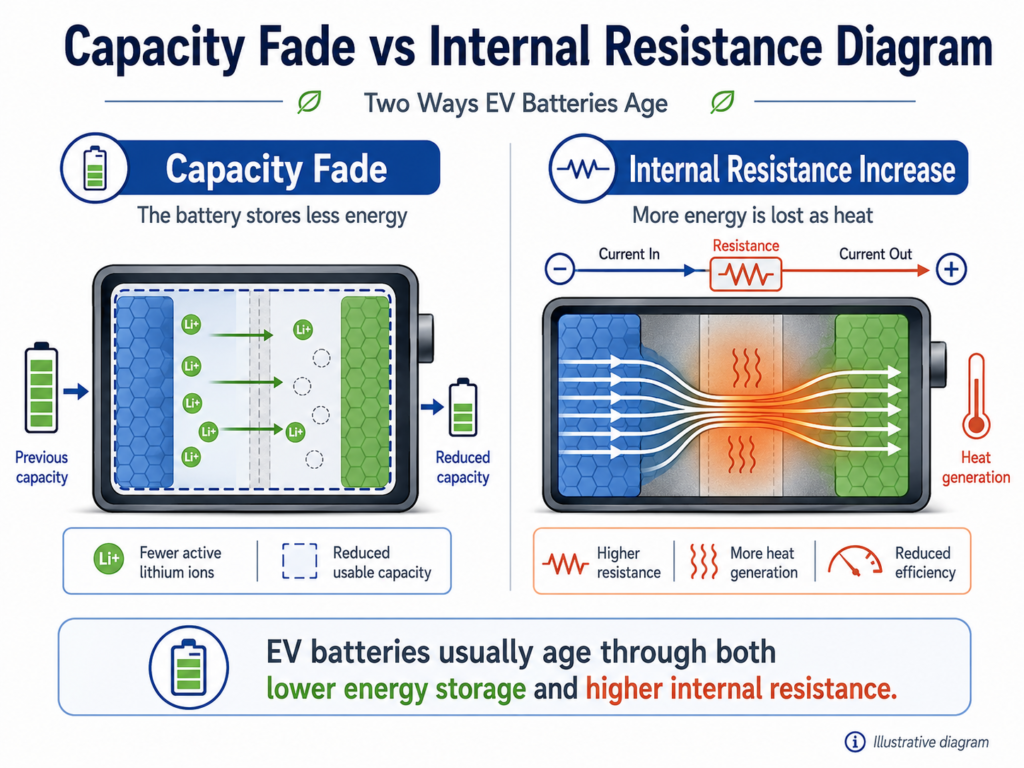
Battery degradation is the gradual loss of battery performance over time. In an EV, drivers usually notice it in two ways. The first is capacity fade. This means the battery can no longer store as much usable energy as it did when new. If the battery originally had enough usable energy to support 300 miles of driving, a 10% capacity loss might reduce that practical range to around 270 miles under similar conditions.
The second is internal resistance increase. This is less obvious to drivers, but it matters. As a battery ages, it becomes slightly harder for energy to move in and out of the cells. Higher internal resistance creates more heat under load, can reduce peak power, and may force the battery management system to limit charging or performance in certain conditions.
These two processes often happen together, but they are not exactly the same thing. A battery can lose capacity while still delivering power reasonably well. Or it can develop higher resistance, which may make fast charging slower even if the total capacity loss is not dramatic.
This is why EV battery health is more complicated than a single range number on the dashboard. The car’s displayed range depends on battery capacity, temperature, driving efficiency, tire condition, HVAC use, driving speed, elevation changes, and software estimates. A lower range estimate does not always mean the battery has degraded by the same amount.
For a deeper explanation of how battery health is measured, this site already has a related guide: EV Battery SOH Explained: How State of Health Is Actually Measured in 2026.
Capacity Fade: Why the Battery Stores Less Energy Over Time
Capacity fade happens because some of the lithium inside the battery gradually becomes unavailable for normal charging and discharging. In a simplified sense, lithium ions move back and forth between the anode and cathode as the battery charges and discharges. Over thousands of cycles and years of use, side reactions slowly consume active lithium, change electrode surfaces, thicken protective layers inside the cell, and reduce the amount of energy the cell can store.
This is normal aging. It does not mean the battery was defective. It is closer to tire wear than engine failure. The battery is still working, but one of its performance margins is gradually shrinking.
Capacity fade can come from two broad types of aging: calendar aging and cycle aging. Calendar aging happens with time, even if the car is barely driven. A battery sitting at a high state of charge in a hot garage can still age because chemical reactions continue inside the cells. Cycle aging happens when the battery is charged and discharged. More driving, more charging, deeper cycles, and more high-power charging can all increase the amount of stress the pack experiences.
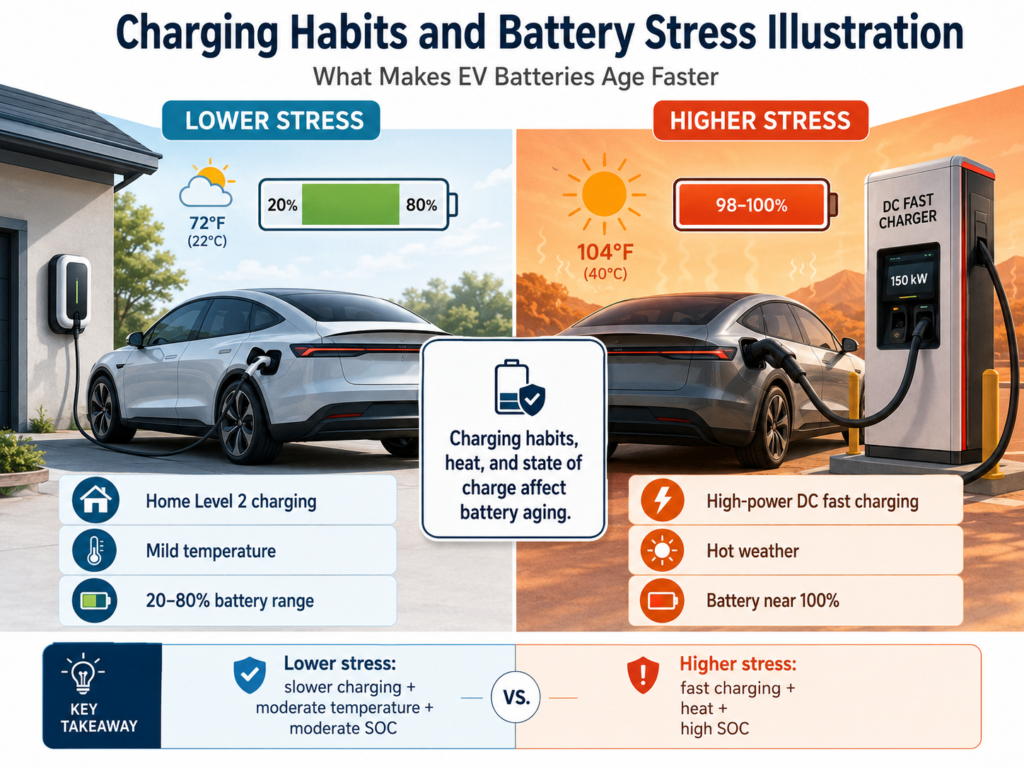
This is why two EVs with the same mileage can age differently. One car may spend most of its life in a mild climate, charged slowly at home, usually kept between moderate state-of-charge levels. Another may live in a hot climate, sit at 100% charge often, and rely heavily on high-power DC fast charging. Their odometers may look similar, but their batteries may not.
Geotab’s latest analysis found that high-power DC fast charging above 100 kW was a major stress factor in its fleet dataset, with high-frequency, high-power DC fast charging associated with higher annual degradation than lower-power charging patterns (Geotab EV Battery Health Study).
That does not mean DC fast charging is “bad” and should be avoided completely. Modern EVs are designed to fast charge. The better takeaway is more practical: use fast charging when it is useful, especially on road trips, but do not treat the fastest charger as the default daily charging method unless your driving pattern requires it.
Related internal article: Why Fast Charging Degrades EV Batteries Faster
Internal Resistance: The Hidden Reason Aging Batteries Feel Different
Capacity fade explains why an older EV may not go as far on a full charge. Internal resistance explains why an aging battery may also feel slightly less efficient, charge more slowly, or generate more heat under demanding conditions.
Every battery has some internal resistance. When current flows through the cell, some energy is lost as heat. This is not unique to EVs. It happens in all batteries. But as lithium-ion cells age, internal resistance can increase because of changes inside the electrodes, electrolyte, and interfaces within the cell.
For the driver, this may show up in subtle ways. The car may still drive normally, but its fast charging curve may taper earlier. In cold weather, the vehicle may be more conservative with power. During repeated hard acceleration or high-speed driving, the battery management system may work harder to control temperature. In extreme cases, the vehicle may limit performance to protect the pack.
This is why EV battery degradation is not only about “how many miles are left.” A battery with higher internal resistance has less margin. It can still operate safely, but the car may need to manage it more carefully.
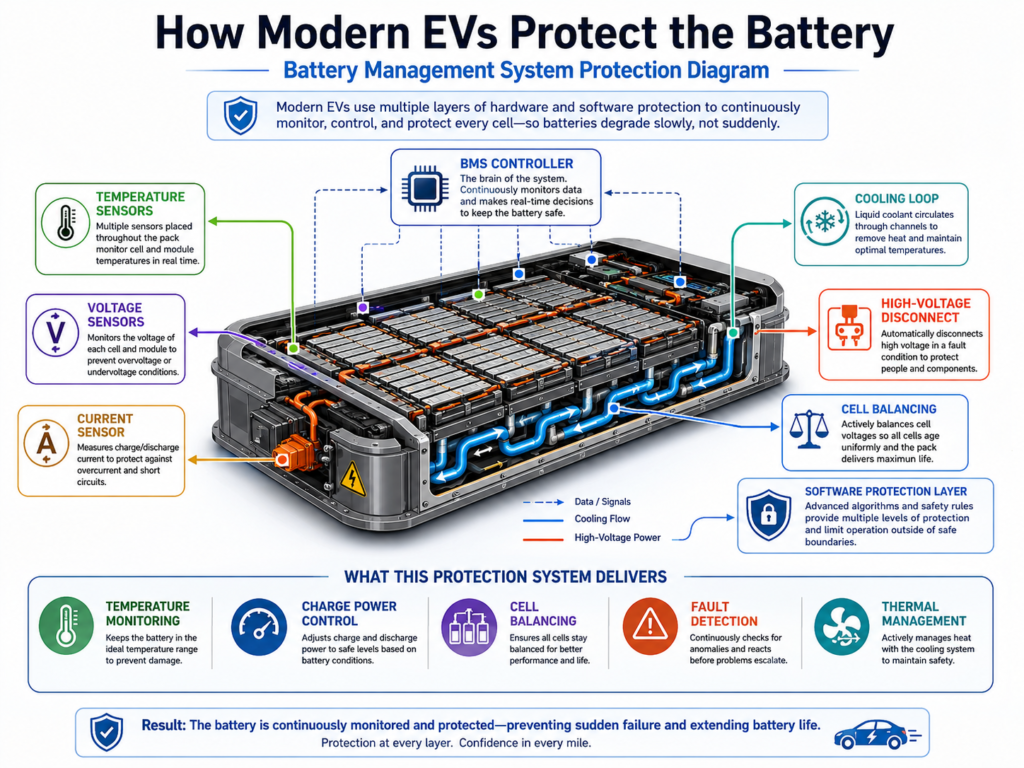
Modern EVs handle this through software. The battery management system watches voltage, current, temperature, state of charge, estimated state of health, and cell imbalance. When the pack is cold, hot, highly charged, deeply discharged, or aging, the system can reduce charging power or limit performance to keep the battery inside a safer operating window.
That is one of the reasons EV batteries usually degrade gradually instead of suddenly failing. The car is constantly protecting the pack from the kinds of conditions that would accelerate damage.
Related internal article: How Modern EV Battery Management Systems Actually Work
Why Range Loss Is Not the Same as Battery Failure
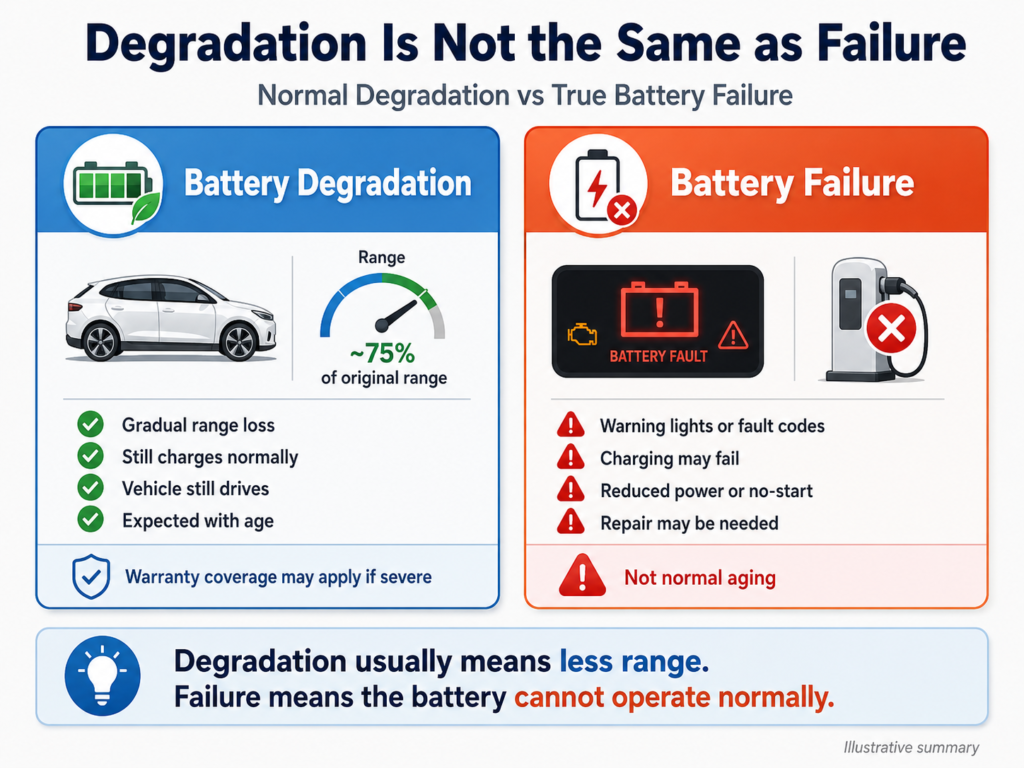
This distinction matters because many people use the word “failure” too loosely. If an EV loses 8% of its original range after years of use, that is not battery failure. If a 300-mile EV becomes a 275-mile EV after years of ownership, that may be annoying, but the battery is still doing its job.
Battery failure is different. It usually means the battery pack has a defect, a serious imbalance, a failed module, a damaged high-voltage component, an internal short, a safety-related fault, or a problem severe enough that the vehicle cannot operate normally.
A degraded battery still charges, discharges, powers the car, and communicates with the vehicle. A failed battery may trigger warning messages, reduced-power mode, inability to charge, isolation faults, contactor faults, or service-required conditions.
This difference is important for used EV buyers. A car with 88% battery health may still be a very usable vehicle, especially if its original range was generous. But a car with battery fault codes, repeated charging failures, coolant intrusion, crash damage, or severe cell imbalance is a different situation entirely. In other words, degradation is a range issue. Failure is a reliability or safety issue. The two can be related, but they are not the same.
Why Modern EV Batteries Rarely “Die” Suddenly
Modern EV batteries rarely fail suddenly because they are not simple battery boxes. They are controlled systems. A modern battery pack includes thousands of cells or many large-format cells, voltage sensors, current sensors, temperature sensors, cooling channels, contactors, fuses, structural protection, isolation monitoring, and a battery management system that constantly estimates what is happening inside the pack.
The BMS does not wait until the battery is damaged. It tries to prevent damaging conditions before they become serious. If the battery is too cold, the car may limit fast charging. If it is too hot, the thermal system may increase cooling. If one cell group is drifting too far from others, the system may balance the pack. If the state of charge is high, the car may reduce charging current to avoid stress.
This is why charging slows above 80%. It is not just charger limitation. It is battery protection. At high state of charge, lithium-ion cells have less room to accept charge safely, so the vehicle reduces current to protect long-term battery health.
Related internal article: Why EV Batteries Charge Slower Above 80%
Another reason sudden battery failure is less common is that EV packs are usually designed with usable-capacity buffers. The number shown to the driver is not always the full physical capacity of the pack. Automakers often reserve some energy at the top and bottom of the battery’s actual operating range. These buffers help reduce stress, protect the cells, and preserve long-term durability.
The result is that most EV batteries do not behave like old laptop batteries that suddenly become useless. They are managed, protected, cooled, heated, and software-limited when needed.
Why Some EV Batteries Lose Range Faster Than Others
Not all EV batteries age at the same rate. That is where the topic becomes more interesting. Battery chemistry matters. LFP batteries are generally known for durability, safety, and cycle life, while NMC batteries usually offer higher energy density and longer range for a given pack size. This is one reason LFP has become popular in more affordable EVs, while NMC and related nickel-rich chemistries remain common in long-range and performance-oriented EVs.
But chemistry is only one part of the story. Thermal management can be just as important. A battery that is actively liquid-cooled and carefully preconditioned before fast charging may age very differently from a battery that spends more time outside its ideal temperature range.
Climate also matters. Heat accelerates many of the chemical side reactions that cause lithium-ion batteries to age. That does not mean EVs cannot survive hot climates, but it does mean thermal management, parking habits, and charging behavior matter more in places like Arizona, Texas, Nevada, or Florida than in cooler regions.
Charging behavior matters too. A driver who usually charges at home on Level 2 power and keeps the battery in a moderate range will typically create less stress than a driver who frequently uses high-power DC fast charging, especially when the battery is cold, hot, or already at a high state of charge.
The vehicle’s software strategy also matters. Some automakers are more conservative. They may hide larger buffers, taper charging earlier, or limit peak performance under certain conditions. Others may prioritize maximum range, high charging power, or aggressive performance. Those decisions can affect long-term aging.
This is why it is too simple to say, “EV batteries last X years.” The better answer is that modern EV batteries usually last a long time, but the rate of range loss depends on vehicle design and how the battery is treated.
Related internal article: LFP vs NMC Batteries: Which EV Battery Is Better in 2026?
The Role of Bigger Batteries in Making Degradation Less Scary
One reason modern EV battery degradation feels less dramatic than many people expected is that EV battery packs have become much larger over time. Recurrent reported that average EV battery sizes increased significantly between 2015 and 2024, which means newer EVs can lose some capacity and still offer useful range (Recurrent EV Battery Longevity Report).
This matters in the real world. If an early EV started with 80 miles of range, losing 15 miles was a big deal. That could change how the car was used. But if a newer EV starts with 300 miles of range, losing 15 or 25 miles over time may be noticeable but not necessarily life-changing.
This is one of the reasons battery degradation anxiety can be overstated. The same percentage loss feels very different depending on the original battery size. A 10% range loss on a short-range early EV may be painful. A 10% range loss on a modern long-range EV may still leave enough range for daily driving, commuting, errands, and most regional trips.
When Battery Degradation Becomes a Real Problem
Even though gradual degradation is normal, it can become a real issue in certain cases. The first case is when the battery falls below the warranty capacity threshold during the warranty period. Many automakers use 70% as the key number, though exact terms vary by brand and model. When a battery drops below that threshold within the covered period, the owner may qualify for repair or replacement according to the warranty terms.
The second case is when degradation reduces the vehicle’s usefulness. A battery does not need to be “failed” to become inconvenient. If the original range was already modest and the owner’s commute is long, even moderate degradation can matter.
The third case is abnormal degradation. If a relatively new EV loses range much faster than similar vehicles, that may point to a faulty module, thermal issue, software problem, cell imbalance, or manufacturing defect.
The fourth case is physical damage or safety-related failure. A battery that has been damaged in a crash, exposed to flooding, affected by coolant leakage, or showing serious warning messages should not be treated as normal degradation. That situation needs professional diagnosis.
For most owners, however, the more common story is less dramatic: the car slowly loses some range over the years, but continues to function normally.
How Owners Can Slow Range Loss Without Obsessing Over It
EV owners do not need to treat the battery like fragile laboratory equipment. Modern EVs are designed for normal use. But a few habits can help reduce unnecessary stress. The most useful habit is to use home or workplace Level 2 charging when possible. It is slower than DC fast charging, but gentler and usually more convenient for daily driving. Fast charging is best treated as a road-trip tool or a practical solution when time matters.
It also helps not to leave the car sitting at 100% for long periods unless the vehicle or chemistry is specifically designed for frequent full charging. Many LFP-equipped EVs tolerate regular full charging better than nickel-rich chemistries, but even then, long-term heat exposure at high state of charge is not ideal.
Temperature is another big factor. Parking in shade, using scheduled charging, and allowing the car’s thermal management system to do its job can all help. In winter, using battery preconditioning before DC fast charging is especially important because cold batteries are more vulnerable to lithium plating during high-power charging.
Related internal article: EV Battery Preconditioning Explained
The goal is not perfection. It is avoiding the most stressful combinations: high heat, high state of charge, high charging power, and long dwell time.
Conclusion: EV Batteries Age, But They Usually Don’t Just Die
EV batteries do lose range over time. That part is real. Capacity fade and internal resistance growth are normal parts of lithium-ion battery aging.
But that does not mean EV batteries usually “die” in the way many people imagine. A battery that has lost some range can still be safe, reliable, and useful for many years. Modern EV packs are protected by advanced battery management systems, thermal controls, charging limits, safety monitoring, and warranty thresholds designed around the reality of gradual aging.
The better way to think about EV battery life is this: range slowly changes, but the battery usually remains functional. For most owners, the real question is not whether the battery will suddenly fail. It is how much usable range the vehicle will retain over time, how well the car manages heat and charging stress, and whether the remaining range still fits the owner’s daily life.
That is a much less frightening question than “When will the battery die?” And it is also much closer to how modern EV batteries actually age.
FAQ
Do EV batteries lose range every year?
Yes, most EV batteries lose some usable capacity over time. The rate varies by vehicle, climate, charging behavior, battery chemistry, and thermal management. In Geotab’s 2026 analysis, the average annual degradation rate was 2.3%, but individual vehicles can perform better or worse depending on use case (Geotab EV Battery Health Study).
Is battery degradation the same as battery failure?
No. Degradation means the battery gradually stores less energy or develops higher internal resistance. Failure means the battery has a serious fault, cannot operate normally, or requires repair or replacement.
At what battery health is an EV battery considered bad?
Many automakers use 70% capacity as an important warranty threshold, but that does not mean a battery instantly becomes useless at 69% or 70%. It means the pack has lost enough capacity that it may qualify for warranty action depending on the vehicle and warranty terms.
Does fast charging destroy EV batteries?
No, occasional DC fast charging does not destroy an EV battery. However, frequent high-power DC fast charging can accelerate degradation, especially when combined with high heat, cold battery temperature, or high state of charge.
Can an EV battery be repaired instead of replaced?
In some cases, yes. Depending on the pack design and fault type, technicians may be able to replace modules or repair specific components rather than replacing the entire battery pack. However, repairability varies widely by automaker and battery architecture.