
Quick Answer
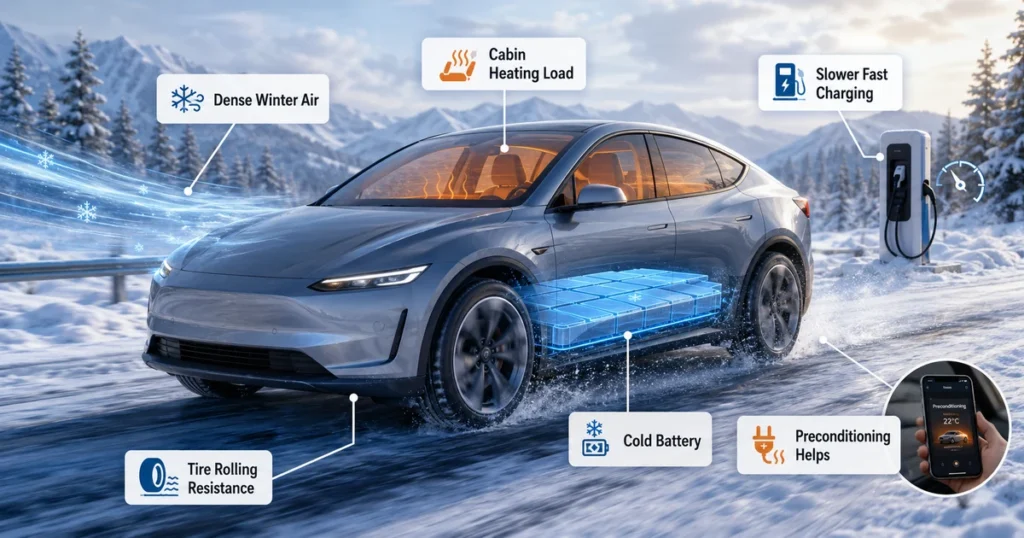
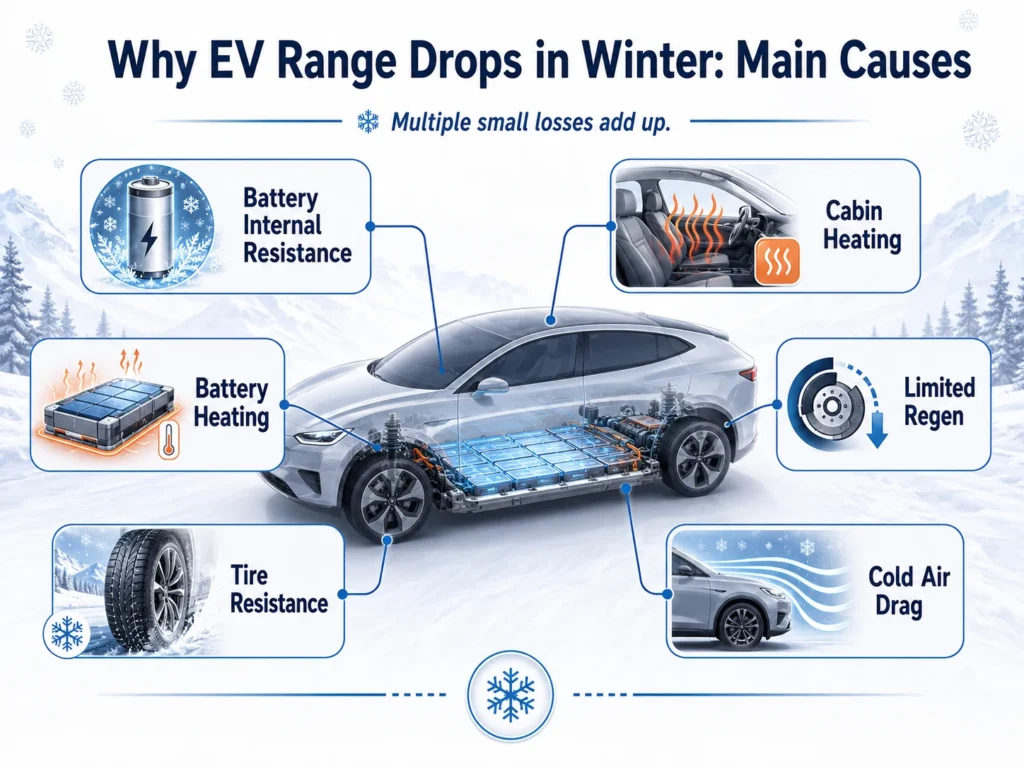
Why EV range drops in winter is not just a battery problem. Cold weather affects several parts of the vehicle at the same time, including battery efficiency, cabin heating, tire resistance, air drag, regenerative braking, and fast charging speed.
For many EV owners, a winter range drop of around 15–35% is realistic. In very cold weather, the loss can be higher, especially during highway driving or short trips with heavy cabin heating. According to Recurrent’s 2025/2026 winter EV range study, popular EV models averaged about 78% of their ideal-temperature range at 32°F and about 70% at 20°F. AAA’s 2026 testing also found that EVs in its study showed a large range and efficiency decrease at 20°F compared with 75°F, as reported in AAA’s temperature impact study.
The good news is that winter range loss is usually temporary. In most cases, it does not mean the battery suddenly degraded. Once temperatures rise, much of that lost range returns.
Introduction: Winter Range Loss Is Real, But It Is Often Misunderstood
Every winter, EV owners ask the same question: “Why did my range suddenly drop?” It is a fair question. An EV that feels easy to live with in September can suddenly feel less predictable in January. The dashboard estimate may look lower. The car may use more energy per mile. Fast charging may take longer. Regenerative braking may feel weaker during the first few minutes of driving.
The simple explanation is that EVs do not like cold weather as much as mild weather. But the real answer is more interesting. Winter range loss is not caused by one single problem. It is the combined result of battery chemistry, cabin heating, battery thermal management, tire behavior, air density, road conditions, driving speed, and charging strategy.
That is why two EV owners can see very different winter results. A driver who parks in a garage, preconditions while plugged in, and drives 25 miles at city speeds may only notice a modest drop. Another driver doing a highway road trip at 15°F with winter tires, a headwind, passengers, luggage, and public fast charging may feel like the car has lost a huge amount of range.
The key point is this: winter range loss is usually not the same thing as permanent battery degradation. A cold battery may temporarily deliver less usable range, but that does not mean the battery’s long-term health suddenly dropped by the same amount.
For a deeper look at long-term aging, see our related guide: How Long Do EV Batteries Last? Real-World Data and Battery Degradation.
What Actually Happens to an EV Battery in Cold Weather?
Lithium-ion batteries work by moving lithium ions between the electrodes. When the battery is warm, those ions move more easily. When the battery is cold, the internal chemistry slows down. The electrolyte becomes less conductive, internal resistance increases, and the battery management system has to be more careful about how much power the pack can deliver or accept.
That does not mean the battery stops working. Modern EVs are designed for winter operation. But a cold battery is not operating in its most efficient zone. In practical terms, a cold battery may lead to lower efficiency, reduced available power, slower charging, and limited regenerative braking. The vehicle may also spend energy warming the battery itself, especially before fast charging or during very cold operation.
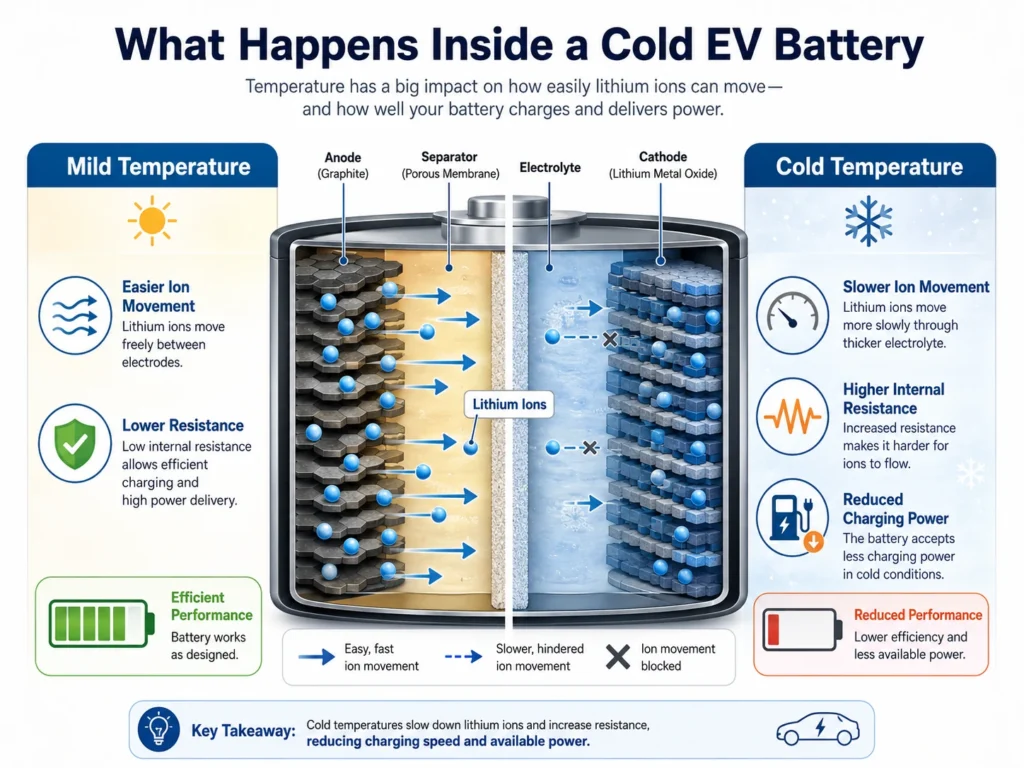
This is one reason winter range loss can feel confusing. Some energy is used to move the car. Some energy is used to heat the cabin. Some energy may be used to warm the battery. And some energy is lost because the vehicle is simply less efficient in cold conditions. Cold charging is especially important. If a lithium-ion battery is charged too aggressively at low temperature, lithium plating risk can increase. Lithium plating happens when lithium deposits on the anode surface instead of smoothly entering the graphite structure. Over time, this can reduce battery capacity and increase safety risk. That is why EVs often limit charging speed when the pack is cold. The car is not being annoying. It is protecting the battery.
For a dedicated explanation of that mechanism, see our article: Lithium Plating Explained: Why Fast Charging Can Damage EV Batteries.
Cabin Heating Is One of the Biggest Reasons EV Range Drops
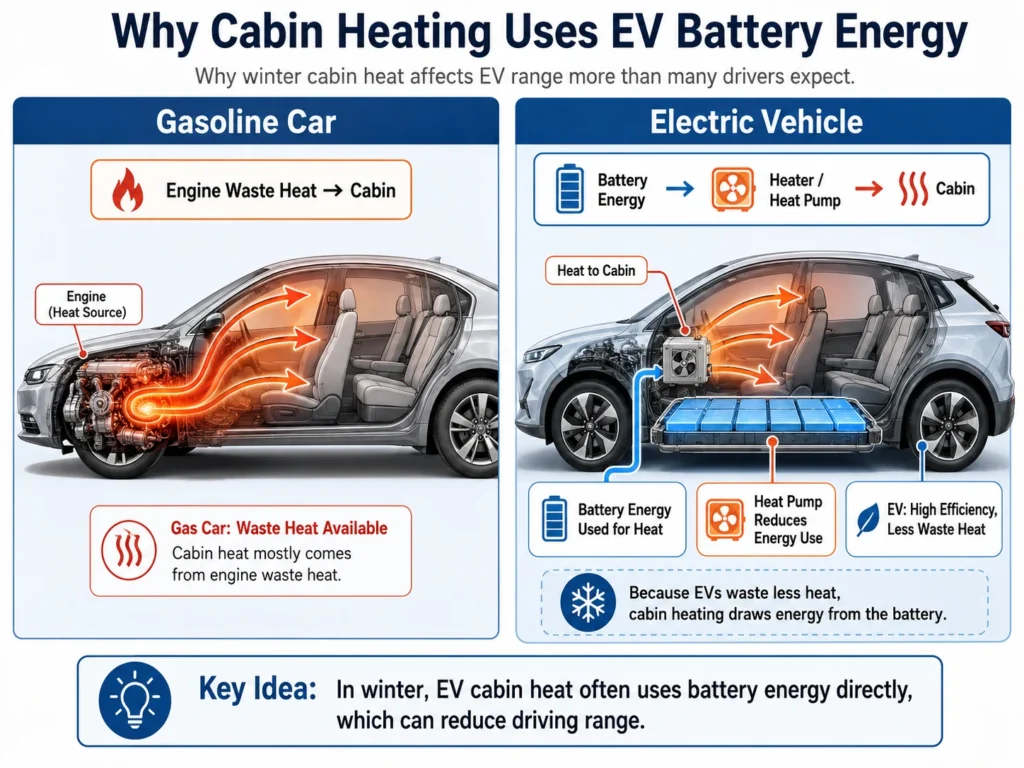
In a gasoline car, winter cabin heat mostly comes from waste heat. The engine produces a lot of heat anyway, so using some of it to warm the cabin does not feel like a major energy penalty. EVs are different. Electric motors are much more efficient, which is one of their biggest advantages. But because they waste less energy as heat, there is less “free” heat available for the cabin.
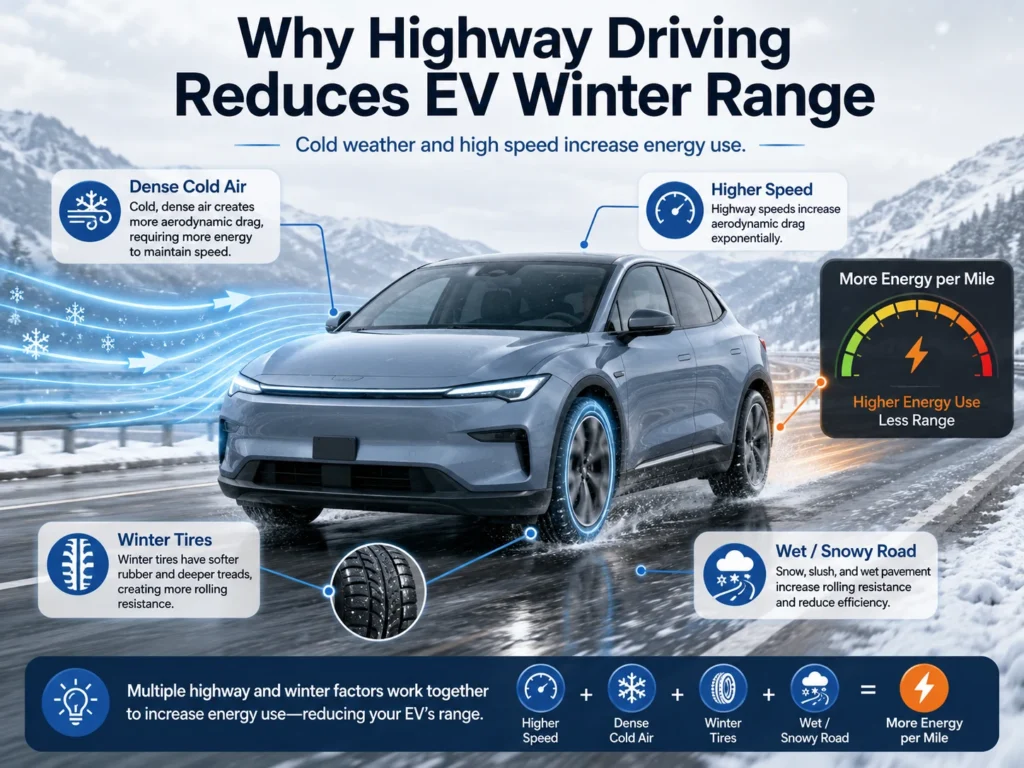
So when an EV needs to warm the interior, that heat usually comes from the high-voltage battery. This is one of the biggest reasons winter range drops. A resistive heater works almost like an electric space heater. It turns electricity into heat. It is simple and effective, but it can use a lot of energy, especially at the beginning of a cold trip when the cabin is freezing.
A heat pump is more efficient because it moves heat instead of simply generating it. This is why many newer EVs use heat pumps to improve cold-weather efficiency. Recurrent’s winter range analysis notes that heat pump technology can help preserve range in cold weather, especially around freezing temperatures, although results still vary by model and thermal system design.
The U.S. Department of Energy also recommends preconditioning an EV before driving in winter, especially while the vehicle is still plugged in. Its winter EV guidance explains that warming the car before departure can improve battery performance and comfort without using as much stored battery energy once the trip begins. You can read the DOE guidance here: Winterizing Your Electric Vehicle.
Small comfort choices matter too. Heated seats and a heated steering wheel warm your body directly. They often use less energy than heating the entire cabin to a high temperature. You do not need to freeze yourself to save range, but using seat heaters and setting the cabin temperature reasonably can make winter driving more efficient.
For more on this topic, see: EV Heat Pumps Explained: The Secret to Better Winter Range.
Heat Pumps Help, But They Do Not Make Winter Range Loss Disappear
Heat pumps are one of the most useful winter EV technologies, but they are not magic. A heat pump can improve efficiency because it transfers heat from outside air, the battery loop, power electronics, or other thermal sources. In many cold-weather conditions, this is more efficient than relying only on resistive heating.
However, heat pump performance depends on temperature. Around freezing, the benefit can be meaningful. In very cold weather, the system may need help from supplemental resistive heating. When that happens, energy use rises again. This is why two EVs with heat pumps can still perform differently in winter. The heat pump itself matters, but so does the rest of the thermal system. Battery size, software calibration, coolant loop design, cabin insulation, battery preconditioning logic, and route planning can all affect real-world winter range. In other words, “has a heat pump” is a useful feature, but it does not tell the whole story.
A well-integrated thermal management system can decide when to warm the battery, when to warm the cabin, how to reuse waste heat, and how to prepare the pack for fast charging. A less sophisticated system may use more energy to achieve the same comfort and performance. This is why winter EV performance is increasingly a software and systems-engineering problem, not just a battery-size problem.
Highway Driving Makes Winter Range Loss More Noticeable
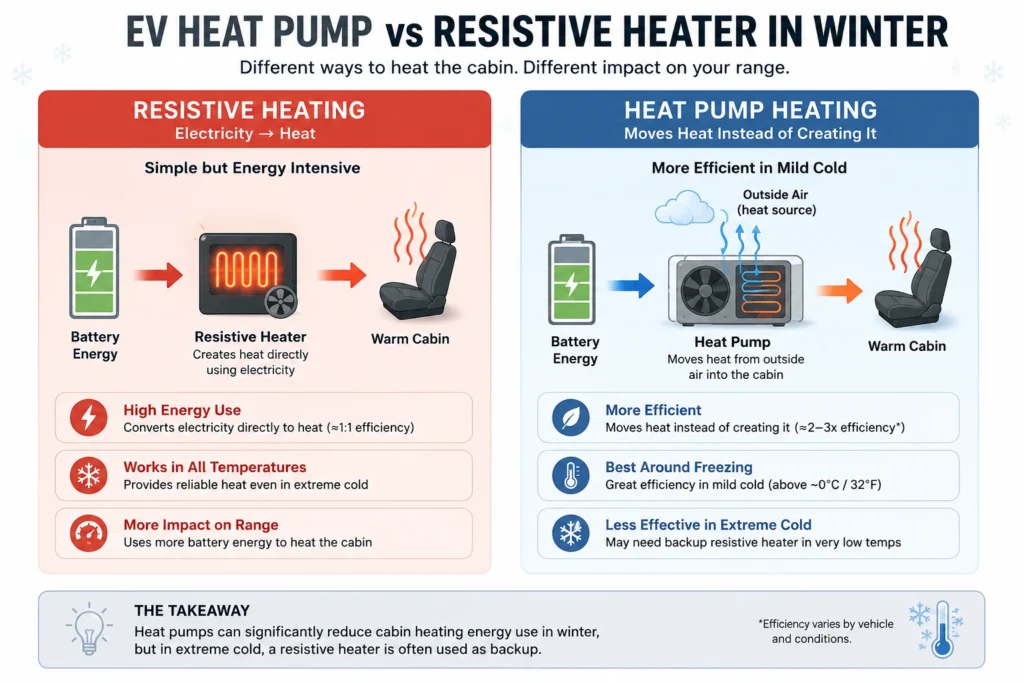
Winter range loss often feels worse on the highway than in city driving. At highway speeds, aerodynamic drag is already one of the biggest energy demands. Cold air is denser than warm air, which increases drag. Add a headwind, winter tires, wet pavement, snow, slush, or a roof box, and the car needs more energy just to maintain speed.
This is why an EV may feel fine during local driving but lose range quickly on a winter road trip. At 70–75 mph in cold weather, the vehicle is dealing with several penalties at once: cabin heating, cold battery behavior, higher rolling resistance, and higher aerodynamic drag.
Gasoline vehicles also become less efficient in winter. Fluids are thicker, tires lose pressure, engines take longer to warm up, and road conditions are worse. The difference is that EV drivers often notice it more because the range estimate is visible all the time.
The U.S. Department of Energy’s Alternative Fuels Data Center overview of all-electric vehicles explains that EV efficiency and range depend on operating conditions, including climate control loads. In real winter driving, that climate-control load combines with speed and weather conditions to create the range drop drivers actually experience. A simple way to think about it is this: winter does not just reduce how much energy the battery can use efficiently. It also increases how much energy the car needs per mile.
Regenerative Braking May Be Limited When the Battery Is Cold
Many EV owners first notice winter behavior through regenerative braking. In normal conditions, regenerative braking sends energy back into the battery when the car slows down. In cold weather, the battery may not be ready to accept that energy at the usual rate. To protect the pack, the battery management system may reduce regen until the battery warms up.
This can make the car feel different. One-pedal driving may be weaker. The car may coast more than expected. Some EVs show a dotted line, a temporary warning, or a reduced power/regen indicator. This is normal. It does not mean the braking system is broken. The vehicle is simply managing the battery’s safe operating window. As the pack warms during driving, regenerative braking often returns gradually. Preconditioning can also help because the battery starts the trip closer to its preferred operating temperature. This is another reason winter range can be better when the car is parked in a garage or plugged in before departure. The battery begins the drive in a less stressful condition.
Cold Weather Can Slow DC Fast Charging
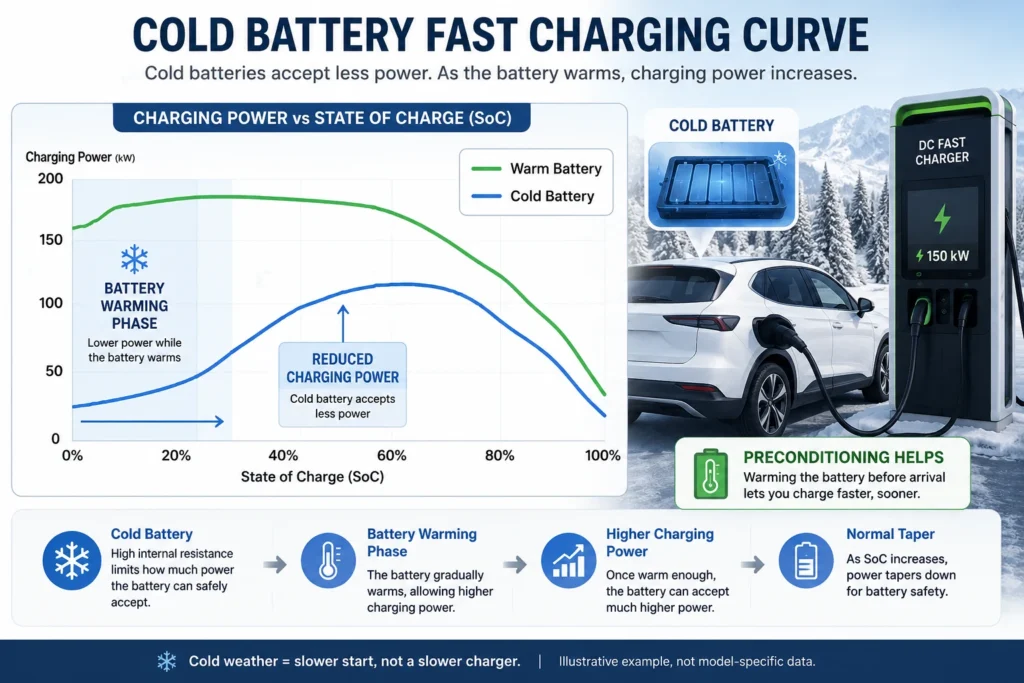
Winter road trips can feel challenging for two reasons. First, the car uses more energy per mile. Second, charging can take longer if the battery is cold. A DC fast charger may be rated for 150 kW, 250 kW, or 350 kW, but the charger does not decide the final charging speed by itself. The EV decides how much power to request based on battery temperature, state of charge, battery chemistry, voltage, and safety limits.
If the battery is too cold, the car may request much less power until the pack warms up. Idaho National Laboratory has discussed this issue in its article on EV charging in cold temperatures. INL explains that cold temperatures affect electrochemical reactions inside the cell, and onboard battery management systems limit charging rate to avoid battery damage.
This is why battery preconditioning matters so much. Many modern EVs can warm the battery before arriving at a fast charger. In some vehicles, this happens automatically when you use the built-in navigation system to route to a DC fast charging station. That last detail matters. Typing the charger into your phone may not activate the vehicle’s battery preconditioning. The car often needs to know through its own navigation system that you are heading to a fast charger.
If the battery is warm when you arrive, the charging session can start at a higher power level and stay more predictable. If the battery is cold-soaked, the charger may feel disappointingly slow even if the station is working correctly.
For a deeper explanation, read: EV Battery Preconditioning: Why Fast Charging Depends on Battery Temperature.
Why Your Displayed Range Can Drop Before You Even Drive
Many EV drivers notice that the estimated range drops overnight in winter. That can feel alarming, but it does not always mean the battery lost a large amount of energy. The displayed range is an estimate. It is not a fixed measurement like the number of gallons in a fuel tank.
The car may adjust the estimate based on outside temperature, recent driving efficiency, HVAC use, route data, battery temperature, elevation, and driving style. If the vehicle expects lower efficiency because it is cold, the range estimate may drop even before you start moving. This is similar to a gasoline vehicle’s “miles to empty” estimate changing after towing, highway driving, city driving, or cold-weather use.
A better number to watch is miles per kWh. That tells you how efficiently the vehicle is using energy. For example, an EV that averages 3.5 miles per kWh in mild weather could deliver about 245 miles from 70 kWh of usable energy. If winter efficiency drops to 2.6 miles per kWh, that same usable energy would deliver about 182 miles. That does not mean the battery degraded by 25%. It means each kWh is moving the car fewer miles under winter conditions. This example is illustrative, not a universal rule. Actual results depend on the vehicle, battery size, speed, weather, tires, and HVAC use.
Are LFP Batteries Worse in Winter?
This question is becoming more common because LFP batteries are now used in many affordable EVs. LFP batteries have major advantages. They are generally lower cost, durable, thermally stable, and do not rely on nickel or cobalt. But like all lithium-ion batteries, they are temperature-sensitive.
In cold weather, LFP batteries may be conservative with charging and state-of-charge estimation. Some LFP-equipped EVs also recommend periodic charging to 100% to help the battery management system calibrate the state-of-charge estimate.
That does not mean LFP EVs are bad winter vehicles. Many LFP EVs work well in cold climates when they have good thermal management and battery preconditioning software. The real-world experience depends less on chemistry alone and more on the full vehicle system. Battery chemistry matters, but so do pack heating, battery insulation, charging software, heat pump design, and how well the car predicts range in cold conditions.
For a broader comparison, see: LFP vs NMC Batteries: Which EV Battery Is Better in 2026?.
How Much Winter Range Loss Should You Expect?
Understanding why EV range drops in winter helps explain why one driver may see only a modest loss while another sees a much larger drop on a cold highway trip. There is no single winter range loss number that applies to every EV. A mild winter day around 40°F may only cause a modest drop. A freezing day around 32°F may reduce range more noticeably. A 20°F highway trip with cabin heat, winter tires, wind, and public fast charging can reduce range much more.
The latest real-world and lab data show why driver experiences vary so much. Recurrent’s 2025/2026 winter EV range study found that the 34 EV models it analyzed averaged 78% of their ideal-temperature range at 32°F and 70% at 20°F. Meanwhile, AAA’s 2026 study on temperature impacts found that EVs in its test had a 35.6% drop in MPGe and a 39.0% decrease in calculated driving range at 20°F compared with 75°F.
These numbers should not be treated as exact predictions for every owner. They are better understood as realistic reference points. In daily commuting, winter range loss may not matter much if you charge at home. If your normal commute uses only 25–40% of the battery, a winter efficiency drop is manageable. On road trips, the same drop matters more because it affects charging stop spacing, arrival buffer, and total travel time. This is why winter EV planning is less about panic and more about margin. Give yourself more buffer than you would in mild weather.
Why Short Trips Are Especially Inefficient in Winter
Short trips can look surprisingly inefficient in winter. The reason is simple: the car may spend a lot of energy warming the cabin and battery, but the trip ends before that warm-up energy is spread over many miles. Imagine starting an EV at 15°F for a five-mile grocery trip. The heater works hard right away. The battery is cold. The tires are cold. The cabin may not even reach a comfortable temperature before you arrive. The energy use per mile can look terrible.
Now imagine a 40-mile commute after preconditioning while plugged in. The first few minutes still use more energy, but the battery and cabin stabilize. The warm-up penalty is spread over more miles. Efficiency usually looks better. This is why winter efficiency can feel inconsistent from trip to trip. A short errand may show poor miles per kWh, while a longer drive on the same day may look much more reasonable. For owners, the lesson is simple: do not judge winter range from one short cold-start trip. Look at the pattern over several drives.
The Best Way to Improve Winter EV Range
The most effective winter EV habit is preconditioning while plugged in. When the car is connected to power, it can warm the cabin and, in some cases, the battery using grid electricity instead of stored battery energy. You start the trip with a warm interior, a more prepared battery, and more usable energy for driving. The DOE’s Winterizing Your Electric Vehicle guide recommends warming the vehicle before driving, and this is especially useful when the EV is still plugged in.
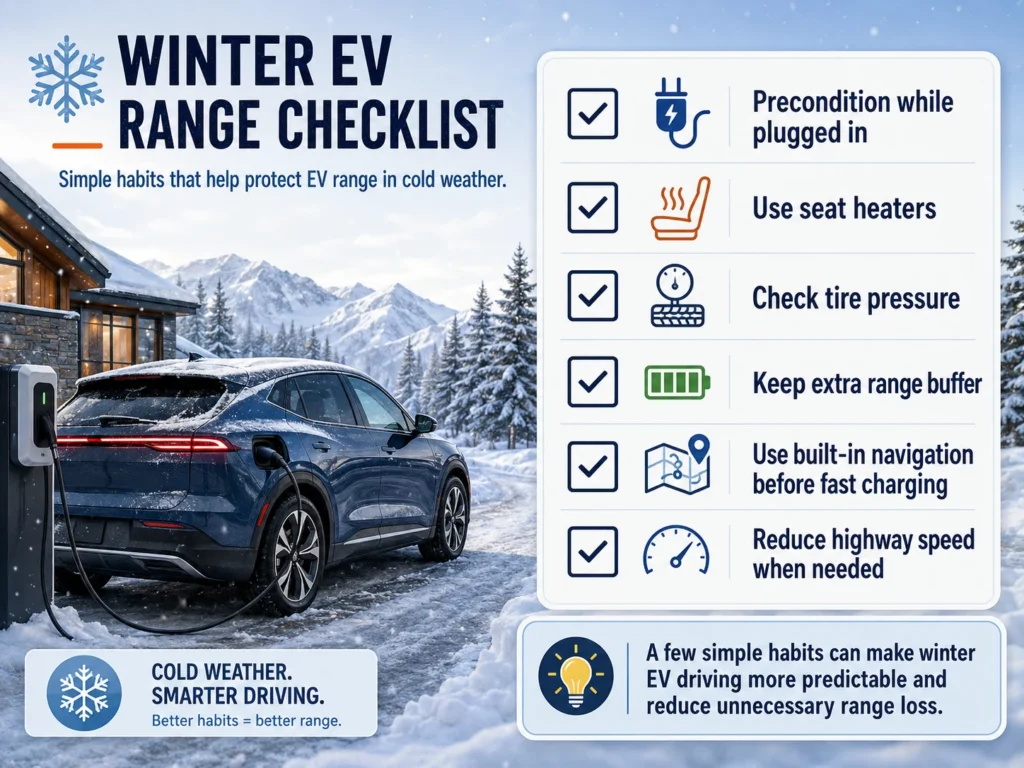
A practical winter routine does not have to be complicated. Set a departure time in the vehicle app or infotainment system. Keep the car plugged in overnight when possible. Warm the cabin before you leave. Use heated seats and a heated steering wheel. Keep tire pressure correct. On road trips, use the built-in navigation system before DC fast charging so the battery can precondition.
Tire pressure deserves special attention. Cold air lowers tire pressure, and underinflated tires increase rolling resistance. That means the car uses more energy per mile. Checking tire pressure during winter is one of the simplest ways to protect range.
Speed also matters. Dropping from 75 mph to 68–70 mph can make a noticeable difference in winter highway range. It is not always convenient, but on a cold road trip, a slightly lower cruising speed can sometimes save more time than driving faster and needing an extra charging stop.
Should You Charge More in Winter?
In winter, it is smart to keep a larger buffer than you would in mild weather. That does not mean every EV should be charged to 100% every day. For many nickel-based battery packs, charging to around 80% remains a good daily habit unless you need more range. For LFP packs, some manufacturers recommend charging to 100% more regularly for calibration, so it is best to follow the owner’s manual.
The practical point is this: winter reduces your margin. If you normally arrive home with 20% in summer, the same trip might leave you with a much smaller buffer in January. Increasing your daily charge limit during very cold weather can be reasonable, especially if your commute is long or charging access is limited. For road trips, charging to 100% before departure is normal. The main thing to avoid is leaving the vehicle sitting at 100% for long periods when you do not need that range.
For more about charging behavior near the top of the battery, see: Why EV Batteries Charge Slower Above 80%.
Does Winter Range Loss Damage the Battery?
Usually, no.
Cold weather can temporarily reduce efficiency, available power, and charging speed. But that is not the same thing as permanent battery degradation. In fact, high temperature is usually a bigger concern for long-term battery aging than cold storage. Heat accelerates chemical reactions inside the battery. Cold weather is more of an operational challenge: lower efficiency, slower charging, and the need for more careful battery management.
The main winter battery-health concern is aggressive charging when the pack is too cold. That is exactly why EVs limit fast charging power and use preconditioning. The battery management system is designed to avoid harmful conditions. So if your EV charges slowly on a cold day, it does not automatically mean something is wrong. It may simply mean the car is protecting the battery.
For owners, the best strategy is straightforward: precondition before fast charging, avoid repeated unnecessary cold-soaked fast charging, follow the manufacturer’s recommendations, and do not confuse temporary winter range loss with long-term battery failure.
What Future EVs Will Do Better
Winter EV performance is improving quickly. Newer EVs are getting better heat pumps, more advanced battery preconditioning, improved route planning, better insulation, and smarter thermal management. The most important improvement may be coordination.
Future EVs will not treat cabin heating, battery heating, fast charging, navigation, and range prediction as separate features. They will manage them together. For example, the car may know that you are leaving at 7:30 a.m., driving 90 miles, stopping at a fast charger, and arriving in 15°F weather. Instead of simply warming the cabin, it can decide how much to warm the battery before departure, how much heat to preserve during the drive, and when to start preconditioning for the charger.
This is where EV software becomes just as important as battery size. A large battery helps, but intelligent energy management can make winter driving feel much more predictable. That is the direction the industry is moving: not just bigger packs, but smarter thermal systems.
Conclusion: Winter EV Range Loss Is Manageable Once You Understand It
EV range drops in winter because cold weather changes the energy balance of the whole vehicle. The battery is less efficient. The cabin needs heat. The battery may need warming. Tires and air create more resistance. Regenerative braking may be limited. Fast charging may slow down until the pack reaches a safer temperature.
That sounds like a long list, but the solution is not complicated. Precondition while plugged in. Use seat heaters. Keep tires inflated. Give yourself more range buffer. Use built-in navigation before fast charging. Expect lower highway efficiency in very cold weather.
Most importantly, do not confuse winter range loss with battery failure. In most cases, the range comes back when the weather warms up. Winter does not make EVs impractical. It just makes planning more important.
FAQs
Why does my EV range drop so much in winter?
Your EV range drops because the battery is less efficient when cold, cabin heating uses battery energy, tires and air create more resistance, and the vehicle may use energy to warm the battery.
Is winter range loss permanent?
Usually no. Winter range loss is mostly temporary. It normally improves when temperatures rise. Permanent battery degradation is a different issue and happens gradually over time.
Do heat pumps really help EV range in winter?
Yes. Heat pumps can reduce the energy needed for cabin heating, especially around freezing temperatures. They do not eliminate winter range loss, but they can make a meaningful difference.
Why does my EV charge slower in winter?
Cold batteries cannot safely accept high charging power. The battery management system limits charging speed to reduce lithium plating risk and protect long-term battery health.
Should I precondition my EV in winter?
Yes. Preconditioning while plugged in is one of the best ways to improve winter range and comfort. It warms the cabin and may warm the battery before driving.
Should I charge to 100% in winter?
For daily driving, it depends on your battery chemistry and manufacturer recommendation. For many EVs, 80–90% is reasonable for daily use, while 100% is useful before road trips. LFP-equipped EVs may have different guidance, so check the owner’s manual.
Does cold weather permanently damage EV batteries?
Normal cold-weather driving usually does not permanently damage the battery. The bigger concern is charging too aggressively when the battery is very cold, which is why EVs limit charging speed and use preconditioning.
Editor’s note: We originally covered this topic in an earlier version of this article. This updated guide adds newer winter range data, clearer explanations, verified external sources, and more practical advice for EV owners driving in cold weather.