
Quick Answer
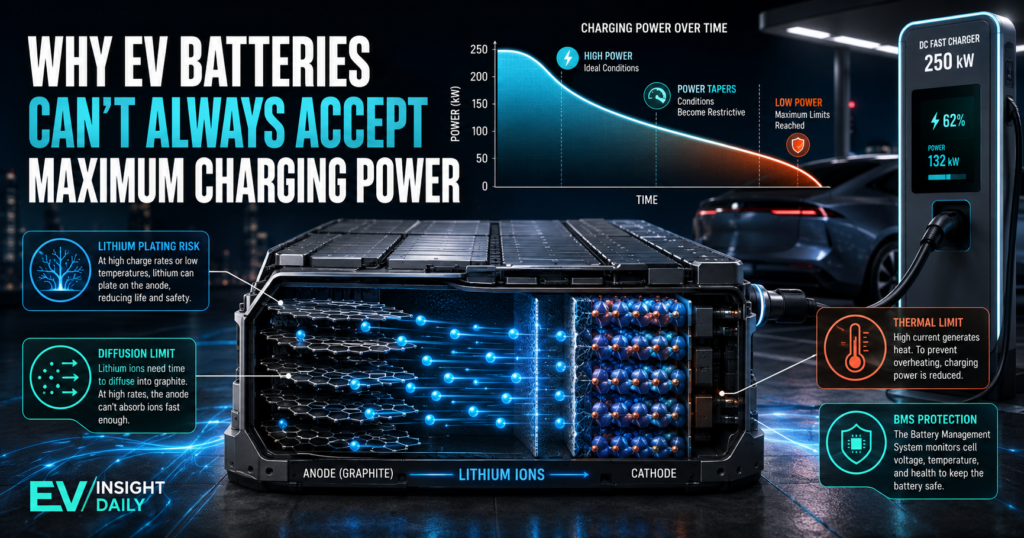
EV battery charging power is not fixed by the charger alone. It depends on what the battery cells can safely accept at that moment. EV batteries cannot charge at full power all the time because lithium-ion cells have physical limits inside the battery. Even if a DC fast charger can deliver 250 kW, 300 kW, or more, the battery itself may not be able to safely accept that much power at every state of charge or temperature.
The main limits come from lithium plating risk, lithium-ion diffusion speed, heat generation, cell voltage limits, and Battery Management System restrictions. At low state of charge and ideal temperature, an EV may accept very high charging power. But as the battery fills up, warms up, cools down, or approaches electrochemical limits, the vehicle intentionally reduces charging power to protect battery life and safety. That charging slowdown is not a charger failure. It is the battery protecting itself.
Introduction: The Charger Is Not Always the Limiting Factor
Many EV owners assume that charging speed is mostly determined by the charger. Plug into a 350 kW DC fast charger, and the car should charge at 350 kW. Plug into a 150 kW charger, and the car should charge at 150 kW.
In reality, fast charging is much more complicated. The charger only provides the opportunity. The EV decides how much power the battery can safely accept at that moment. That decision depends on battery temperature, state of charge, cell chemistry, pack voltage, battery age, thermal system capability, and the control strategy inside the Battery Management System, or BMS. This is why two EVs plugged into the same charger can charge at very different speeds. It is also why the same EV may charge quickly one day and slowly another day.
We already covered the owner-facing side of this topic in our article on why EV batteries charge slower above 80%. This article goes one level deeper. Instead of only looking at the charging curve from the outside, we will look at what is happening inside the lithium-ion cell. The short version is this: fast charging is not just about pushing electricity into a battery. It is about moving lithium ions through a complex electrochemical system without causing damage.
What Actually Happens Inside an EV Battery During Charging?
During discharge, lithium ions move from the anode to the cathode through the electrolyte, while electrons flow through the external circuit to power the vehicle.
During charging, the process reverses. Lithium ions leave the cathode, move through the electrolyte, pass through the separator, and enter the anode. In most EV lithium-ion batteries, that anode is graphite or graphite blended with silicon.
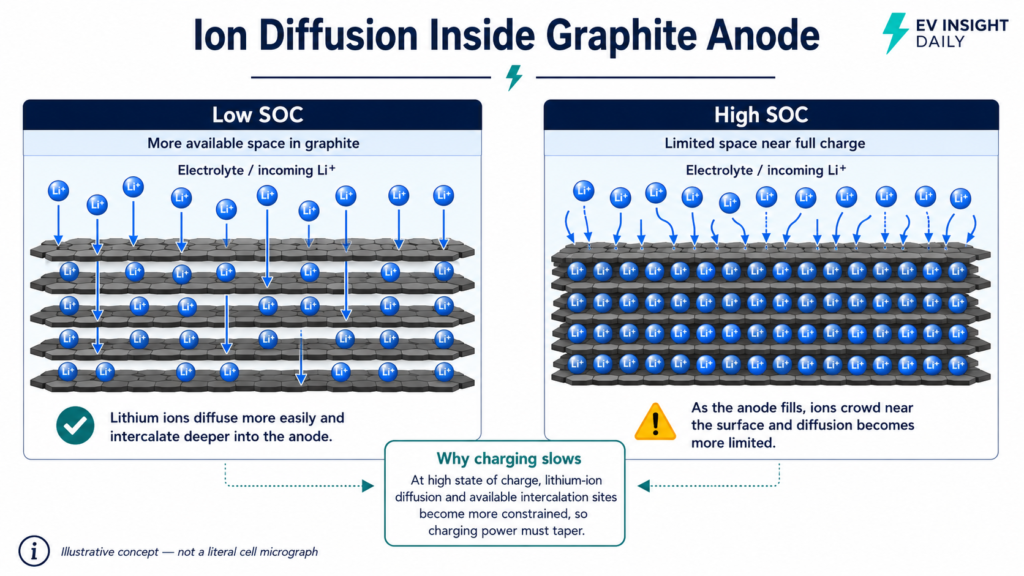
The key word is “enter.” Lithium ions are not supposed to simply pile up on the surface of the anode. Under normal charging conditions, they intercalate into the graphite structure. That means they slide into spaces between graphite layers.
This process sounds simple, but it is not instant. Lithium ions must travel through the electrolyte, cross the solid-electrolyte interphase layer, reach the graphite surface, and diffuse into graphite particles. A 2023 open-access review on graphite anode fast-charging limits explains that lithium-ion intercalation involves several steps, including desolvation, crossing the SEI layer, intercalation, particle diffusion, and transport through the porous electrode. These steps create kinetic limits during fast charging (PMC). That is the core reason an EV battery cannot always accept maximum power.
The battery is not an empty bucket. It is more like a large stadium with thousands of narrow entrances. At first, people can enter quickly. But as seats fill, pathways crowd, and movement slows, the entrance rate must be controlled. If you keep forcing people in too aggressively, congestion turns into a safety problem. Inside a battery, that “congestion” can become lithium plating.
Lithium Plating: The Big Reason Fast Charging Must Be Controlled
Lithium plating is one of the most important reasons EVs reduce charging power. Under healthy charging conditions, lithium ions enter the graphite anode. Under stressful conditions, some lithium ions instead deposit as metallic lithium on the anode surface. That is lithium plating.
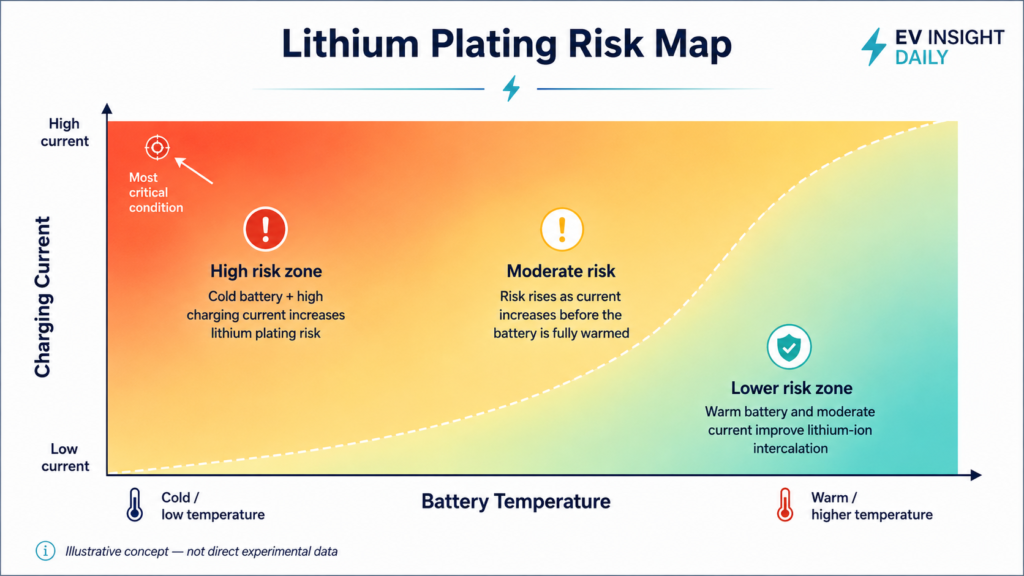
This tends to happen when the battery is charged too aggressively, especially when the anode cannot absorb lithium ions fast enough. The risk increases at low temperature, high charging current, and high state of charge.
Researchers have repeatedly identified lithium plating as a major barrier to extreme fast charging. Argonne National Laboratory describes fast charging as a key research target and notes that lithium-ion batteries must be engineered carefully to support faster charging without damaging the cell (Argonne National Lab). Nature Communications research on onboard lithium plating detection also explains that many current charging protocols use conservative current steps specifically to avoid hazardous lithium plating and related side reactions (Nature).
The problem is not only that lithium plating reduces battery capacity. Some plated lithium can become “dead lithium,” meaning it no longer participates usefully in the battery’s charge and discharge reactions. Over time, this reduces available lithium inventory and causes permanent capacity loss.
In severe cases, lithium plating can also contribute to dendrite-like growth, which raises safety concerns. That does not mean normal DC fast charging automatically creates a dangerous battery. Modern EVs are designed to avoid that. But it does explain why the BMS does not simply allow full power whenever the charger offers it. The BMS is constantly trying to stay below the plating threshold.
Why Cold Batteries Charge So Slowly
Cold weather is one of the most visible examples of battery physics limiting charging power. When a battery is cold, lithium-ion diffusion slows down. The electrolyte becomes less conductive, the SEI layer becomes harder for ions to cross, and the graphite anode becomes less able to accept lithium quickly. The charger may still be capable of delivering high power, but the battery is not ready to receive it. This is why winter fast charging can feel frustrating. You may arrive at a 250 kW charger and see only 60 kW or 80 kW at first. The charger is not necessarily broken. The battery may simply be too cold.
Porsche gives a real-world example of this principle in its battery guidance. Porsche states that the optimum battery temperature for short charging times is around 30–35°C, and that fast charging ideally starts at a low state of charge to reach the highest charging power (Ask Porsche). Porsche also notes that lower-than-expected charging power can be caused by battery temperature, including cases where the battery is too cold or too hot (Ask Porsche).
This is exactly why battery preconditioning exists. A modern EV may warm the battery before arriving at a DC fast charger so the cells are closer to their ideal fast-charging window. We covered this practical side in detail in EV Battery Preconditioning Explained. The important point is that cold charging is not just slower because the car is being cautious. It is slower because the lithium ions physically cannot move through the cell as easily.
Diffusion Limits: Why EV Battery Charging Power Drops as the Pack Fills
Even at a comfortable temperature, batteries still cannot accept maximum power all the way to 100%. At low state of charge, there is more room in the anode for lithium ions to intercalate. The concentration gradient is favorable, and the cell can often accept high current.
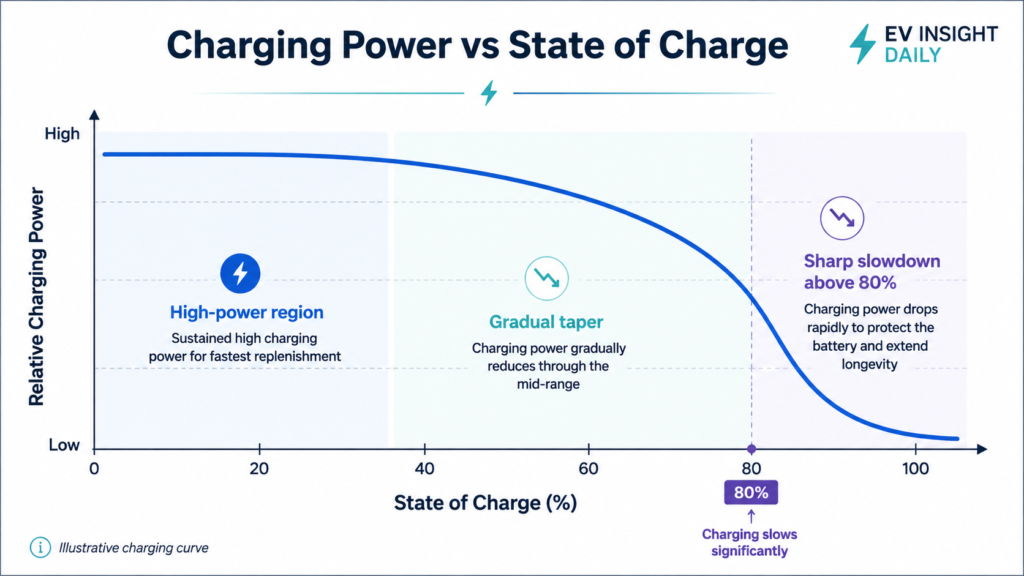
As state of charge rises, the anode becomes increasingly filled with lithium. The available sites become more limited, internal concentration gradients become more severe, and the cell voltage approaches its upper limit. At that point, pushing the same current becomes more stressful. This is why most EV charging curves follow a pattern. The car may charge very quickly from roughly 10% to 50% or 60%, then gradually taper. After 80%, charging power often drops sharply.
That taper is not arbitrary. It reflects the cell moving from a high-current charging phase toward a voltage-limited phase. In simple terms, the battery can absorb energy quickly when it is relatively empty. As it gets closer to full, it needs a gentler approach. This is similar to filling a glass of water. At first, you can pour quickly. Near the top, you slow down to avoid spilling. In a battery, the “spill” is not water. It is excess electrochemical stress, lithium plating risk, heat generation, and accelerated aging.
Hyundai’s E-GMP platform gives a good example of what modern EVs can achieve under ideal conditions. Hyundai states that the IONIQ 5 can charge from 10% to 80% in 18 minutes on a 350 kW charger (Hyundai News). But even vehicles with excellent charging performance usually advertise the 10–80% window, not 10–100%. That is because the final 20% is governed by much tighter electrochemical limits.
Thermal Limits: Fast Charging Creates Heat
Fast charging is not only an ion-transport problem. It is also a heat problem. When high current flows through a battery, heat is generated inside cells, busbars, connectors, cables, and power electronics. Some of that heat comes from electrical resistance. Some comes from electrochemical reactions. The higher the current, the more difficult heat management becomes.
This matters because lithium-ion cells operate best within a limited temperature range. If the battery is too cold, lithium diffusion slows and plating risk increases. If the battery is too hot, unwanted side reactions accelerate, the electrolyte can degrade faster, and long-term battery aging can increase.
A major review on battery thermal management explains that high-power lithium-ion batteries need efficient thermal management for performance, safety, and longevity (PMC). A 2024 review of advanced battery thermal management systems also emphasizes that reliable thermal management is critical during fast charging because high charging power increases thermal stress (MDPI). This is why modern EVs use liquid cooling, heat pumps, chillers, coolant pumps, thermal valves, and predictive software to manage pack temperature. The thermal system is not just there to keep the battery from overheating. It also helps the battery accept more charging power safely.
But thermal systems are not magic. If the pack temperature rises too quickly, the BMS will reduce charging power. If one region of the pack becomes hotter than another, the BMS may become more conservative. If ambient temperature is very high and the cooling system is already working hard, charging power may be limited. This is one of the reasons peak charging power can be misleading. A vehicle may briefly hit 250 kW or 300 kW, but what matters more is how long it can hold high power without crossing thermal or electrochemical limits.
Why Cell Design Changes Charging Speed
Not all lithium-ion batteries have the same fast-charging capability. Cell design matters. Electrode thickness, particle size, porosity, electrolyte formulation, anode material, cathode chemistry, tab design, internal resistance, and cooling path all affect how quickly lithium ions can move and how much heat the cell generates.
High-energy cells often use thicker electrodes to store more energy. That can be good for range, but it can make fast charging harder because lithium ions must travel through longer and more complex pathways. A high-power cell may use thinner electrodes or more optimized transport pathways, but that can reduce energy density or increase cost. This is one of the biggest tradeoffs in EV battery engineering.
A battery designed for maximum range is not automatically the fastest-charging battery. A battery designed for ultra-fast charging may require more advanced materials, more cooling, more pack complexity, or a different cost structure.
Graphite anodes are especially important here. Graphite is widely used because it is stable, affordable, and energy-dense. But it is also a bottleneck for extreme fast charging. The 2023 review on graphite anode kinetic limits describes high-rate charging challenges such as large polarization, low intercalation capacity, and side reactions (PMC).
This is why battery companies are researching silicon-rich anodes, coated graphite, improved SEI layers, new electrolytes, and even lithium-metal or solid-state designs. These technologies may improve fast-charging capability in the future, but they still need to balance cycle life, safety, manufacturing cost, and real-world durability.
Why 800V EVs Still Cannot Charge at Full Power Forever
Higher-voltage EV platforms can charge faster, but they still face cell-level limits. An 800V architecture allows the vehicle to deliver the same charging power with lower current compared with a 400V system. Lower current can reduce cable losses and thermal stress in parts of the charging path. That is why 800V vehicles such as the Hyundai IONIQ 5, Kia EV6, Porsche Taycan, and other high-voltage platforms can achieve impressive charging speeds. We covered this electrical architecture side in 400V vs 800V EV: Why Higher Voltage Matters.
But an 800V system does not eliminate lithium plating, diffusion limits, voltage limits, or thermal limits inside the cells. It simply makes the external power delivery problem easier. Think of it this way: 800V architecture improves the highway leading to the battery. But once lithium ions reach the cell, they still have to enter the graphite anode safely. That is why even the fastest-charging EVs taper. They may taper later, more smoothly, or from a higher peak, but they still taper.
How the BMS Controls EV Battery Charging Power
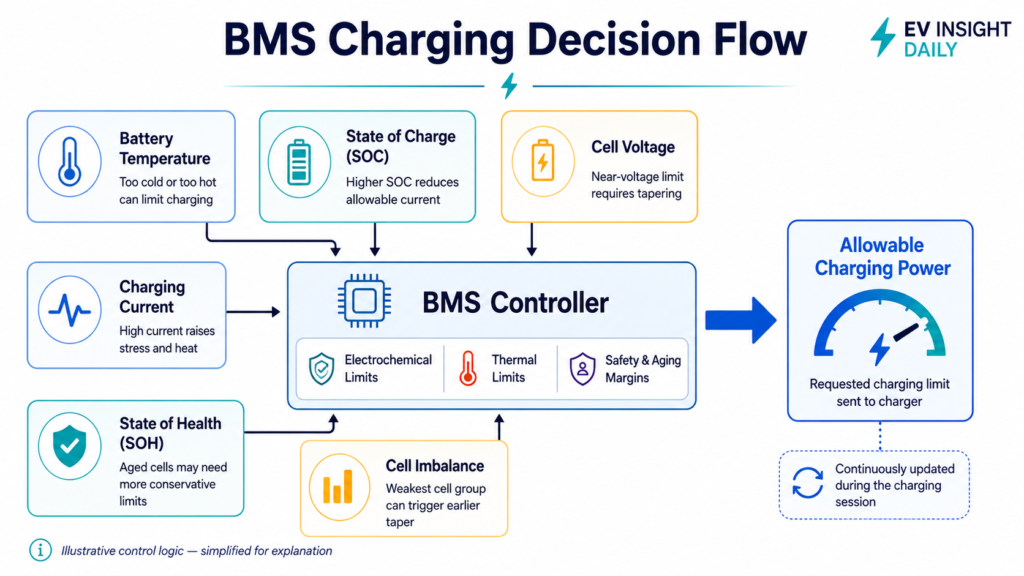
The Battery Management System is the reason charging feels smooth and safe to the driver. The BMS monitors or estimates cell voltage, current, pack temperature, module temperature, state of charge, state of health, impedance, and safety limits. Based on those conditions, it tells the charger how much current the vehicle is willing to accept.
This is a dynamic process. The EV does not request one fixed charging power for the entire session. It continuously adjusts the allowable current as conditions change. If the battery is cold, the BMS may limit current until the pack warms up. If the battery is near full, it reduces current to avoid overvoltage and plating risk. If the pack becomes hot, it may reduce charging power to control thermal stress. If one cell group reaches a voltage limit earlier than others, the BMS may taper charging even if the overall pack state of charge looks moderate.
This is one of the reasons charging curves vary in the real world. The same vehicle may show different behavior depending on state of charge at arrival, battery temperature, charger power, ambient temperature, pack age, recent driving load, preconditioning quality, and even cell balancing condition. The driver sees one number on the charging screen. The BMS sees a constantly changing electrochemical system.
Why Fast Charging Is Not Automatically Bad
It is easy to read about lithium plating and thermal limits and assume DC fast charging is harmful. That is too simplistic. Modern EVs are designed to fast charge. The BMS, thermal system, charging curve, and cell design are all engineered to keep the battery within safe limits. Occasional fast charging during road trips is normal use.
The real issue is repeated stress under difficult conditions. Fast charging a warm but not overheated battery from 10% to 60% is very different from repeatedly fast charging a cold battery, charging to 100%, leaving the pack full, and doing it again in extreme heat.
This is why owner habits still matter, but they do not need to be extreme. For most drivers, the practical advice is simple. Use Level 2 charging for daily needs when convenient. Save DC fast charging for road trips or busy days. Precondition before fast charging when your EV supports it. Avoid sitting at 100% longer than necessary. And understand that charging from 80% to 100% on a fast charger is usually slow because the battery is protecting itself. This connects closely with our broader battery health guide: How Long Do EV Batteries Last?
Why Automakers Use Conservative Charging Curves
Automakers could make charging curves more aggressive. In some cases, they already do. Premium EVs with advanced thermal systems and high-voltage architectures can hold high charging power longer than older or lower-cost EVs.
But automakers must balance charging speed against warranty risk, battery life, safety margins, manufacturing variation, and customer behavior. A charging curve has to work not only in a lab, but also in Arizona heat, Michigan winter, aging battery packs, imperfect chargers, different driving patterns, and thousands of vehicles with slightly different cells. That is why automakers build in margins.
The BMS does not only protect the average cell. It must protect the weakest cell group in the pack. A battery pack is made of many cells connected together, and not every cell ages at exactly the same rate. If one cell group reaches its voltage or temperature limit earlier, the pack as a whole must slow down.
This is also why battery software has become a competitive advantage. A company with better cell models, better thermal prediction, better plating-risk estimation, and better pack sensing can safely allow more charging power without shortening battery life. Future EVs may not simply have bigger batteries. They may have smarter charging control.
Future Fast Charging: Better Cells, Better Cooling, Better Software
The industry is working on several ways to make EV batteries accept high power for longer. One path is improved anode design. Better graphite structures, silicon-graphite blends, engineered coatings, and improved SEI chemistry can help lithium ions enter the anode more easily.
Another path is better thermal management. More effective cooling plates, improved coolant routing, immersion cooling concepts, and stronger heat pump integration can help keep cells in the ideal fast-charging window.
A third path is better sensing and control. Research on onboard lithium plating detection shows how future BMS systems may dynamically adjust charging current based on real-time indicators rather than relying only on conservative pre-programmed maps (Nature).
This is where EV charging will likely improve most. Not every future improvement will come from higher charger power. Many improvements will come from batteries that can safely accept high current over a wider temperature and state-of-charge range. That distinction matters. A 500 kW charger is only useful if the vehicle can accept that power. The future of fast charging depends just as much on cell chemistry, pack design, and BMS intelligence as it does on public charging infrastructure.
Conclusion: Charging Slowdown Is a Feature, Not a Flaw
EV batteries cannot charge at full power all the time because lithium-ion cells are governed by physics. Lithium ions need time to move through the electrolyte, cross interfaces, and enter the anode. If charging current is too high for the battery’s temperature or state of charge, lithium plating can occur. If heat builds too quickly, the battery can age faster. If cell voltage rises too close to its limit, the BMS must taper current.
That is why maximum charging power is only one part of the story. A good EV charging experience depends on the full charging curve, battery preconditioning, thermal management, voltage architecture, and BMS strategy.
So the next time your EV starts charging at high power and then gradually slows down, remember what is happening inside the pack. The battery is not being lazy. It is carefully managing lithium movement, heat, voltage, and long-term health. Fast charging is impressive. Controlled fast charging is what makes it durable.
FAQ
Why does my EV not charge at the advertised peak charging speed?
Peak charging speed only happens under ideal conditions. The battery usually needs to be at a low state of charge, within the right temperature range, connected to a powerful enough charger, and free from thermal or voltage limitations.
Is slow charging above 80% normal?
Yes. Charging above 80% is slower because the battery is closer to full, cell voltage is higher, and lithium-ion movement into the anode becomes more constrained. The BMS reduces current to protect battery life and safety.
Does fast charging always damage EV batteries?
No. Modern EVs are designed for DC fast charging. Occasional fast charging is normal. The higher-risk situations are repeated fast charging in extreme heat, fast charging a cold battery without preconditioning, and frequently charging to 100% when it is not needed.
What is lithium plating?
Lithium plating happens when lithium deposits as metallic lithium on the anode surface instead of entering the graphite structure. It can reduce battery capacity and, in severe cases, create safety concerns. Modern EVs use BMS limits to reduce this risk.
Why does preconditioning improve fast charging?
Preconditioning warms or cools the battery before fast charging. This helps bring the cells closer to their ideal temperature range, improving lithium-ion transport and reducing the need for charging power restrictions.