
Quick Answer
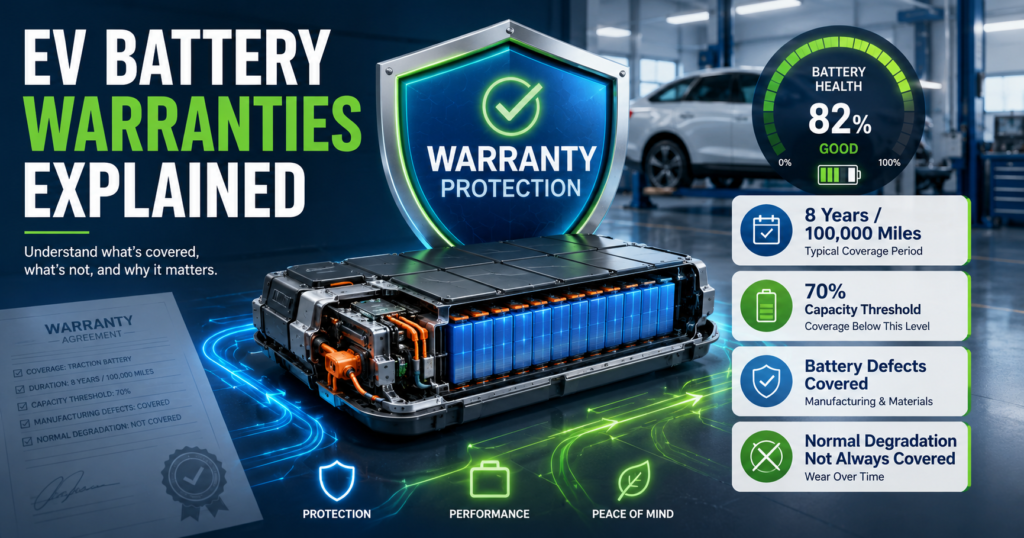
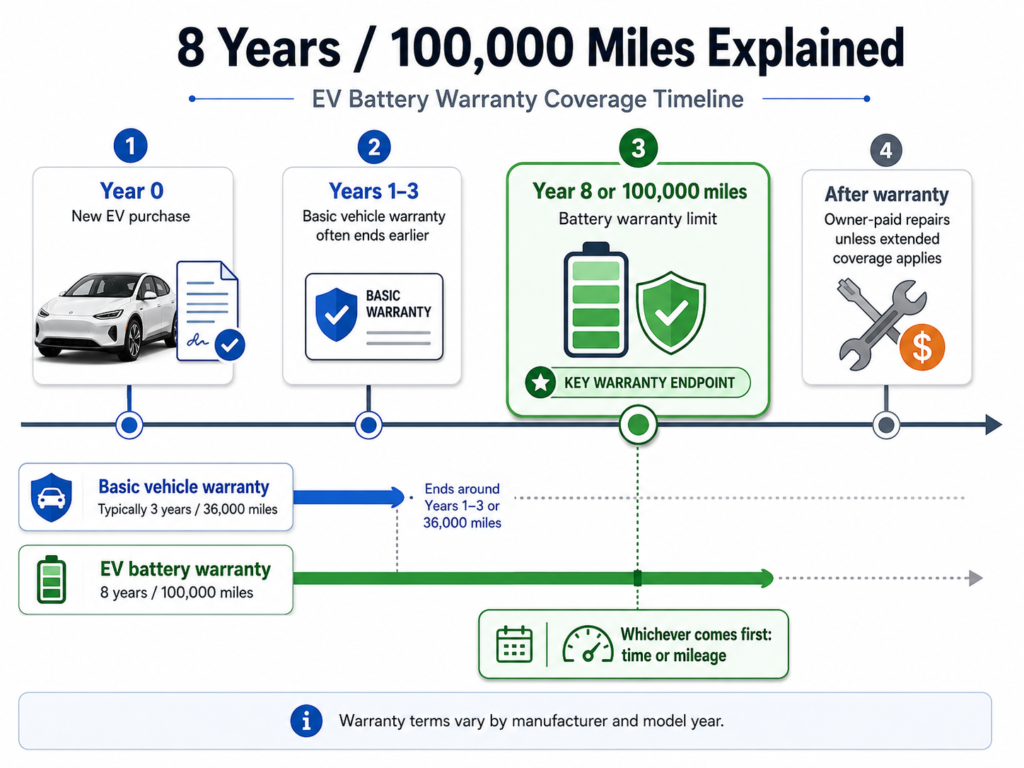
Most EV battery warranties in the U.S. cover the high-voltage battery for 8 years or 100,000 miles, whichever comes first. Many brands also include a capacity guarantee, often around 70% of original battery capacity. That means the warranty usually does not promise your EV will keep its original driving range. It promises that the battery will not fall below a defined health threshold during the warranty period.
Tesla, Ford, and Hyundai clearly use a 70% battery-capacity benchmark in their current warranty language. Hyundai goes further with a 10-year/100,000-mile hybrid, plug-in hybrid, and electric vehicle battery warranty. Chevrolet currently advertises an 8-year/100,000-mile battery limited warranty for its EVs, while some Chevrolet EV warranty documents have used a 75% capacity threshold, so owners should always check the warranty booklet for their exact model year (Tesla, Hyundai, Ford, Chevrolet).
Introduction
EV battery warranties sound simple at first. Most shoppers hear “8 years or 100,000 miles” and assume that means the battery is fully protected for almost a decade. The reality is a little more complicated.
An EV battery warranty does not usually mean your car will keep the same range it had on day one. It also does not mean every kind of battery-related issue is automatically covered. The warranty is mainly designed to protect owners from abnormal battery defects, severe capacity loss, and certain high-voltage battery failures during the warranty period.
That distinction matters because EV batteries do not behave like gasoline engines. They rarely go from “perfect” to “dead” overnight. More often, they slowly lose usable capacity over time. A car that once delivered 300 miles of range may eventually deliver 270 miles, then 250 miles, and still be considered normal.
For EV owners, used-EV buyers, and anyone comparing Tesla, Hyundai, Ford, and GM vehicles, the important question is not just “how long is the battery warranty?” The better question is: what exactly has to happen before the warranty pays for a repair or replacement? That is what this guide explains.
What an EV Battery Warranty Is Really Protecting
The battery warranty is separate from the normal bumper-to-bumper warranty. In most EVs, the basic vehicle warranty covers items such as electronics, interior components, suspension parts, switches, and many non-battery systems for a shorter period. Tesla, for example, lists a 4-year/50,000-mile basic vehicle warranty, while its battery and drive unit warranty lasts much longer depending on the model (Tesla).
The high-voltage battery warranty is different because the battery is the most expensive single component in the vehicle. It includes thousands of cells, battery management electronics, cooling systems, contactors, sensors, high-voltage connections, and structural protection.
But the warranty is not written to cover every change in battery behavior. It normally focuses on two broad problems. The first is a defect. This could mean a battery module, internal component, high-voltage connection, or related battery system fails earlier than expected because of materials or workmanship. In that case, the manufacturer may repair the pack, replace a module, or replace the entire battery pack, depending on the design and the failure.
The second is excessive capacity loss. This is where the famous 70% threshold comes in. If a battery falls below the manufacturer’s stated capacity-retention level during the warranty period, it may qualify for warranty service.
The key word is “excessive.” Gradual range loss is expected. A few percent of degradation over years of driving is not usually a warranty issue. Even a noticeable range drop may still be considered normal if the battery remains above the warranty threshold.
That is why battery warranties can feel confusing. A driver may feel that the car has lost too much range, while the manufacturer may still consider the battery healthy enough under the warranty terms.
Why 8 Years / 100,000 Miles Became the Common Standard
In the U.S. EV market, 8 years or 100,000 miles has become the most common EV battery warranty period. It is long enough to give new-car buyers confidence, and it is usually much longer than the basic vehicle warranty.
You will see this standard across many major EV brands. Tesla uses 8 years with mileage limits that vary by model and trim. Model 3 and Model Y RWD versions are listed at 8 years or 100,000 miles, while some premium, AWD, or performance versions receive 8 years or 120,000 miles. Model S, Model X, and Cybertruck are listed at 8 years or 150,000 miles, each with at least 70% battery capacity retention during the warranty period (Tesla).
Ford’s official support information states that hybrid and electric vehicle warranty coverage lasts 8 years or 100,000 miles, and Ford’s EV battery warranty language also refers to 70% capacity retention for covered battery-electric vehicles (Ford).
Chevrolet’s EV ownership page says every Chevy EV is backed by an 8-year/100,000-mile battery limited warranty (Chevrolet).
Hyundai is a notable exception on time. Its 2026 warranty handbook lists the hybrid, plug-in hybrid, and electric vehicle direct-energy components warranty at 10 years or 100,000 miles, and the same section states that covered EV battery repair or replacement will provide no less than 70% of original battery capacity (Hyundai).
For buyers, this means the headline warranty length is useful, but not enough. You also need to look at the capacity threshold, transferability, exclusions, and how the manufacturer measures battery health.
What the 70% Capacity Threshold Actually Means
The 70% capacity threshold is probably the most misunderstood part of EV battery warranties.
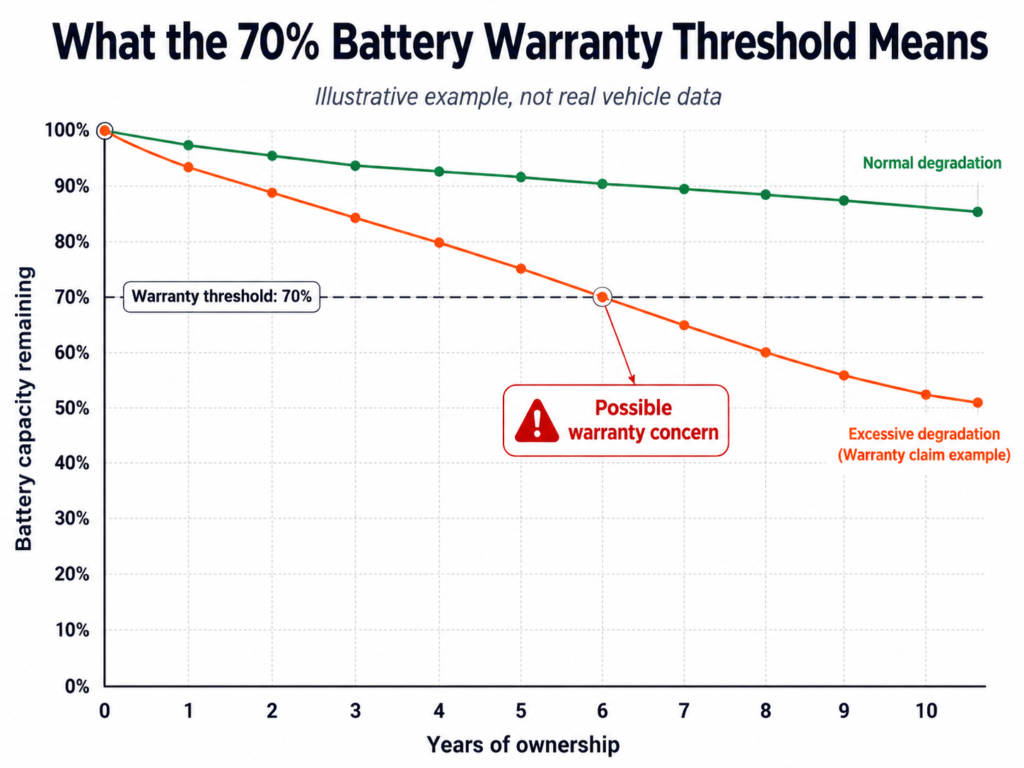
It does not mean the battery is expected to lose 30% of its range. It also does not mean the battery will definitely be replaced once the range feels lower. It means that, under the warranty, the manufacturer is generally promising the battery should retain at least 70% of its original capacity during the covered period.
A simple example helps. Imagine a new EV has an EPA-rated range of 300 miles. If its battery capacity dropped to 70% of its original usable capacity, the rough equivalent range might be around 210 miles under similar driving conditions. In real life, the number would vary because driving speed, weather, tires, HVAC use, and battery temperature all affect range.
Most modern EV owners will not see that much degradation during the warranty period. Real-world battery-health data continues to show that many EV batteries degrade gradually rather than failing suddenly. Recurrent, which tracks EV battery data from real-world vehicles, describes the standard U.S. battery warranty as 8 years or 100,000 miles and uses Tesla’s 70% warranty threshold as an example of how capacity guarantees are written (Recurrent).
This is also why range loss and battery failure should not be treated as the same thing. A battery that has lost 8%, 10%, or even 15% of its original capacity may be frustrating for some owners, but it is not necessarily defective.
For a deeper explanation of normal aging versus actual battery failure, see our related guide: EV Battery Range Loss vs Battery Failure (EV Insight Daily).
Tesla Battery Warranty: Strong Coverage, Different Mileage by Model
Tesla’s warranty structure is fairly clear because the company publishes battery and drive unit coverage by model.
As of the current Tesla warranty page, Model 3 RWD, Model Y RWD, and Model Y AWD are listed at 8 years or 100,000 miles with minimum 70% battery capacity retention. Some Model 3 and Model Y premium, AWD, and performance versions are listed at 8 years or 120,000 miles. Model S, Model X, and Cybertruck are listed at 8 years or 150,000 miles, also with minimum 70% battery capacity retention (Tesla).
That makes Tesla’s warranty especially mileage-dependent. A high-mileage driver buying a Model S or Model X gets more battery-warranty mileage than someone buying a rear-wheel-drive Model 3 or Model Y. For many owners, that may not matter. For someone driving 20,000 miles per year, it matters a lot.
Tesla also says the original battery and drive unit warranty remains with pre-owned vehicles, which is important for used Tesla buyers. The basic used-vehicle warranty may be different, but the remaining original battery warranty can still apply (Tesla).
The practical takeaway is simple: do not assume all Teslas have the same battery warranty. Check the exact trim, delivery date, and warranty screen in the Tesla app before buying.
Hyundai Battery Warranty: Longer Time, Same Key Capacity Benchmark
Hyundai’s EV battery warranty is one of the more consumer-friendly policies in the U.S. market because it extends to 10 years or 100,000 miles for hybrid, plug-in hybrid, and electric vehicle direct-energy components.
The 2026 Hyundai warranty handbook states that these components are covered for 10 years from the original retail delivery or first-use date, or 100,000 miles, whichever comes first. The same document explains that if an EV battery needs warranty service, the battery may be repaired or replaced, and that the repair or replacement will provide at least equal energy capacity to the battery before the failure, but no less than 70% of the original battery capacity (Hyundai).
That extra two years can be meaningful for lower-mileage owners. Someone who drives 10,000 miles per year could reach the 10-year mark before hitting 100,000 miles. In that situation, Hyundai’s longer time coverage may provide more peace of mind than a typical 8-year warranty.
There is one important detail, though: warranty terms can differ between the original owner and later owners depending on the specific warranty category. Hyundai’s EV battery section should be read together with the full warranty booklet for the exact model year and ownership situation.
For buyers comparing Hyundai IONIQ models with Tesla, Ford, or GM EVs, Hyundai’s 10-year period is a real advantage on paper. But as always, the fine print matters.
GM and Chevrolet Battery Warranty: Check the Exact Model-Year Manual
Chevrolet’s public EV pages clearly advertise an 8-year/100,000-mile battery limited warranty for Chevy EVs. The Chevrolet EV range and battery page says every Chevy EV is backed by an 8-year/100,000-mile battery limited warranty (Chevrolet).
Where GM requires more careful reading is capacity coverage.
Some Chevrolet EV-specific warranty documents state that the battery will be repaired or replaced if capacity falls below 75% of its original value during the warranty period, as determined by a certified dealer. That is higher than the commonly discussed 70% industry threshold, but the exact wording can vary by model year and document type (GM Answers).
A current 2026 Chevrolet limited warranty booklet available online describes propulsion battery coverage for 8 years or 100,000 miles and says gradual capacity loss is expected and not covered under the vehicle’s warranty. It also says Chevrolet may repair or replace the propulsion battery with new or refurbished components at Chevrolet’s discretion if service is required due to a defect in materials or workmanship (GM Answers).
So the safest way to write about GM/Chevrolet is not to assume a universal 70% rule. For shoppers, the better advice is this: Chevrolet provides the familiar 8-year/100,000-mile EV battery warranty, but the capacity-loss threshold should be verified in the warranty manual for that specific vehicle and model year.
This is especially important for used EV buyers. A 2024 Bolt EUV, 2025 Equinox EV, 2026 Blazer EV, and future Bolt may not all have identical warranty-language details.
Ford Battery Warranty: Standard Length, 70% Capacity Protection
Ford’s EV warranty is closer to the industry-standard structure. Ford’s official support material states that hybrid and electric vehicle warranty coverage lasts 8 years or 100,000 miles, and Ford warranty references for battery-electric vehicles describe protection against excessive battery capacity loss, typically tied to retaining at least 70% of original high-voltage battery capacity (Ford).
For Mustang Mach-E and F-150 Lightning shoppers, that means Ford’s warranty is generally competitive with Tesla’s lower-mileage Model 3 and Model Y coverage, but not as long as Tesla’s Model S, Model X, or Cybertruck mileage limit.
Ford also notes that improper vehicle storage can affect battery warranty coverage. This matters more than many owners realize. Letting an EV sit for a long time at an extremely low state of charge, or ignoring storage instructions, can create battery problems that may not be treated the same as a normal defect (Ford).
For most owners who drive and charge normally, this will not be an issue. But for seasonal vehicles, fleet vehicles, or EVs that sit unused for months, storage guidance is worth taking seriously.
Tesla vs Hyundai vs GM vs Ford: Quick Comparison
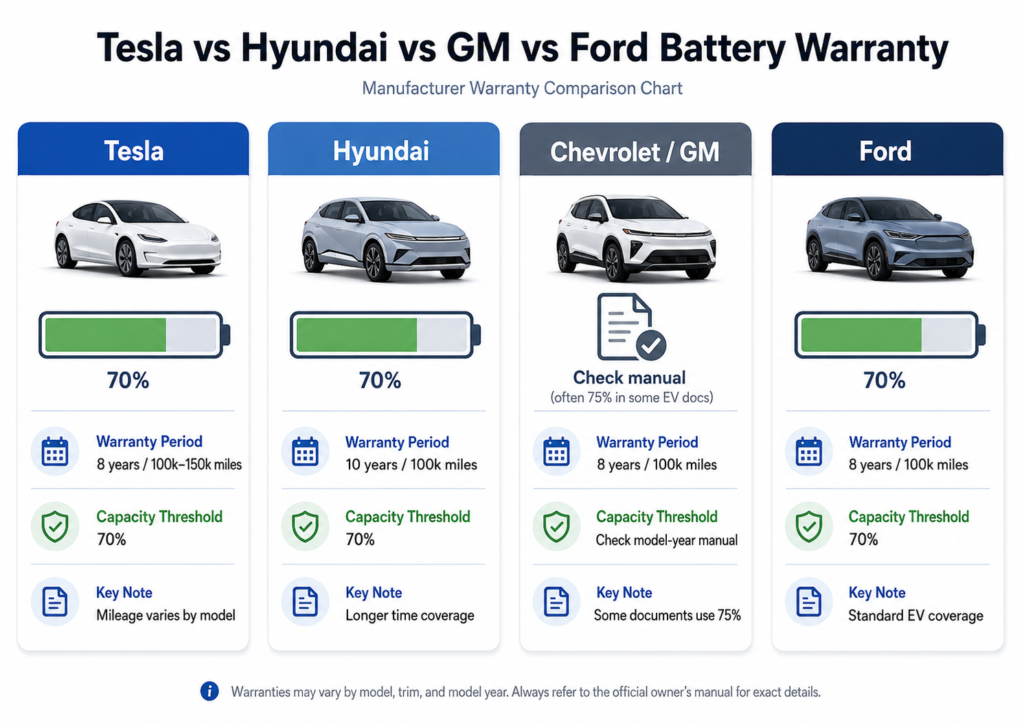
This table is useful for comparison, but it should not replace the actual warranty booklet. Automakers update warranty wording, and terms can vary by state, model year, battery type, ownership history, and whether the vehicle is new, certified pre-owned, or used.
What EV Battery Warranties Usually Do Not Cover
This is where many owners get surprised.
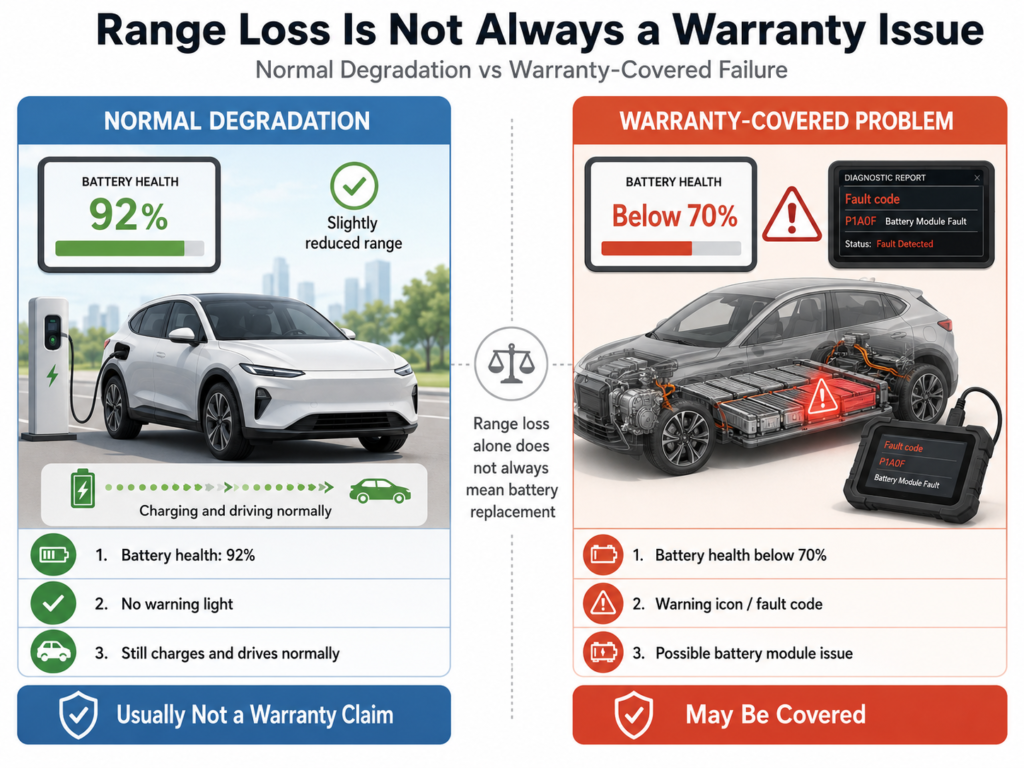
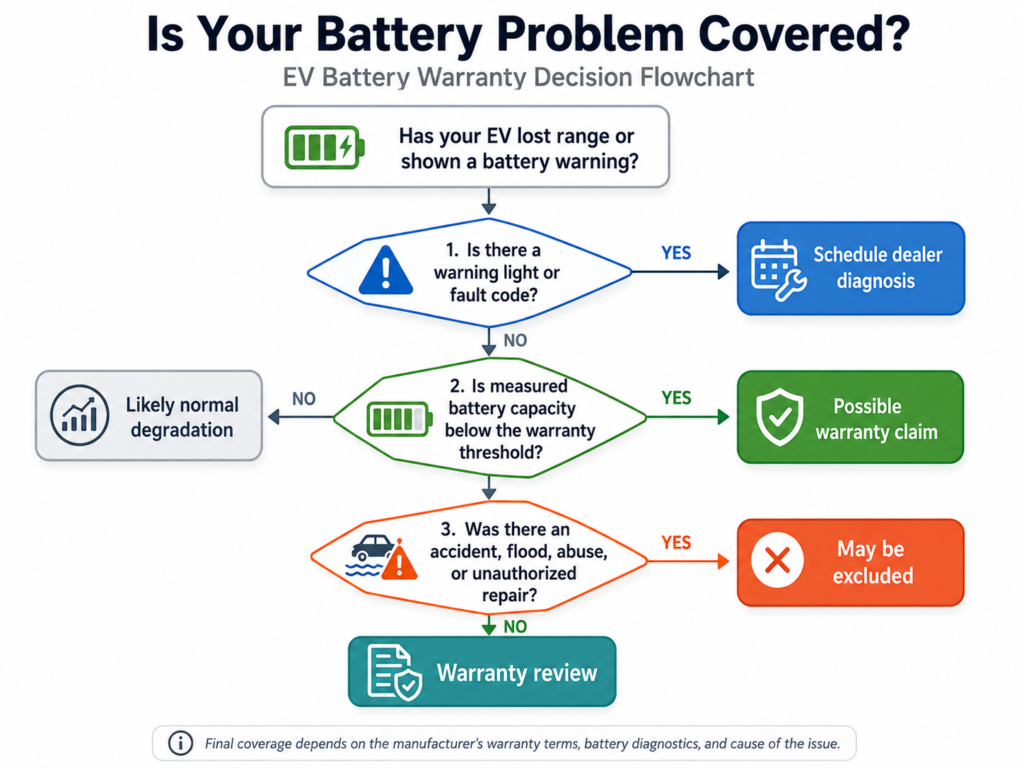
A battery warranty usually does not cover normal range loss above the threshold. If your EV loses some range after several years but remains above the warranty capacity limit, that is generally considered normal degradation.
It also may not cover damage caused by accidents, flooding, fire exposure, physical battery damage, unauthorized service, software or hardware modifications, improper charging equipment, or ignoring vehicle warnings. Hyundai’s warranty language, for example, excludes battery damage from intentional abuse, collision, unauthorized servicing or opening of the battery, direct flame exposure, and flooding (Hyundai USA).
Charging habits can also matter indirectly. A manufacturer usually cannot deny coverage simply because you used DC fast charging normally. However, damage caused by misuse, improper equipment, unauthorized modifications, or ignoring instructions can create warranty disputes.
This is one reason EV owners should avoid aftermarket battery modifications, unauthorized high-voltage repairs, and questionable charging adapters. Saving money in the short term can create a much bigger problem if the battery later needs warranty work.
Will the Manufacturer Replace the Whole Battery Pack?
Not always.
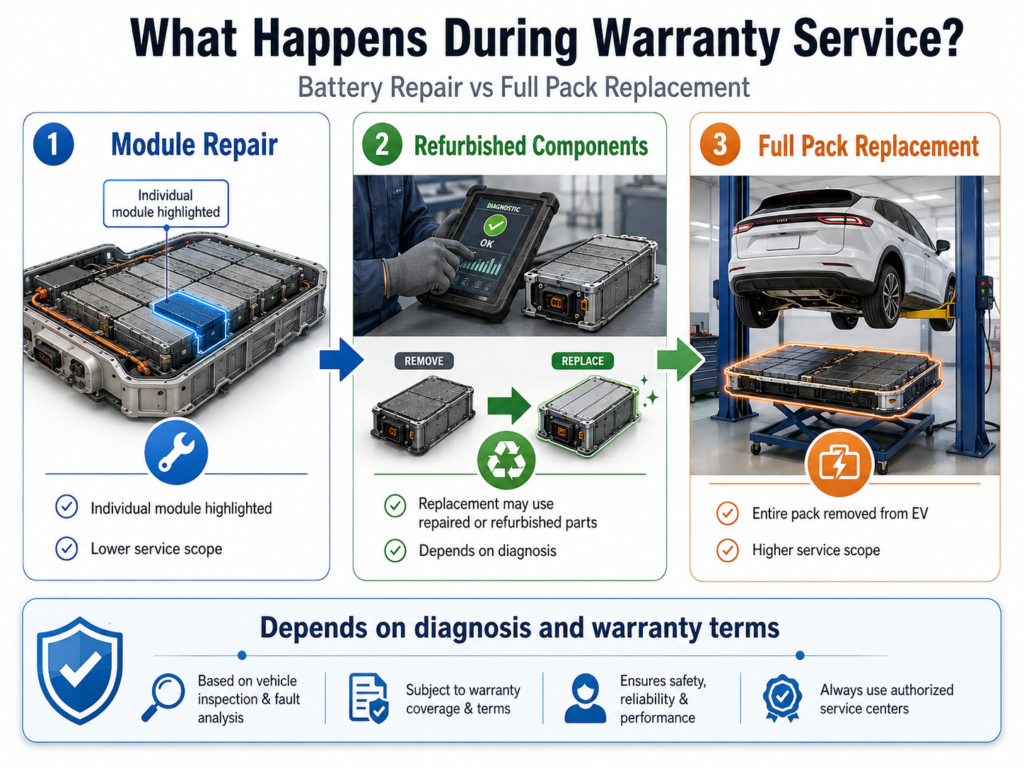
Many owners imagine battery warranty service as a full pack replacement. Sometimes that happens, especially if the pack has a serious defect or cannot be repaired economically. But automakers increasingly prefer targeted repair when possible.
Hyundai’s warranty handbook says EV battery components may be repaired or replaced if possible, and that if necessary, the EV battery may be replaced with either a new or refurbished lithium-ion battery (Hyundai USA).
Chevrolet’s 2026 warranty booklet also says the propulsion battery may be repaired or replaced with new or refurbished components at Chevrolet’s discretion when service is required due to a defect (GM Answers).
This matters because “replacement” does not always mean a brand-new battery pack. A warranty repair may involve a module, subcomponent, refurbished pack, remanufactured unit, or software-supported diagnostic process.
That may sound disappointing, but it is normal in the auto industry. Warranty repairs are meant to restore the vehicle to proper function under the warranty terms, not necessarily upgrade it to a brand-new battery.
For more background on why full pack replacement is still relatively rare, see our EV battery replacement cost guide.
How Battery Health Is Measured for Warranty Claims
This is one of the most important ownership details.
Your dashboard range estimate is not the same as official battery capacity. The number shown on the screen depends on recent driving efficiency, temperature, HVAC use, route, elevation, tire condition, and software assumptions.
For a warranty claim, the manufacturer or dealer usually needs to run a diagnostic test. That may include battery management system data, usable energy estimation, charge/discharge information, fault codes, temperature history, and sometimes more specialized procedures.
This is why an owner may say, “My range dropped from 300 miles to 240 miles,” while the dealer says, “The battery still passes.” Both can be true. The displayed range may have changed due to driving conditions, while the measured battery capacity may still be above the warranty threshold.
Modern EV battery SOH, or state of health, is not measured by one simple dashboard number. It is estimated using battery voltage, current, temperature, charge throughput, model-based estimation, and sometimes more advanced diagnostic methods. We explained this in more detail in our guide to EV battery SOH measurement.
Why Battery Care Still Matters Even With a Warranty
A warranty is protection against abnormal problems. It is not a reason to ignore battery care.
Most EV owners do not need to baby the battery, but a few habits can help preserve long-term range. Avoid leaving the battery at 100% for long periods unless the owner’s manual recommends it. Avoid letting the battery sit near 0% for extended storage. Use DC fast charging when needed, but do not treat it as the only charging method if Level 2 charging is convenient. Pay attention to battery preconditioning in cold weather. And in very hot climates, covered parking or a garage can help reduce long-term heat exposure.
Chevrolet’s own battery-health tips recommend charging to 80% for daily use on many Chevy EVs, charging above 80% for longer trips when needed, and keeping the vehicle plugged in when possible to help condition the battery. Chevrolet also notes that the Bolt is an exception to its 80% recommendation and should be regularly charged to 100% for accurate range and battery-level display (Chevrolet).
This is not about fear. It is about reducing avoidable stress. Heat, high state of charge, low-temperature fast charging, and repeated high-current charging can all influence battery aging. NREL research has discussed how fast charging and sustained operation can increase battery temperature and degradation risk, while active cooling systems can help control peak battery temperatures.
For related reading, see our article on why EV batteries charge slower above 80%.
What Used EV Buyers Should Check Before Purchase
Battery warranty matters even more in the used EV market.
A used EV may still have several years of battery coverage left, but you should verify it rather than assume. Ask for the VIN, check the in-service date, review the warranty status in the manufacturer app or owner portal if available, and confirm whether the battery warranty transfers to the next owner.
Tesla states that the remaining original battery and drive unit limited warranty still applies to pre-owned vehicles purchased directly from Tesla (Tesla). Hyundai’s full warranty booklet should be checked carefully because different warranty categories may have different transfer rules (Hyundai USA).
Used EV buyers should also look for signs of accident history, flood damage, battery replacement history, open recalls, charging problems, and abnormal range behavior. A clean battery report is useful, but it should not be treated as a perfect prediction of future battery life.
The best used EV is not necessarily the one with the biggest original range. It is often the one with a healthy battery, complete service history, remaining warranty coverage, and charging habits that match your daily routine.
Conclusion
EV battery warranties are better than many people realize, but they are also more limited than the headline numbers suggest.
The common 8-year/100,000-mile warranty is mainly there to protect owners from abnormal battery defects and severe capacity loss. The 70% threshold used by Tesla, Hyundai, and Ford does not mean your battery is expected to lose 30%. It simply defines the point where capacity loss may become a warranty issue.
Hyundai stands out with a 10-year/100,000-mile EV battery warranty. Tesla offers longer mileage coverage on certain models. Ford follows the common 8-year/100,000-mile structure with 70% capacity language. Chevrolet also offers 8-year/100,000-mile EV battery coverage, but GM/Chevrolet capacity terms should be checked by exact model year because some EV-specific documents use a 75% threshold rather than the more common 70%.
For owners, the most practical mindset is this: use the warranty as a safety net, not as a battery-care strategy. Most modern EV batteries are designed to last well beyond the early ownership period, but good charging habits, temperature management, and careful used-EV inspection still matter.
FAQ
Does an EV battery warranty cover normal range loss?
Usually not. Normal battery degradation is expected. The warranty typically applies only if the battery falls below the manufacturer’s stated capacity threshold during the warranty period or if there is a covered defect.
Is 70% battery capacity considered failure?
Not exactly. A 70% threshold is usually a warranty trigger, not a technical definition of total failure. An EV with 70% battery capacity may still drive, but with significantly reduced range.
Will my EV battery be replaced with a brand-new battery?
Not always. The manufacturer may repair the pack, replace modules, install refurbished components, or replace the full pack depending on the diagnosis and warranty terms.
Does fast charging void the battery warranty?
Normal DC fast charging generally does not void the warranty. However, damage from improper charging equipment, unauthorized modifications, abuse, or ignoring manufacturer instructions may not be covered.
Which EV brand has the best battery warranty?
Among the brands discussed here, Hyundai offers one of the longest time periods at 10 years or 100,000 miles. Tesla offers higher mileage limits on some models. The best warranty depends on your model, driving mileage, ownership period, and whether you are buying new or used.