
Quick Answer
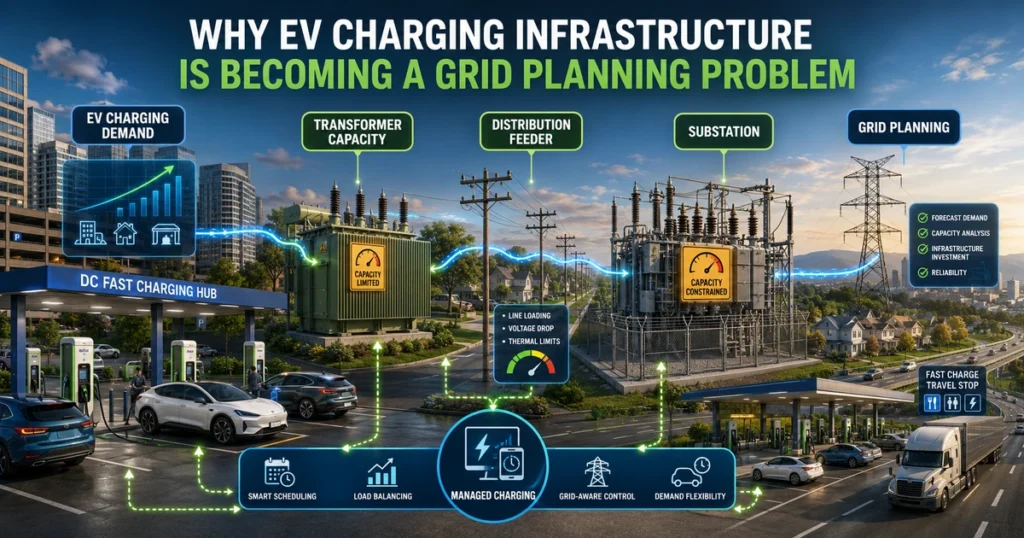
EV charging grid planning is becoming one of the most important infrastructure challenges in the transition to electric vehicles. The next stage of EV charging expansion will not be defined only by how many chargers are installed. It will increasingly depend on whether local distribution grids, substations, feeders, transformers, and commercial electrical systems can deliver enough power at the right locations.
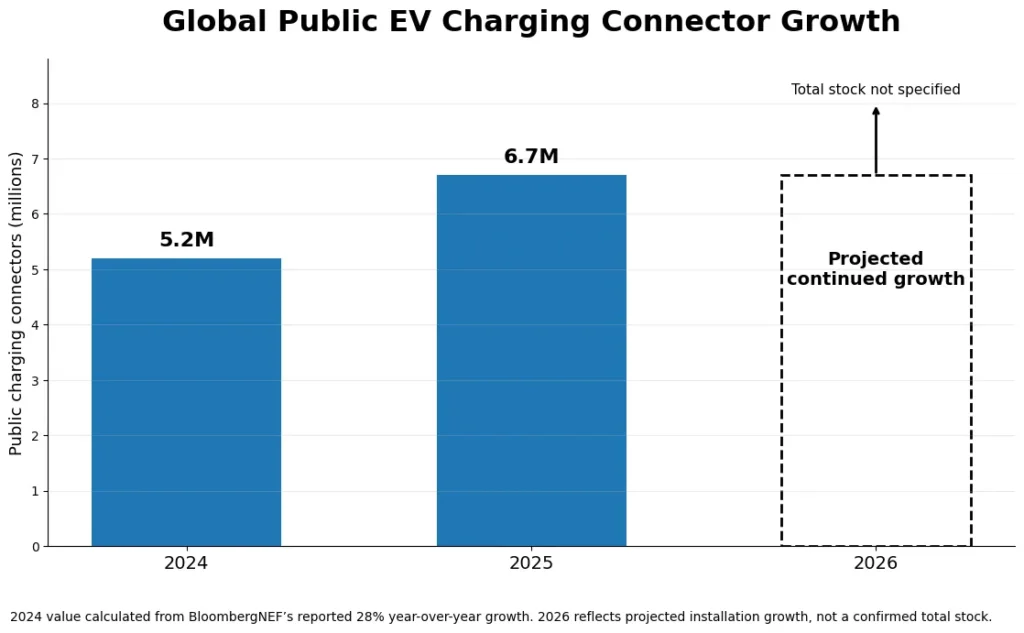
Global public charging networks are still growing rapidly. According to BloombergNEF’s Electric Vehicle Outlook 2026, the number of public charging connectors increased 28% in 2025 to 6.7 million. BloombergNEF expects installations to continue rising in 2026, although at a slower rate.
But a charger on a map does not necessarily mean the grid behind it is ready. A highway charging plaza with twelve 350-kW chargers can create several megawatts of potential demand. An apartment district may need hundreds of lower-power charging connections. A suburban neighborhood may have plenty of garages but aging residential transformers. A delivery depot may need to charge dozens of vehicles in the same overnight window.
These are not simply charger-installation problems. They are power-system planning problems. The most successful charging networks will therefore be built through coordination among charging companies, utilities, property owners, cities, regulators, automakers, and software providers. The goal will no longer be just to install more plugs. It will be to place the right type of charging where the electrical system can support it—or where grid upgrades and flexible charging can make it supportable.
Introduction
The global EV charging network is expanding quickly. Millions of public charging connectors are now available worldwide, and governments, automakers, utilities, and charging companies continue to announce new stations.
But the next phase of charging growth will be more complicated than installing additional hardware. A charger may be visible to drivers, but the electrical infrastructure supporting it is mostly hidden. Transformers, distribution feeders, substations, commercial service connections, and utility upgrade schedules determine how much charging power can actually be delivered at a location.
That distinction is becoming increasingly important as charging projects grow larger. A few Level 2 chargers may fit within an existing building connection. A highway fast-charging hub or fleet depot may require several megawatts of power, new transformers, and upgrades extending far beyond the parking lot.
The EV charging challenge is therefore shifting. The industry still needs more reliable and conveniently located chargers, but charger count alone is no longer the best measure of infrastructure readiness. Local grid capacity, charging behavior, site location, and software control are becoming equally important.
The Charging Conversation Has Focused on the Wrong Number
For years, the EV infrastructure debate has revolved around one simple question: How many public chargers do we need? That number is easy to understand. Drivers can see charger icons on an app. Governments can announce funding for thousands of new ports. Charging companies can report how many stations they operate. Automakers can tell buyers that a network is expanding.
The number of connectors still matters. A driver cannot use infrastructure that does not exist, and areas with few reliable stations remain a real barrier to EV adoption. The International Energy Agency’s Global EV Outlook 2026 estimates that the worldwide stock of public charging points exceeded 7 million by the end of 2025. Nearly 1.8 million public points were added during the year.
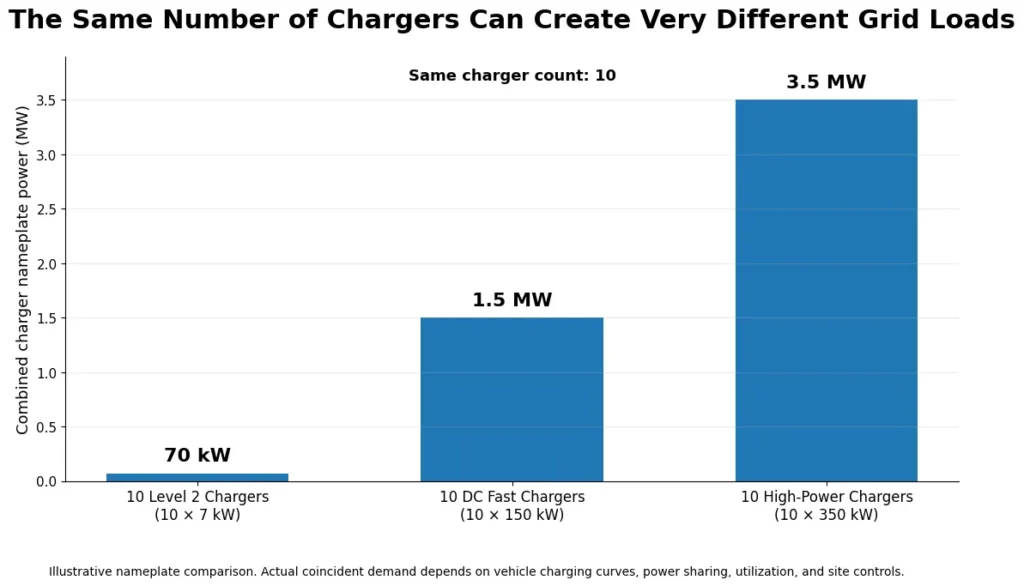
Yet total charger count gives only a partial picture. Ten Level 2 chargers in a shopping-center parking lot are not equivalent to ten high-power DC fast-charging stalls along an interstate. A charger that is regularly occupied, broken, derated, or waiting for a utility connection does not provide the same value as a reliably powered station in the right location.
More importantly, charger counts say very little about what is happening behind the meter. The grid does not see “one charger.” It sees electrical load. That load can be small and flexible, or it can be large, concentrated, and difficult to serve.
A 7-kW residential charger operating overnight is a very different grid resource from a 350-kW highway charger. A row of apartment chargers may be manageable if their power is shared intelligently. A truck-charging depot can create demand similar to a major industrial facility. Treating all connectors as equal hides the part of the problem that is becoming most important.
A Charging Station Is Also a Power Facility
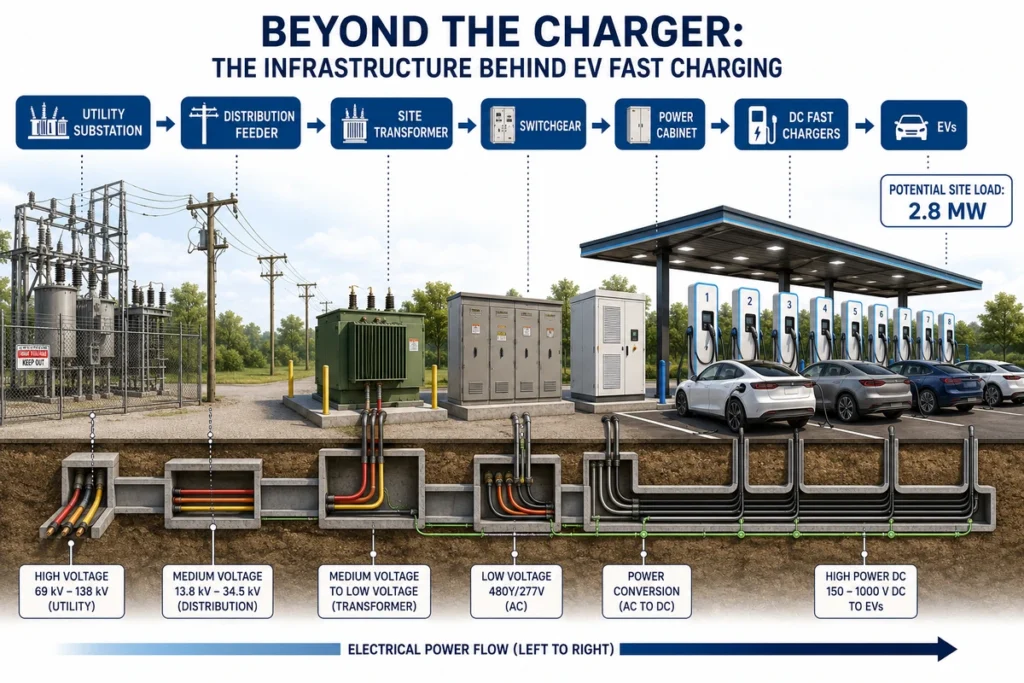
A modern public fast-charging site may look like a parking lot with charging dispensers. Electrically, however, it can resemble a small commercial or industrial facility. Consider a station with eight chargers rated at 350 kW. The simple nameplate total is:
8 × 350 kW = 2.8 MW
The site may not draw 2.8 MW continuously. Not every vehicle will request maximum power at the same time, and actual charging power depends on battery state of charge, temperature, vehicle architecture, and charging-curve limits. As explained in Why EV Batteries Charge Slower Above 80%, a charger’s maximum rating does not mean the vehicle accepts that power throughout the session.
Even so, the charging operator and utility must plan for a meaningful coincident load. The site may require new switchgear, larger service conductors, utility transformers, protection equipment, metering, and possibly feeder or substation upgrades.
The charger dispensers are often the most visible part of the installation, but they may not be the most difficult part.
- The harder questions are less visible:
- Can the nearest distribution feeder handle the additional peak load?
- Does the substation have enough capacity?
- Will a new transformer be needed?
- Is suitable three-phase service available?
- How long will the interconnection study take?
- Will the utility need new easements, permitting, or upstream equipment?
- Can the station operate at reduced power until a larger connection becomes available?
Those questions determine whether a planned charging site opens in months or waits years for electrical upgrades.
Why EV Charging Grid Planning Depends on Local Distribution Capacity
Discussions about EV grid impact often focus on total national electricity consumption. People ask whether the United States can generate enough electricity if millions of vehicles become electric. That is a valid long-term question, but it can distract from the more immediate challenge.
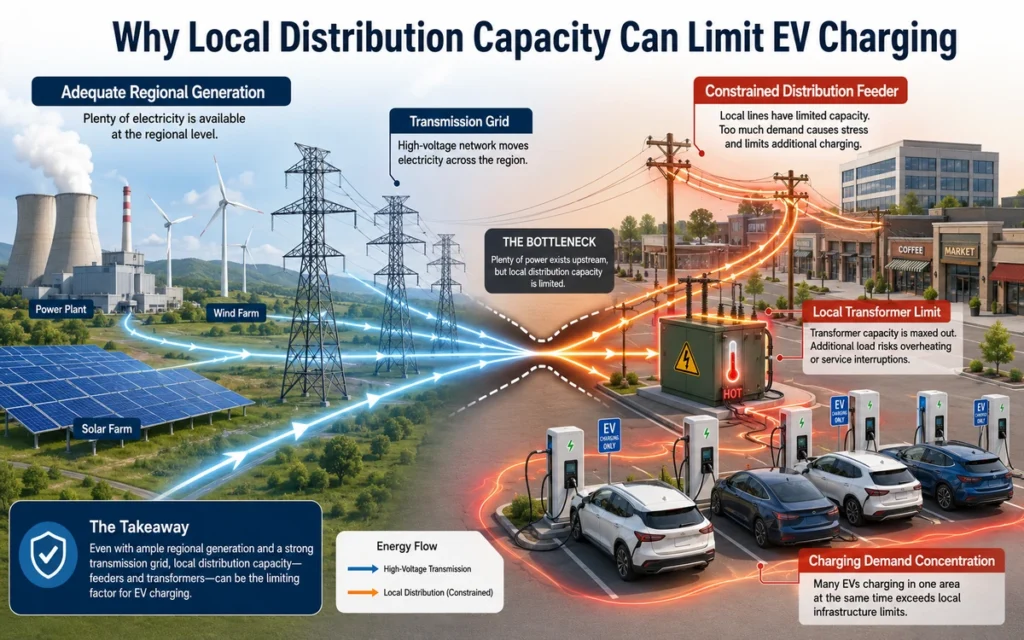
The first grid bottleneck is often not the amount of energy generated across the country. It is whether electricity can be delivered through a particular transformer, feeder, or substation at a particular hour. Electric power moves through several layers. Large generators send electricity through the high-voltage transmission network. Substations reduce voltage, and distribution systems deliver power to neighborhoods, businesses, parking facilities, and charging stations.
A region may have sufficient generation in annual energy terms while still facing a local capacity problem. A specific feeder may already be heavily loaded on hot summer afternoons. A neighborhood transformer may be sized around historical household demand. A commercial district may have electrical infrastructure designed before multi-megawatt EV charging was considered. This makes EV charging a highly local problem.
A charger developer cannot solve a constrained feeder by pointing to unused generation hundreds of miles away. Power must physically reach the site through equipment with limited thermal and electrical capacity. The U.S. Department of Energy’s work on distribution-system planning reflects the growing importance of more proactive planning. Utilities increasingly need to forecast transportation electrification alongside rooftop solar, batteries, heat pumps, data centers, and other new electrical loads.
The challenge is not simply predicting how much electricity EVs will consume. It is predicting where vehicles will charge, when they will charge, and how much of that demand will occur simultaneously.
Substation Capacity Is Becoming a Site-Selection Issue
In the gasoline era, a developer searching for a new fueling site cared about traffic volume, visibility, access, land cost, and nearby amenities. Those factors still matter for EV charging, but electrical capacity is becoming an equally important part of site selection.
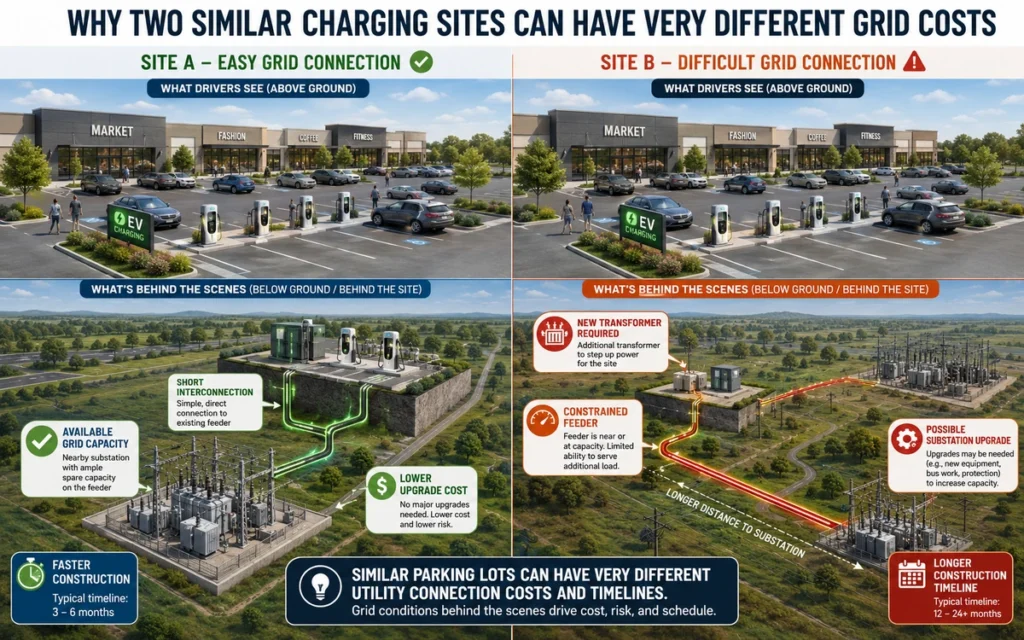
Two retail properties across the street from each other may appear almost identical to drivers. From the utility’s perspective, they may be completely different. One may sit close to a substation with available capacity. The other may be connected to a feeder that is already near its planning limit. One may have access to suitable three-phase power. The other may require a long line extension or a major transformer upgrade. As a result, the best visible location is not always the easiest electrical location.
This creates a difficult tradeoff. Charging companies want stations where drivers need them, not merely where unused grid capacity happens to exist. Utilities, meanwhile, cannot instantly move substation capacity to the most convenient parking lot. The mismatch becomes more serious for charging hubs, fleet depots, electric bus facilities, and future heavy-duty truck charging. These sites can require power at a scale that changes the local utility planning process.
A large depot is not just another commercial customer adding a few chargers. It may be a new multi-megawatt load with a predictable but concentrated operating schedule. The required electrical infrastructure could include a dedicated substation, medium-voltage distribution, on-site battery storage, and sophisticated energy management. In other words, charger placement is gradually becoming inseparable from grid topology.
Why Highway Fast Charging Is a Special Challenge
Highway charging appears simple from a network-planning perspective. Drivers need reliable stations along major travel corridors, so chargers should be installed at regular intervals near interstate exits. The electrical reality is more complicated.
Some highway locations are far from dense electrical infrastructure. A travel center may have enough power for lighting, restaurants, fuel pumps, refrigeration, and ordinary building loads, but not enough for a large bank of high-power chargers. Early charging sites could sometimes begin with four or six stalls. Future demand may require twelve, twenty, or more. At the same time, newer EVs increasingly support high charging power.
Vehicle voltage is part of that trend. As discussed in 400V vs 800V EV: Why Higher Voltage Matters, an 800V-class vehicle can deliver the same charging power at lower current than a comparable 400V system. This can reduce resistive losses and make very high charging power easier to manage on the vehicle side.
But improved vehicle architecture does not create utility capacity. A station serving several 800V vehicles simultaneously still needs enough input power. Faster charging may reduce how long each vehicle occupies a stall, but it can also raise the site’s instantaneous power requirement.
This is why some highway charging sites may need phased expansion. A developer might install the full number of parking stalls and dispensers while initially limiting total site power. Additional capacity could be added later as utility upgrades are completed.
On-site batteries may also help by charging more slowly from the grid and discharging during periods of high charging demand. That can reduce short-duration peaks, although storage does not eliminate the need to supply the site’s total energy over time.
The Urban Charging Problem Is Not the Suburban Charging Problem
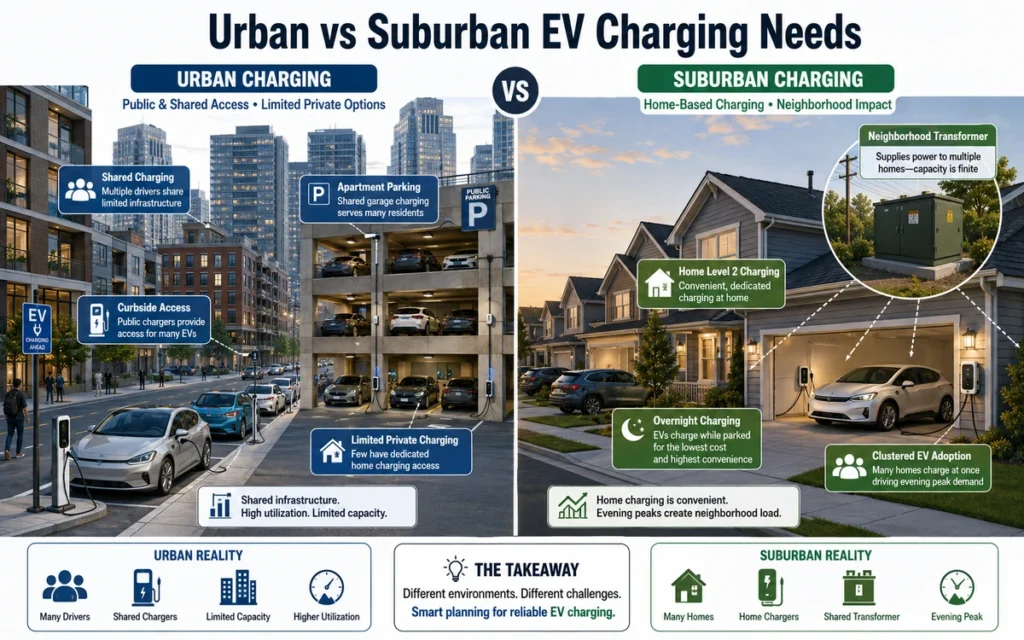
EV charging infrastructure is often discussed as though every driver has the same needs. In reality, the charging problem changes dramatically with housing type and land use. In suburban areas, many EV owners can charge in private garages or driveways. Public charging may be used mainly for road trips, occasional convenience, or drivers who cannot install home equipment.
Urban neighborhoods have a different problem. Many residents live in apartments, condominiums, or homes without dedicated parking. Even when a parking garage exists, installing chargers may require negotiations among landlords, tenants, homeowners’ associations, utilities, electricians, and local permitting authorities.
The IEA continues to describe home charging as the most common form of EV charging, while emphasizing that public access becomes increasingly important for drivers without private charging. This creates an urban-suburban mismatch. A suburban county may show strong EV adoption because homeowners can install Level 2 chargers relatively easily. Yet the same area may have limited public fast charging because most residents do not depend on it.
A dense city may have many potential EV buyers but weak access to overnight charging. Installing more highway fast chargers outside the city does not solve that problem. Urban residents may need curbside charging, workplace charging, shared garage charging, lower-power community hubs, or chargers integrated into existing parking facilities.
The optimal infrastructure is therefore not always the fastest charger. A vehicle parked for eight hours does not necessarily need 150 or 350 kW. It may need a reliable 6–11 kW connection, fair billing, and the ability to share electrical capacity with many other vehicles.
This is where software-controlled load sharing becomes especially valuable. Instead of assuming every parking space requires full power simultaneously, the system can distribute available power based on departure time, state of charge, price, and grid conditions.
Residential Transformers Can Become Local Bottlenecks
Home charging is often described as the easiest form of EV charging. For an individual homeowner, that may be true. A Level 2 charger can often be installed using a 240V circuit, and most vehicles remain parked long enough to charge gradually overnight. The grid impact appears modest when only one home on a street owns an EV.
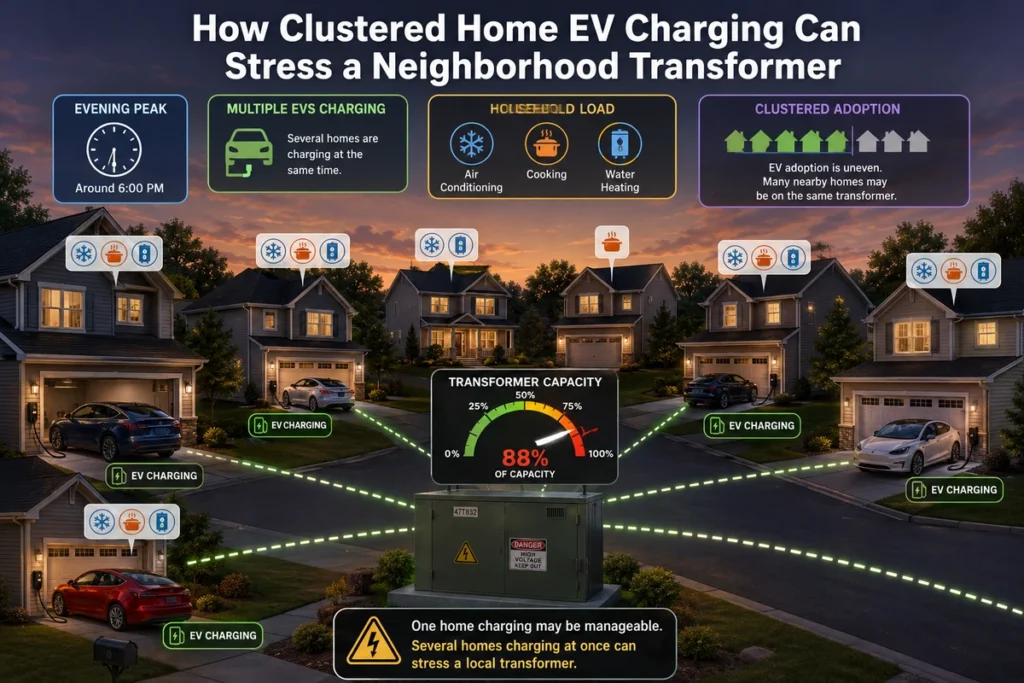
The planning problem changes when EV adoption clusters. New technologies rarely spread evenly. Neighbors often have similar incomes, commute patterns, housing types, and purchasing habits. Several households on one residential transformer may adopt EVs within a relatively short period.
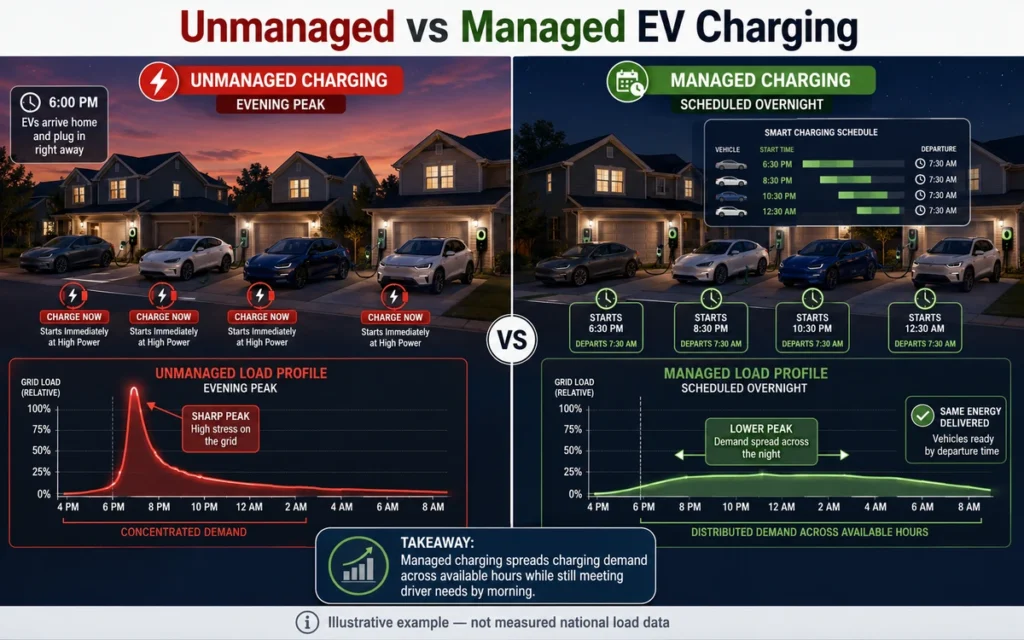
If drivers all return home around 6 p.m. and begin charging immediately, EV load can overlap with air-conditioning, cooking, water heating, and other household demand. The total annual energy may still be manageable, but the local evening peak can increase sharply.
Utilities generally design distribution equipment with diversity in mind. Not every appliance operates at maximum power simultaneously. Unmanaged EV charging can reduce that diversity because many vehicles follow similar daily schedules. This does not mean residential EV charging will automatically overload the grid. It means utilities need better visibility and forecasting at a neighborhood level.
They may need to know where chargers are being installed, how quickly EV adoption is rising, and whether charging behavior can be shifted away from existing peaks. Traditional planning based mainly on historical load growth may not be enough. Transportation electrification can appear unevenly and move faster than normal replacement cycles for transformers and other equipment.
Fleet Charging Changes the Scale of the Problem
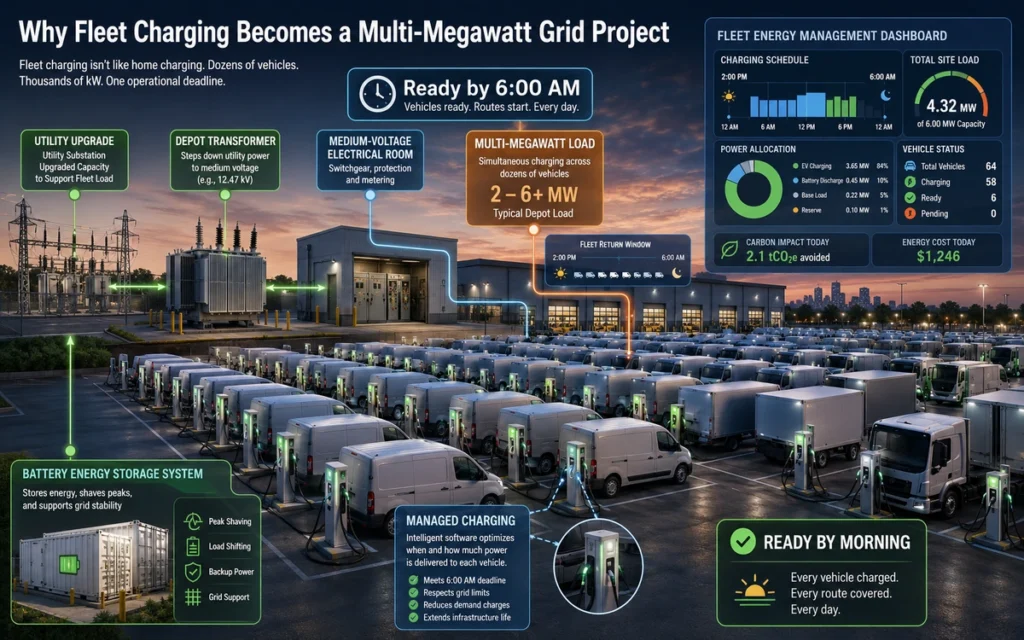
Passenger EV charging receives most public attention, but fleets may create some of the most demanding grid connections. A household might add one 7–11 kW charger. A fleet depot could add dozens or hundreds of chargers. Even when each vehicle charges at moderate power, the combined load can be substantial.
Delivery vans often return to the depot around the same time and need to be ready the next morning. Electric school buses may have predictable daily schedules but limited charging windows. Ride-hailing vehicles may depend on public fast chargers during high-demand periods. Heavy-duty trucks can require very high power because of their large batteries and strict operating schedules.
Fleet operators also face a different economic problem. They cannot simply tell drivers to wait several years for utility upgrades after vehicles have been purchased. The charging connection must be coordinated with vehicle procurement, construction, route planning, permitting, and utility infrastructure. A mismatch in timing can leave expensive electric vehicles underused because the depot cannot charge them.
That is why utilities need early information from fleet customers. A planned 10-MW depot cannot be treated like an ordinary service request submitted shortly before construction. The utility may need years to study the connection, order specialized equipment, upgrade feeders, or expand a substation. Charging infrastructure planning must begin before the vehicles arrive, not after.
Managed Charging Can Turn EVs Into Flexible Load
The good news is that EV charging is more flexible than many other large electrical loads. A vehicle may be connected for ten hours but need only three hours of charging. That unused time creates scheduling flexibility. Managed charging uses software to adjust charging power or timing based on factors such as:
- Driver departure time
- Required state of charge
- Electricity price
- Building demand
- Transformer loading
- Renewable energy availability
- Utility signals
- Total power available at the site
The driver still receives the energy needed for the next trip, but the vehicle does not necessarily begin charging at maximum power as soon as it is plugged in. Research from the U.S. Department of Energy, NREL, Berkeley Lab, and Kevala illustrates why this matters. In its multi-state transportation electrification study, managed charging reduced estimated incremental distribution-grid investment needs by approximately 30% under the analyzed scenario.
The study also found reductions in modeled needs for substations, feeders, and service transformers. The exact results should not be treated as a universal promise for every utility, but they show the scale of the opportunity. Managed charging does not remove electrical limits. It cannot deliver unlimited energy through an undersized connection. What it can do is prevent every vehicle from demanding maximum power at the same moment.
The Berkeley Lab vehicle-grid integration program similarly studies EVs as flexible, relatively high-power loads that can be coordinated to reduce grid costs and distribution-level impacts. This is why the future of charging will be increasingly software-defined. Physical chargers matter, but the control system deciding when and how they operate may determine whether a site needs an immediate grid upgrade.
Flexible Interconnections Could Help Sites Open Sooner
Traditional utility interconnection is often based on a firm capacity assumption. If a charging site requests 5 MW, the grid may be studied and upgraded so that the full 5 MW can be delivered whenever the customer asks for it. That approach is reliable, but it can be slow and expensive when the local network is constrained.
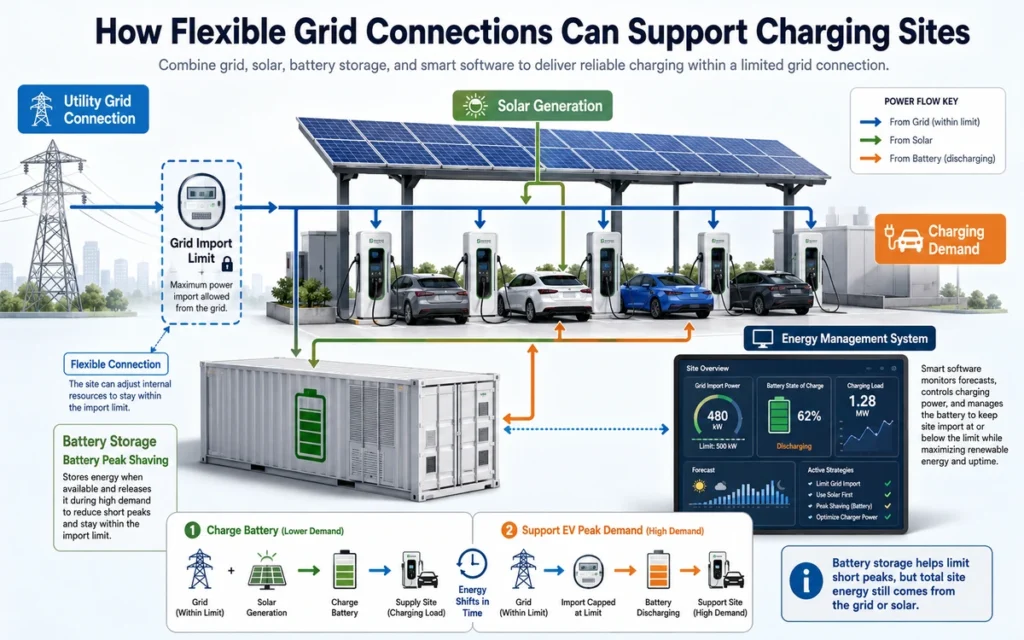
A flexible interconnection offers another possibility. The site may agree to operate within dynamic limits set by grid conditions. For example, it could use its full capacity during unconstrained hours but reduce charging power during certain local peaks or contingencies. DOE’s report on Flexible DER and EV Connections describes this type of approach as a way to address distribution-capacity constraints by optimizing the timing and magnitude of EV charging.
For fleet depots and charging hubs, flexible connections could sometimes allow earlier operation while a permanent upgrade is planned. On-site batteries, solar generation, and energy-management software may help the facility stay within its agreed import limit.
There are tradeoffs. Charging operators need predictable service. Drivers will not accept a highway station that becomes unusably slow whenever local demand rises. Utilities also need reliable communications, control rules, cybersecurity, and clear responsibility when capacity is curtailed. Flexible connections are therefore not a substitute for all grid investment. They are another planning tool.
Battery Storage Helps, but It Does Not Create Energy
Battery storage is increasingly proposed as a solution for grid-constrained charging sites. The idea is straightforward. The battery charges from the grid when demand is lower, then supplies part of the charging load when several vehicles arrive at once. This can reduce the peak power seen by the utility. For example, a site that occasionally reaches 2 MW may be able to operate with a smaller grid connection if an on-site battery supplies the difference during short peaks.
Storage can also provide backup functions, participate in demand-response programs, or pair with local solar generation. But batteries should not be described as a magical replacement for the grid. A storage system shifts electricity through time. It does not produce the energy required by the vehicles. If a busy station delivers 20 MWh to vehicles each day, that energy ultimately has to come from the grid or on-site generation regardless of how the battery smooths the peak.
Storage works best when charging demand is uneven. It is less effective when the site operates near maximum load continuously, because the battery has little time to recharge. The same distinction appears in other emerging grid loads. EV Insight Daily’s discussion of AI data center battery storage explains that batteries can smooth peaks and improve flexibility, but they do not eliminate the need for substations, transmission, generation, and long-term grid planning.
Why Utilities Need Better Charging Forecasts
Utility planning has traditionally relied on historical load, population growth, economic development, weather, and known customer projects. EV charging adds new uncertainties.
- How quickly will EV adoption grow in a particular neighborhood?
- How many apartment residents will depend on public charging?
- Will drivers charge immediately after work or respond to time-of-use prices?
- Will a fleet electrify ten vehicles or two hundred?
- Will a highway station expand from eight stalls to thirty?
- Will future vehicles charge faster but stay for less time?
- Will autonomous fleets create new charging patterns?
The answer to each question affects grid investment. Underestimating demand can cause long connection delays, overloaded equipment, or rushed upgrades. Overestimating demand can leave customers paying for infrastructure that is underused for years.
Better planning requires data sharing without compromising customer privacy. Utilities need geographically useful adoption forecasts. Charging companies need clearer information about available grid capacity. Cities need to incorporate charging demand into land-use and transportation plans. Fleet operators need to communicate electrification schedules early.
Some utilities are beginning to publish hosting-capacity maps or provide preliminary service-capacity information. These tools are not perfect, and distribution capacity can change as other customers connect, but they can help developers avoid pursuing sites that are clearly difficult to serve.
The long-term goal should be coordinated planning rather than sequential planning. The old sequence was: select a site, sign a lease, design the station, and then ask the utility for power. The better sequence is: understand transportation demand, review grid capacity, compare sites, plan upgrades, design flexible operation, and coordinate construction schedules.
Charger Reliability Also Depends on Grid-Side Design
Public charging reliability is usually discussed in terms of broken connectors, payment failures, communication problems, damaged cables, or software errors. Those issues matter, but electrical design can also affect reliability.
A station may be operational yet deliver less power than drivers expect because total site capacity is shared among stalls. Charging performance may be reduced during extreme weather. A transformer or switchgear failure can disable multiple chargers simultaneously. A site waiting for permanent utility service may operate under temporary power limits.
This is one reason advertised charger power can be misleading. A 350-kW label describes the maximum capability of an individual charger under appropriate conditions. It does not guarantee that every stall can provide 350 kW simultaneously. It also does not guarantee that the connected vehicle will request that power.
For a closer look at the vehicle side of this issue, see Why Some EVs Charge Faster Than Others. Vehicle voltage, battery temperature, battery chemistry, state of charge, thermal management, and BMS calibration all influence the final charging rate. The station and vehicle form one system. Grid capacity sits behind both.
The Best Charging Network Will Not Use One Type of Charger
A grid-aware charging strategy does not try to install the fastest possible charger everywhere. Instead, it matches charging power to how long vehicles remain parked and how much energy they need.
Homes, apartment garages, and workplaces can often use lower-power AC charging because vehicles stay for hours. Retail locations may benefit from moderate-power charging. Highway corridors need high-power DC charging because drivers want to resume travel quickly. Fleet depots require solutions tailored to routes, dwell time, battery size, and operating schedules.
This mixed approach is better for drivers and more efficient for the grid. Installing a 350-kW charger where vehicles typically remain parked for four hours may add unnecessary cost and connection complexity. Installing only slow chargers along an interstate would create unacceptable delays. The question is not simply, “How many chargers should be installed?” It is:
- What vehicles will use them?
- How long will those vehicles stay?
- How much energy will they need?
- What grid capacity is available?
- Can the load be managed?
- How will demand change over the next ten years?
That is the language of infrastructure planning, not merely equipment deployment.
The Charging Industry Is Entering Its Utility Phase
The first stage of EV charging was largely about proving that a usable network could be built. The industry needed more stations, broader geographic coverage, common connectors, reliable payment, and better integration with vehicle navigation. Those priorities remain important.
But the next stage will require the charging industry to think more like the electric utility industry. Projects will need longer planning horizons. Developers will need to consider load forecasts, feeder capacity, substation expansion, demand charges, transformer procurement, phased connections, and flexible operation. Utilities will need to treat charging networks as an emerging part of transportation infrastructure rather than a collection of isolated commercial loads.
Regulators will also have a role. Utilities may need approval for proactive investments before all charging demand is certain. Policymakers will have to decide who pays for upgrades that serve both charging sites and future community growth. Rate designs will need to encourage efficient charging without making early-stage stations uneconomic.
This transition may feel slower and less visible than announcing thousands of new chargers. Yet it will determine whether charging networks can scale reliably. A charger can be manufactured relatively quickly. A major transformer, feeder reinforcement, or substation upgrade may take much longer. Planning must therefore move ahead of demand rather than waiting for constraints to become emergencies.
Conclusion: The Real Bottleneck Is Moving Behind the Charger
EV charging infrastructure is expanding rapidly. BloombergNEF reports that public charging connectors grew 28% in 2025, while the IEA estimates that the global public charging stock passed 7 million points. Those numbers show real progress. They do not mean the infrastructure challenge is solved. The next bottleneck is moving behind the charger.
Distribution feeders, transformers, substations, commercial electrical systems, urban parking access, and utility interconnection schedules are becoming just as important as the charging hardware itself. This does not mean the grid cannot support EVs. It means the transition must be planned.
EV charging is unusually flexible compared with many other electrical loads. Managed charging, load sharing, time-of-use rates, on-site storage, phased construction, and flexible connections can reduce peaks and make better use of existing infrastructure. Research suggests that coordinated charging can materially reduce some distribution-grid investment needs.
But software and storage cannot replace every wire, transformer, or substation. Physical investment will still be necessary, particularly for highway hubs, fleets, buses, trucks, and areas with rapid EV adoption.
The charging networks that succeed will not simply install the largest number of plugs. They will understand the relationship among vehicles, driver behavior, land use, software, and local grid capacity. Public charging is no longer just an EV hardware business. It is becoming a grid planning business.
FAQs
Will EV charging overload the power grid?
EV charging will increase electricity demand, but overload is not inevitable. The impact depends heavily on where and when vehicles charge. Managed charging, time-of-use pricing, local grid upgrades, and better utility planning can reduce peak loads and distribute demand more efficiently.
Why can a charging station take so long to build?
The charging equipment itself may not be the main delay. Projects can require utility studies, new transformers, feeder upgrades, permitting, switchgear, construction, easements, and sometimes substation expansion. Specialized electrical equipment can also have long procurement lead times.
How much power does a fast-charging station need?
It depends on the number and rating of chargers, how many are used simultaneously, and whether the site shares power among stalls. A large highway charging hub can require several megawatts, putting it in the same general power range as some industrial or large commercial facilities.
Can battery storage avoid a utility grid upgrade?
Sometimes it can reduce or delay an upgrade by lowering short-duration peak demand. However, storage must eventually recharge. It cannot replace the total energy required by a busy station, especially if charging demand remains high for long periods.
What is managed EV charging?
Managed charging is the use of software to control when and how quickly vehicles charge. It can consider driver needs, departure times, electricity prices, building demand, and local grid conditions. The goal is to deliver the required energy without creating unnecessary peaks.
Are more fast chargers always better?
Not necessarily. Fast chargers are essential for highway travel and vehicles with short dwell times, but homes, workplaces, apartments, and long-duration parking areas can often be served more efficiently by lower-power charging. The best network uses a mix of charging levels.
Why is apartment charging harder than suburban home charging?
Apartment charging often involves shared parking, limited electrical capacity, landlord or condominium approval, billing systems, and many vehicles using the same service connection. Suburban homeowners with garages generally have more control over installing a dedicated circuit.